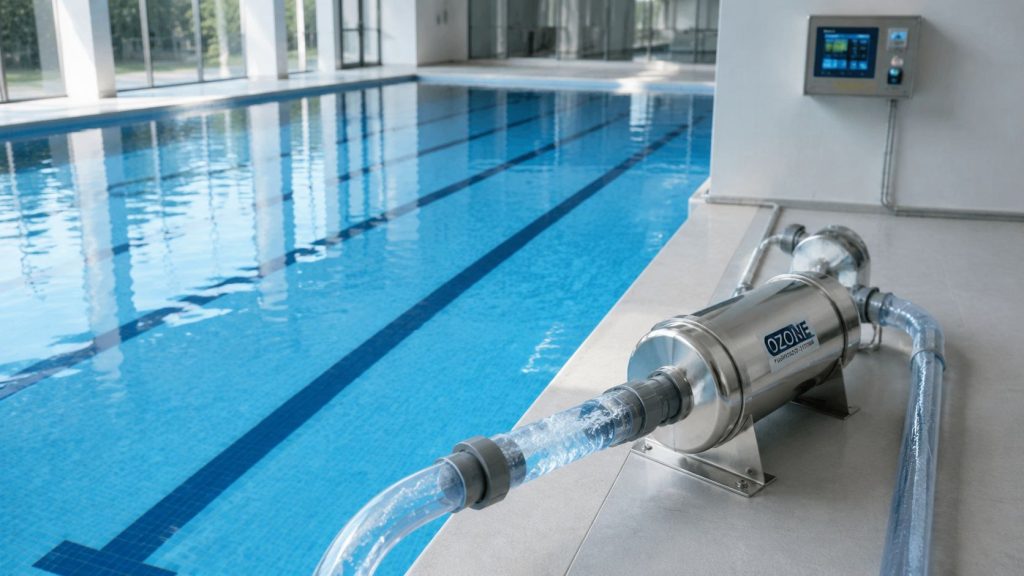
You're probably here because a commercial pool already has the usual symptoms. Chlorine demand keeps climbing. Staff complain about odor in the natatorium. Swimmers notice eye irritation. The mechanical room has piecemeal upgrades, but water quality still feels harder to control than it should.
That's usually the point where an industrial ozone system pool project moves from “interesting option” to procurement reality. The question isn't whether ozone is powerful. It is. The main question is whether the system is engineered correctly, integrated into the hydraulic loop correctly, and controlled in a way that helps chlorine instead of fighting it.
Table of Contents
- Why Industrial Pools Need Advanced Sanitation
- How Industrial Ozone Pool Systems Operate
- Ozone vs Chlorine and UV A Technical Comparison
- Sizing and Selecting Commercial Ozone Systems
- Integration and Operational Best Practices
- Cost Analysis and Procurement Checklist
Why Industrial Pools Need Advanced Sanitation
A high-use aquatic facility rarely struggles because it lacks chlorine feed. It struggles because chlorine alone gets forced to do jobs it doesn't do efficiently. In a school natatorium, therapy pool, hotel competition pool, or municipal indoor basin, the burden includes oxidation of organics, suppression of combined chlorine, water clarity, and air quality around the pool deck.
That's where operators start looking at an ozone system pool design as a process upgrade, not a gadget. The improvement isn't just in disinfection strength inside the treatment loop. It's in how the whole plant behaves when organics are attacked earlier and more aggressively.
What operators usually see first
Procurement teams often get pulled in after operations has already spent months chasing symptoms:
- Rising chemical use: The facility keeps feeding sanitizer, yet water quality still feels unstable.
- Poor indoor air quality: Chloramine-related odor becomes a building complaint, not just a pool complaint.
- Inconsistent swimmer experience: Water may test acceptable at one moment and still feel harsh or dull in practice.
- Maintenance friction: Existing filtration and feed systems work, but they're carrying too much oxidation load.
In industrial water treatment, this pattern is familiar. A process loop underperforms when upstream treatment is weak. The same logic shows up in other recirculating water systems, including industrial cooling tower water treatment systems, where oxidation, solids control, and dosing strategy have to work together instead of independently.
Why ozone belongs in the specification
Ozone earns its place because it's extremely effective in direct contact. The CDC reference is still one of the clearest demonstrations. At 1 ppm, ozone achieved complete sterilization of pool water artificially contaminated with B. coli, and at 0.5 ppm it still produced a 99.8% bacterial reduction according to the CDC ozone treatment reference.
Practical rule: Buy ozone for oxidation strength inside the treatment loop, not because someone promised it would eliminate the need for residual sanitizer.
That distinction matters. Ozone is not a primary stand-alone sanitizer for the whole pool body. It doesn't leave a substantial residual in the water. The same CDC reference notes that industry and regulatory practice require a chlorine residual, typically 0.2 ppm to 1.0 ppm, because continuous protection in the vessel still depends on residual sanitizer.
What works and what doesn't
What works is using ozone to attack contaminants in circulation, reduce the oxidation burden on chlorine, and support cleaner water with fewer byproducts. What doesn't work is treating ozone as a drop-in replacement for the rest of the treatment train.
For buyers, that changes the purchasing mindset. You're not buying a generator alone. You're buying a side-stream process with hydraulic, mass-transfer, control, and safety requirements that have to be specified from the start.
How Industrial Ozone Pool Systems Operate
A procurement review often breaks down at the same point. The vendor's brochure says the generator can produce enough ozone, but the submittal is thin on side-stream hydraulics, injector conditions, contact volume, and off-gas handling. In commercial pool work, those details determine whether the system oxidizes contaminants efficiently or just makes ozone and wastes it.
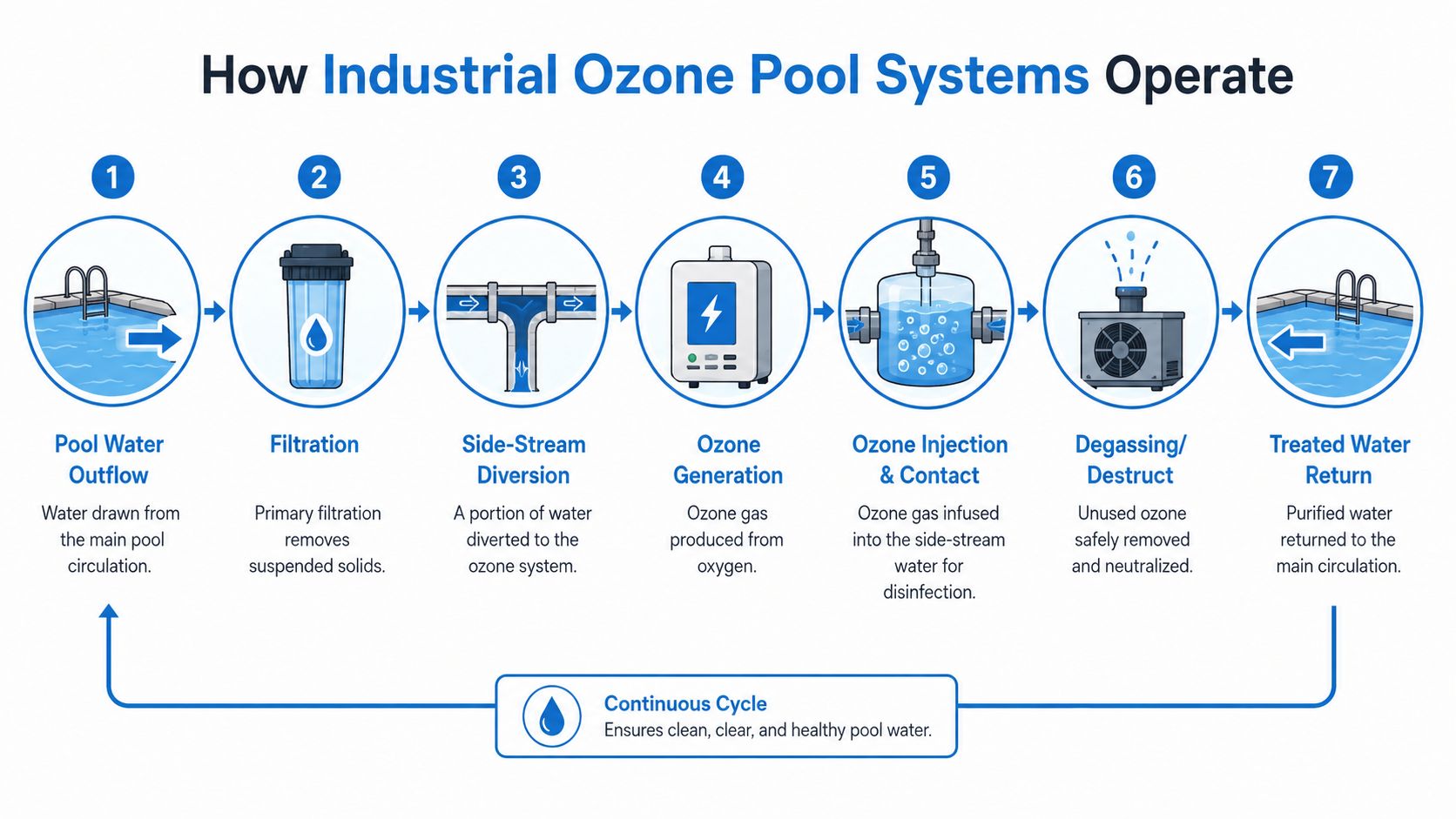
An industrial ozone pool system operates as a controlled side-stream treatment loop. A portion of filtered recirculation water is diverted from the main line, ozone is drawn into that stream through a venturi injector, the water is held in a contact vessel long enough for mass transfer and reaction, unused gas is separated and destroyed, and the treated water returns to the circulation system.
Any serious vendor should provide a process diagram like this:
The core process train
The equipment sequence usually includes these functional blocks:
Air preparation or oxygen feed
Ozone output starts with feed gas quality. Smaller packages may use dried air. Higher-capacity systems often use oxygen concentrators or liquid oxygen supply because they support higher generator efficiency and more stable production. The trade-off is straightforward. Oxygen-fed systems usually perform better, but they add equipment, controls, and maintenance points that need to be captured in the specification.Corona discharge ozone generator
The generator converts oxygen to ozone using high voltage across a dielectric cell. Rated grams per hour matter, but procurement teams should look deeper than nameplate capacity. Cooling method, turndown range, electrode service access, dielectric replacement procedure, and control integration with the building automation or plant PLC often determine lifecycle cost more than peak output does.Side-stream pump and venturi injector
This is one of the common failure points in weak designs. The venturi only works as intended when pressure differential, side-stream flow, and gas feed rate are matched. If suction is inadequate, ozone transfer falls off, gas carryover increases, and the contact tank ends up doing separation work it was not sized for. Ask for the injector performance data at the actual design flow and pressure, not a generic catalog curve.Static mixer or contact inlet arrangement
Some vendors gloss over the mixing step between injection and contact. They should not. Good initial dispersion improves mass transfer and reduces channeling in the contact vessel. On larger systems, I want to see how the vendor handles bubble size, mixing energy, and materials compatibility in this section of the train.Contact tank
The contact tank provides reaction time and gas-liquid separation space. For specification work, tank volume alone is not enough. Buyers should ask about baffling, hydraulic residence profile, pressure rating, inspection access, and where the gas disengagement zone sits relative to the water outlet. A poorly designed vessel can short-circuit even if the nominal retention time looks acceptable on paper.Degassing and ozone destruct
Not all injected ozone dissolves into water, and no commercial pool package should vent raw off-gas directly into the plant room. A proper system includes gas separation and a destruct unit, usually thermal or catalytic, with defined vent routing and fault indication. This is a safety item, not an accessory.Instrumentation and control loop
The package should include flow proving, pressure indication, ozone concentration or generator output feedback, and interlocks that shut the generator down on loss of water flow or abnormal gas conditions. Many commercial systems also use ORP as a supervisory signal within the broader treatment strategy. ORP should not be treated as a direct measure of dissolved ozone transfer efficiency. It is one input in the control architecture, and it needs careful setpoint logic to avoid chasing noisy signals.
Strong ozone performance comes from matching hydraulics, gas transfer, contact time, and controls. Problems usually trace back to one of those four items.
What matters during integration
The side-stream takeoff point matters. In most commercial layouts, ozone treatment is placed after filtration so suspended solids do not consume oxidant or interfere with mass transfer. The return point matters too. The treated stream needs to re-enter the circulation loop where mixing is predictable and where any downstream residual sanitizer feed sequence has been intentionally designed.
Control philosophy also deserves more attention than it usually gets in sales proposals. A generator can run at fixed output, step control, or proportional control. The right choice depends on bather load variability, pool volume, recirculation rate, and how the chlorine system is controlled. If the ozone skid and sanitizer controls are specified independently, the facility often ends up with two loops reacting to the same water quality shift and fighting each other.
For that reason, ask vendors for a simple cause-and-effect table. It should show what happens on low side-stream flow, low gas pressure, destruct unit fault, high ozone cabinet alarm, and abnormal ORP trend. If they only provide a product cut sheet, the package is not ready for an industrial procurement process.
The limitation buyers must understand
Ozone is highly effective inside the treatment loop because the system creates the concentration, mixing, and contact conditions needed for oxidation. That advantage does not extend to a lasting residual in the full pool body. Commercial designs still need a residual sanitizer program, and the ozone package should be specified as part of that architecture, not as a standalone answer.
A practical review point is the P&ID. It should clearly show side-stream source, injector location, contact vessel, off-gas destruct, analyzer locations, interlocks, and where chlorine feed sits relative to the ozone return. Sequence affects both performance and operations.
Red flags during vendor review
Use these questions during technical review:
- Where is the side-stream taken from, and what is the design flow? The answer should tie back to the filtration train and the recirculation rate.
- What are the venturi operating conditions at design point? Request suction pressure, motive flow, pressure drop, and expected gas transfer assumptions.
- How is the contact tank designed internally? Look for baffling details, access provisions, and a clear separation path for undissolved gas.
- How is off-gas handled and monitored? Destruct method, vent routing, and alarm logic should be explicit.
- How is ORP used in the control strategy? Ask whether it is supervisory only or directly tied to generator modulation.
- What are the shutdown interlocks? Loss of flow, generator overtemperature, cooling fault, cabinet ozone alarm, and gas supply abnormality should all trigger defined responses.
A good commercial ozone system behaves like an engineered process package with documented hydraulic, electrical, and controls assumptions. A weak one is just a generator skid attached to a venturi.
Ozone vs Chlorine and UV A Technical Comparison
A procurement team reviewing bids for an indoor aquatic center usually sees three options on paper: increase chlorine feed, add UV, or install ozone. The decision is not about picking a winner in the abstract. It is about assigning the right job to the right process, then making sure that process fits the hydraulic layout, controls philosophy, and maintenance capacity of the plant.
For commercial pools, chlorine remains the primary sanitizer because it maintains a residual in the vessel. Ozone and UV are secondary processes. They reduce oxidation load, improve water quality, and help control byproducts, but they do that in very different ways.
Commercial Sanitizer Technology Comparison
| Metric | Ozone (as Secondary Oxidizer) | Chlorine (as Primary Sanitizer) | Medium-Pressure UV (as Secondary Sanitizer) |
|---|---|---|---|
| Primary role | Strong oxidation in side-stream contact loop | Maintains residual in pool body | Supplemental disinfection in reactor |
| Residual in pool water | No substantial residual | Yes, this is the main reason it remains required | No practical residual |
| Chloramine control | Reduces formation and oxidizes organics effectively | Can contribute to chloramine issues when carrying full oxidation burden | Commonly selected to address chloramines in reactor treatment |
| Reaction profile | Rapid oxidation at effective concentration in the contact loop | Continuous residual action in bulk water | Treatment only while water is inside the reactor |
| Hydraulic dependency | Performance depends on venturi draw, gas transfer, contact time, and degassing | Performance depends on feed control, circulation, and water chemistry | Performance depends on reactor sizing, UV dose, fouling control, and sleeve condition |
| Mechanical complexity | Higher. Generator, gas feed, venturi, contact tank, off-gas destruct | Lower process complexity, though feed control and chemical handling still need discipline | Moderate. Reactor, lamps, sleeves, ballast, sensors, controls |
| Procurement focus | Side-stream engineering, contactor design, off-gas safety, ORP integration | Chemical storage, dosing equipment, control logic, compliance | Reactor sizing, lamp replacement, sensor calibration, ballast reliability |
Where ozone changes system performance
Ozone earns its place when oxidation is the limiting problem. That usually shows up as recurring combined chlorine, strong odor, high organic loading, or unstable water quality during peak occupancy.
The difference is process location. Ozone is generated on site, injected into a side stream, mixed through a venturi or similar gas transfer device, then held in a contact vessel long enough to react before the water returns to the main loop. If that chain is weak at any point, the generator nameplate does not matter much.
This is why system integrators should compare ozone packages by transfer efficiency and contact design, not just by grams per hour. A well-specified side stream with a properly matched injector and contact tank can reduce chlorine demand and improve water clarity. A poorly integrated skid can consume power, add maintenance, and leave operators with little measurable benefit.
Facilities that are also upgrading solids removal often pair ozone with a dedicated pool water filtration machine review, because oxidation and filtration performance affect each other in daily operation.
Where chlorine still carries the public health duty
Chlorine remains the barrier that stays in the pool water after treatment equipment has done its work. That matters every minute the pool is occupied.
A side-stream ozone loop only treats the water that passes through it. UV only treats the water inside the reactor. Neither process leaves a practical residual in the basin, surge tank, or return piping. If contamination enters the vessel between circulation passes, chlorine is still the layer that responds in the bulk water.
From a specification standpoint, that means ozone does not replace chlorine in commercial pool design. It changes how hard chlorine has to work.
Where UV fits better than ozone
UV is often easier to retrofit where plant rooms are tight, off-gas handling is undesirable, or the owner wants supplemental treatment without oxygen feed systems, destruct units, and gas detection. It is a reactor technology. Water passes through the chamber, receives a defined dose if the unit is clean and flow stays within range, then moves on.
That makes UV simpler to insert into some existing recirculation loops. It also sets clear limits. UV does not provide residual, and it does not use a contact tank to continue oxidizing dissolved contaminants after injection the way ozone can.
The maintenance profile is different too. UV systems avoid gas handling but require disciplined lamp replacement, sleeve cleaning, sensor checks, and ballast support. Ozone shifts the burden toward injector performance, contactor hydraulics, off-gas management, dryer or oxygen system upkeep, and controls tuning.
What buyers should compare during technical review
The useful comparison is operational, not promotional.
- Choose chlorine for residual sanitation in the vessel and distribution loop.
- Choose ozone when the project can support a real side-stream process with a venturi injector, verified contact time, off-gas destruct, and controls that coordinate ozone output with flow and ORP response.
- Choose UV when reactor-based secondary treatment fits the space, maintenance model, and retrofit constraints better than a gas-contact system.
For procurement, the hard questions are specific. How will ozone transfer into water at the stated side-stream flow? What contact time is available at peak recirculation? Is ORP being used as a trim input, an alarm point, or a direct control signal? How will chlorine dosing behave after ozone-treated water returns to the loop?
Those details decide whether the technology works in service. The label on the bid does not.
Sizing and Selecting Commercial Ozone Systems
Most specification failures happen before equipment arrives. The generator gets sized loosely, the venturi is treated like a commodity fitting, the contact vessel gets squeezed into leftover floor space, and the package is expected to perform anyway.
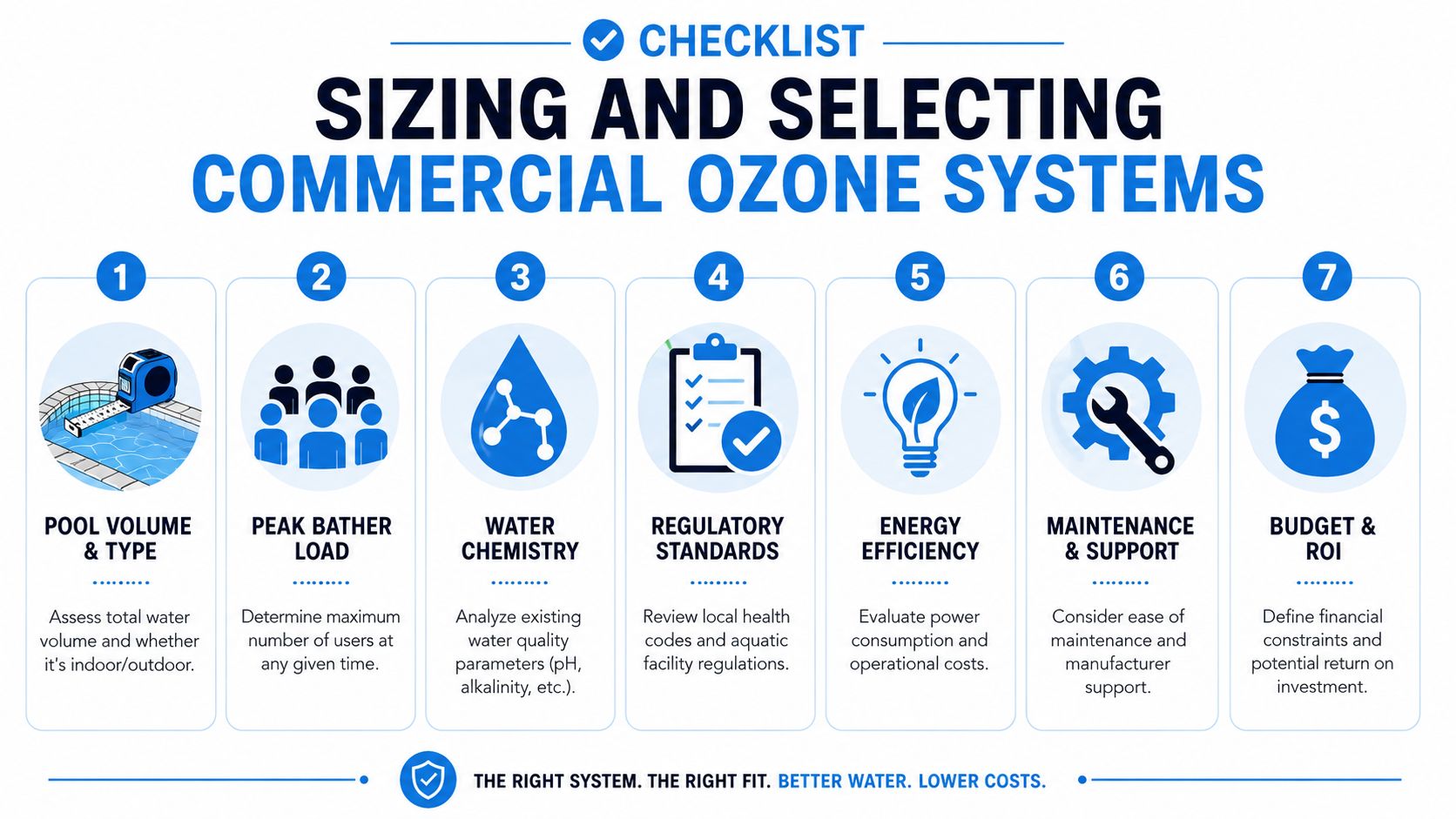
A commercial ozone system pool project needs to be specified as a process package with design conditions, not as a single machine purchase.
Start with the hydraulic basis
The most important design question is simple. How much water will pass through the ozone loop, and for how long will it remain in contact?
For industrial-grade systems, standard design practice diverts 15 to 25 percent of total water flow through a side stream, and ozone then needs a minimum contact time of 2 to 4 minutes at peak flow before treated water returns to the pool, according to commercial pool ozone system design guidance.
That single point drives multiple procurement decisions:
- side-stream pump sizing
- venturi selection
- contact tank volume
- degassing arrangement
- skid footprint in the plant room
If a vendor quotes a generator output but can't show side-stream flow and contact time at design conditions, the quote is incomplete.
What belongs in the RFQ
A useful RFQ for a commercial ozone package should require the vendor to state:
- Pool operating profile: Type of facility, indoor or outdoor status, expected peak use pattern, and recirculation philosophy.
- Hydraulic design point: Main circulation flow, proposed side-stream flow, and design assumptions for peak conditions.
- Generator basis: Rated ozone production, feed gas basis, cooling requirements, and turndown or control method.
- Mass transfer hardware: Venturi model or equivalent injector detail, expected suction conditions, and materials of construction.
- Contact vessel details: Effective contact volume, retention time at peak side-stream flow, and internal configuration if applicable.
- Off-gas handling: Degas vessel, destruct unit, vent routing, and interlock strategy.
- Instrumentation: Flow confirmation, gas pressure or vacuum monitoring, ozone-related safety devices, and communications with building or pool controls.
For buyers already familiar with industrial pretreatment skids, this should sound normal. It's the same discipline used when specifying industrial filtration machines or other process equipment that only works when hydraulics and controls are defined upfront.
Selecting the right supporting equipment
The generator gets most of the attention, but support components decide whether the project succeeds.
Venturi injector selection
The venturi has to match the side-stream pump curve. Too little differential pressure and gas draw collapses. Too much mismatch and the loop becomes unstable or inefficient. Ask vendors for operating conditions, not just injector model numbers.
Contact tank design
Contact time is not a brochure line. It's a sizing requirement. Buyers should confirm effective volume at peak side-stream flow and verify where gas separation occurs. A compact tank that looks clean in a rendering may not provide enough reaction time in service.
Air preparation and gas feed
Dry, stable feed gas helps corona discharge systems perform consistently. Procurement should ask how the package handles feed gas quality, what maintenance it requires, and which alarms indicate declining generator efficiency.
A generator can be technically oversized and still underperform if the injector is wrong or the contact tank is undersized.
Material and integration checks
Commercial ozone systems place unusual demands on materials and seals. Even when the vendor supplies a packaged skid, the connecting spool pieces, valves, and downstream tie-ins need a material review. Don't let a good skid get paired with unsuitable field components.
A practical bid review checklist should also ask:
- What components arrive factory-mounted?
- What site utilities are required?
- What alarms are hardwired versus networked?
- What startup support is included?
- What operating documents will the vendor provide for maintenance staff?
The best procurement outcome comes from forcing each bidder to answer the same engineering questions in the same format. That's how you separate a true process supplier from a reseller with a generator catalog.
Integration and Operational Best Practices
An ozone skid doesn't fix a poorly managed pool on its own. It has to sit in the right place in the treatment train and work in step with filtration, chemical dosing, and control logic. Most operating failures come from integration mistakes, not from ozone chemistry itself.
The biggest operating mistake is easy to describe. Staff install ozone to reduce chlorine demand, then keep running chlorine as if ozone wasn't there.
Control the system as one process
The right operating mindset is to treat the pool as a coordinated loop:
- primary filtration removes solids
- ozone side-stream handles high-strength oxidation
- residual sanitizer protects the pool body
- pH and ORP controls stabilize performance
That means your controls strategy has to reflect cause and effect. If ozone is carrying more oxidation load, chlorine feed should be tuned to maintain a stable residual instead of brute-force overfeeding.
This is why integration with commercial chemical dosing systems matters. The controller architecture should let operators manage residual sanitizer and pH with awareness of how the ozone side-stream is performing, rather than treating every upset as a chlorine-only problem.
The chlorine breakage problem
One of the costliest operating errors is over-chlorinating an ozone-treated system. The practical threshold matters here. Maintaining chlorine above 2 to 3 ppm with an ozone system is wasteful because ozone oxidizes the chlorine into ineffective chloride ions, while the recommended operating strategy is to keep chlorine at 0.5 to 1.0 ppm according to the ozone pool system guide discussing chlorine breakage.
This point gets missed in many installations. Operators see ozone as a supplement, then maintain high chlorine “for safety.” In practice, that can work against the ozone system and erase the expected chemical efficiency.
If an ozone system is installed and chlorine setpoints stay unnecessarily high, the plant can spend more while gaining less.
Where to place sensors and feed points
Good automation starts with sensor placement. ORP and pH readings need to represent the water condition you want to control. If probes are placed where local chemistry is distorted by immediate feed points or turbulent mixing, the control loop will chase noise.
Use these principles during review:
- Separate measurement from injection turbulence: Don't place sensors where chemical feed causes local spikes.
- Verify flow across probes: Poor sample flow produces misleading readings and unstable control.
- Define interlocks clearly: Loss of circulation, no-flow conditions, or ozone system alarms should force safe states.
- Trend operations data: Operators should be able to compare sanitizer behavior, pH control, and ozone runtime over time.
Maintenance discipline that keeps performance stable
Commercial ozone systems don't need constant intervention, but they do need routine discipline. Maintenance planning should include the generator, feed gas preparation equipment, injector, contact loop accessories, and destruct assembly.
A practical operating routine should include:
- Generator inspection: Look for output drift, cooling issues, and alarm history.
- Air or oxygen feed maintenance: Keep dryers, filters, or concentrator-related components in service condition.
- Injector checks: Fouling, scaling, or pressure changes can reduce gas transfer.
- Sensor calibration: pH and ORP probes need scheduled verification if the control loop is going to remain trustworthy.
- Safety review: Ventilation, destruct operation, and ozone-related alarms should be tested, not assumed.
The best-run facilities make one more change after startup. They retrain operators to stop thinking in terms of “more chlorine solves everything.” In an ozone-assisted plant, control quality matters more than chemical aggression.
Cost Analysis and Procurement Checklist
Commercial ozone projects are rarely sold on disinfection theory alone. They get approved when the business case is clear, the mechanical scope is defined, and procurement can compare bids without guessing what each vendor left out.
That starts by separating capital scope from operating impact.

What belongs in capital scope
A serious project budget should include more than the ozone generator cabinet. Buyers should expect the full package to include the side-stream pump arrangement if required, injector assembly, contact tank, degassing and destruct equipment, controls integration, safety devices, startup support, and field installation scope.
Too many quotes look inexpensive because they exclude the expensive parts that make the system function in a commercial plant room.
Capital items to verify in every bid
- Packaged equipment scope: Generator, feed gas prep, injector, contact vessel, off-gas destruct, and controls.
- Mechanical tie-ins: Piping, valves, drains, vents, and access provisions.
- Electrical scope: Power requirements, local disconnects, and integration with facility controls.
- Safety scope: Ventilation interfaces, leak detection if applicable, and alarm outputs.
- Commissioning scope: Startup, operator training, and documentation.
What shows up in operating cost
The operating side of the business case is usually where ozone earns attention. In a well-integrated system, teams often see better oxidation performance, lower burden on chlorine, improved water appearance, and fewer chronic complaints tied to combined chlorine and indoor air quality.
Those outcomes are real, but procurement should resist any proposal that turns them into invented payback numbers. The right way to evaluate savings is to compare your current chemical consumption, your current shock-treatment pattern, your air handling complaints, and your maintenance burden against a realistic future operating model from the proposed design.
The most trustworthy ozone vendor is usually the one who gives you a tighter scope and fewer heroic savings claims.
A procurement checklist that prevents weak bids
Use a bid matrix and require every vendor to answer the same questions.
| Procurement item | What to require from the vendor |
|---|---|
| Design basis | Pool type, operating conditions, and hydraulic assumptions |
| Side-stream performance | Flow rate through ozone loop and how it is maintained |
| Contact performance | Contact vessel sizing and retention basis |
| Injection method | Venturi or equivalent gas transfer details |
| Off-gas handling | Degassing and destruct method |
| Controls | Interlocks, alarms, probe interfaces, and communications |
| Materials | Wetted materials and field connection requirements |
| Service support | Startup, training, maintenance support, and spare parts availability |
The final buying test
Before awarding the job, ask each vendor to walk your team through one operating upset. For example, what happens if side-stream flow drops, if pH drifts, or if chlorine residual rises unnecessarily after startup? The quality of that answer tells you more than a polished submittal package.
A good supplier explains operating logic clearly. A weak supplier falls back on generic claims about “advanced sanitation.”
If you're buying an industrial ozone system pool package, the winning proposal should do three things well. It should show the hydraulic design. It should show the control philosophy. It should show the safety and maintenance plan in enough detail that operations can run it.
If you're specifying industrial-grade water treatment equipment and want support that matches engineering and procurement realities, Purecowater can help you source and configure filtration, RO, EDI, pretreatment, and dosing packages with faster quoting and practical application guidance.