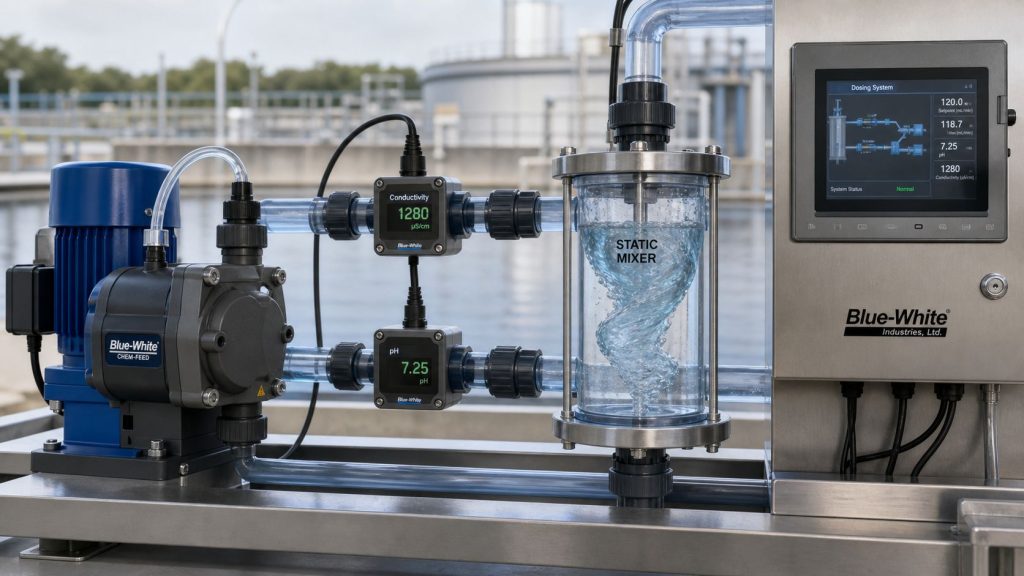
You usually know something is wrong with chemical dosing long before anyone opens the skid door. RO differential pressure starts creeping up. CIP frequency gets harder to explain. Product water quality drifts just enough to trigger operator workarounds. Procurement gets asked for replacement membranes, new cartridge filters, and spare pump heads, even though the original issue started upstream.
That's why buyers who spec industrial water equipment can't treat chemical dosing as a low-priority accessory. In an RO or EDI train, the dosing skid is part of asset protection. If it's undersized, poorly controlled, or built with the wrong materials, it won't just waste chemical. It will shorten membrane life, destabilize pretreatment, and create a maintenance problem that shows up everywhere else in the plant.
Table of Contents
- Why Precise Chemical Dosing is Non-Negotiable
- Anatomy of an Industrial Chemical Dosing Skid
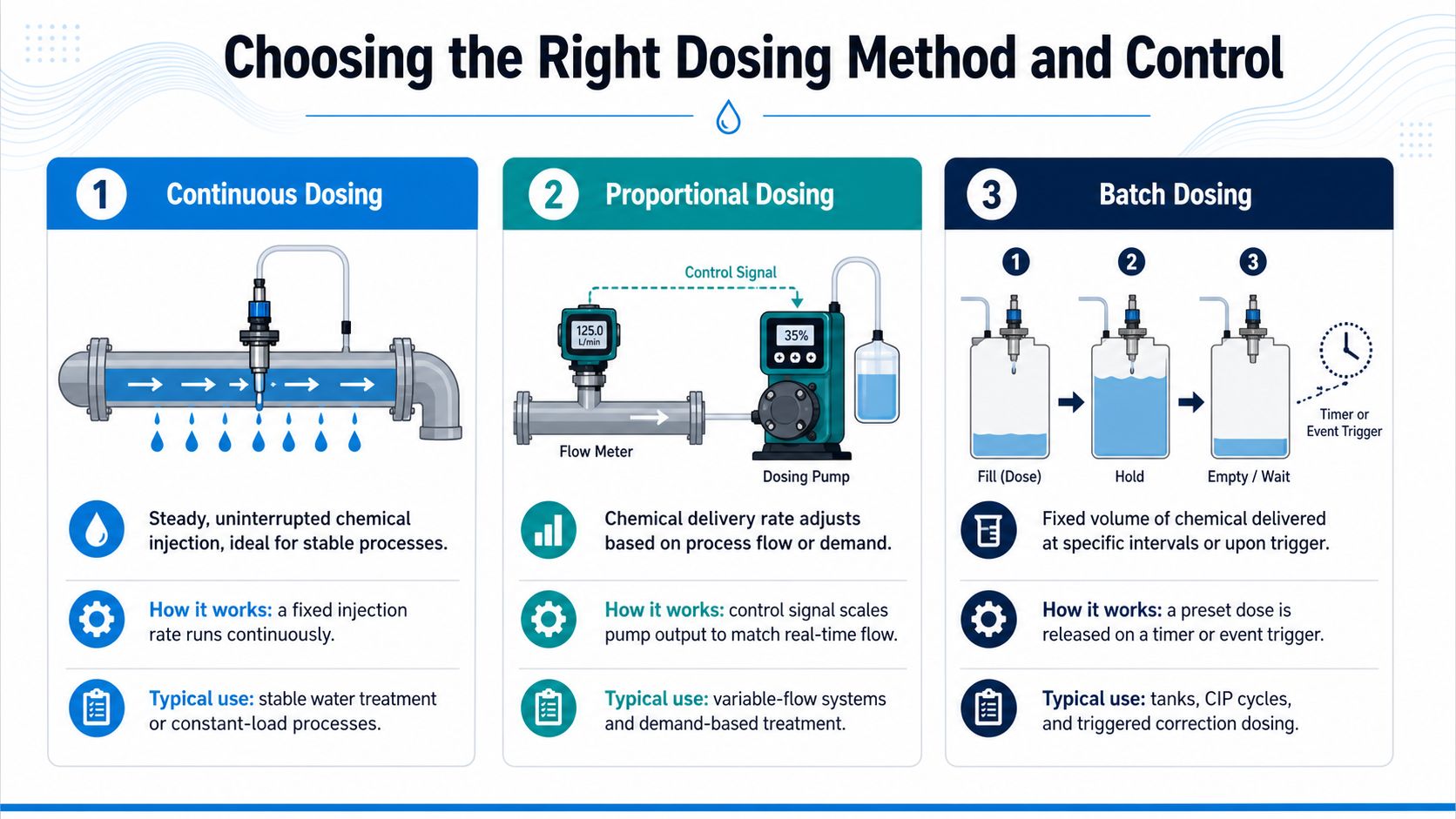
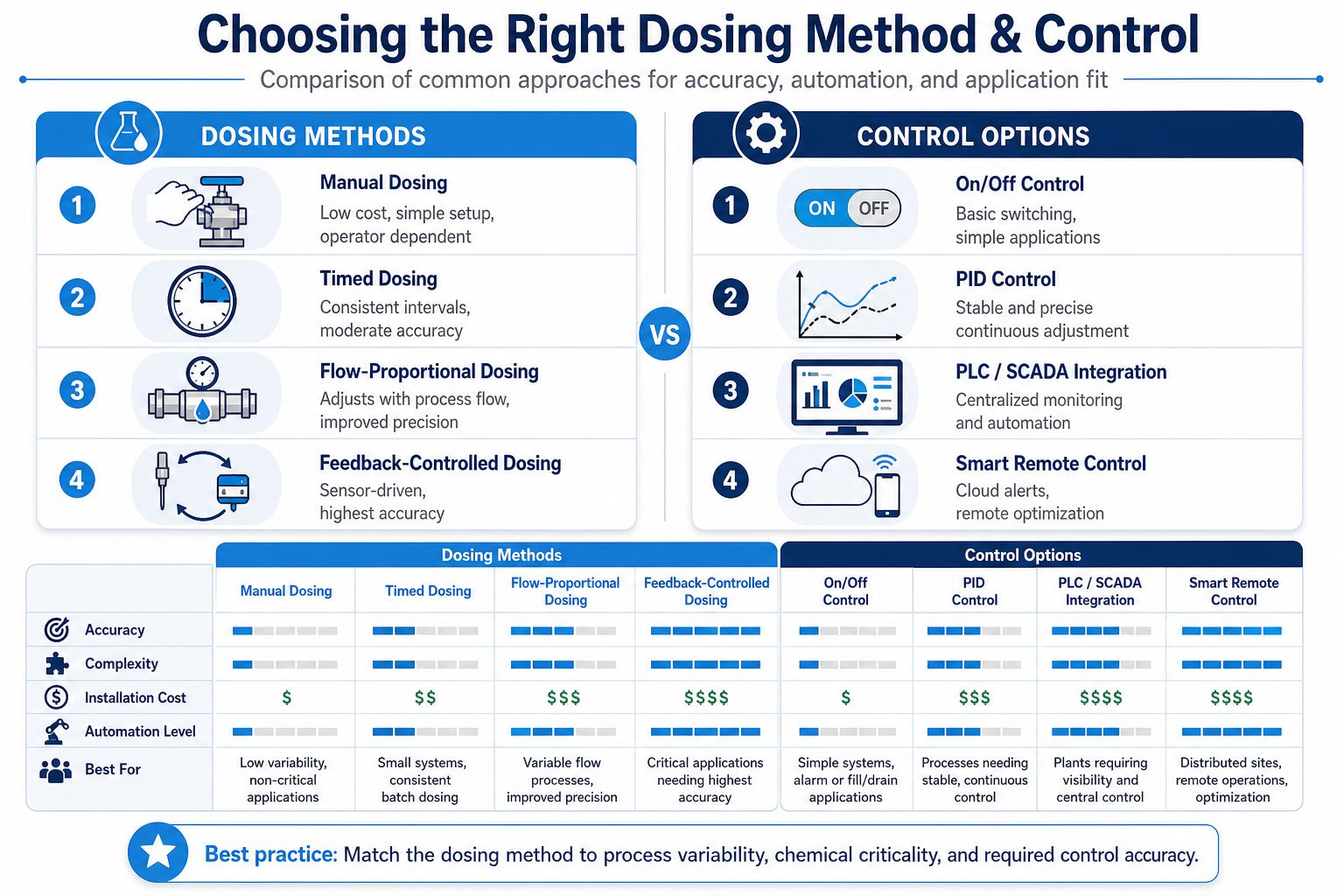
- Choosing the Right Dosing Method and Control
- Common Chemicals and Material Compatibility
- Sizing and Selection Guidelines for Procurement
- Integrating Dosing with RO and Pre-Treatment Systems
- Maintenance Safety and Procurement Checklists
Why Precise Chemical Dosing is Non-Negotiable
Most plants don't lose money because they forgot to buy a dosing pump. They lose money because the installed system can't hold a stable dose under real operating conditions. Flow changes, line pulsation, suction issues, poor injection, and weak controls all show up as membrane fouling, off-spec water, chemical overfeed, or compliance risk.
That's why chemical dosing systems deserve the same scrutiny as RO skids, cartridge filter housings, multimedia filters, and EDI modules. In industrial water treatment, they aren't peripheral equipment. They determine whether antiscalant reaches the membrane train correctly, whether pH stays in range for pretreatment, and whether oxidizing or non-oxidizing chemistry is delivered consistently enough to protect downstream assets.
The investment trend reflects that reality. The global chemical dosing systems market was valued at USD 7,800 million in 2025 and is projected to reach USD 12,300 million by 2034, with water and wastewater treatment accounting for 37.85% of the total market, according to chemical dosing systems market data.
Practical rule: If an RO or EDI system is expensive enough to justify careful membrane selection, it's expensive enough to justify a dosing skid that can actually protect it.
Plants often focus on visible capital items first. Membrane elements, pressure vessels, polishers, and instrumentation get attention. The dosing skid gets compressed into a generic line item. That decision usually comes back later as unstable pretreatment, excess operator intervention, and avoidable replacement spending.
For plant managers and procurement specialists, the business case is simple. Good dosing protects uptime, supports discharge and process targets, and lowers total cost of ownership. Bad dosing gradually turns every downstream asset into a consumable.
Anatomy of an Industrial Chemical Dosing Skid
An industrial dosing skid should be bought as a working system, not as a loose collection of parts. A pump, tank, and controller on the same frame don't automatically deliver reliable chemical feed. The skid has to maintain repeatable output, survive the chemistry, and fit the way the plant runs.
What sits on the skid
The metering pump is the workhorse. In industrial water service, buyers usually compare diaphragm and peristaltic designs based on chemical compatibility, required pressure, suction conditions, and how much maintenance access they want. For corrosive pretreatment chemicals, diaphragm pumps are common because they give controlled delivery and fit well with automated control loops.
The chemical tank does more than store product. It sets refill intervals, affects suction stability, and determines how easy it is to inspect, clean, and isolate the system. On some services, the tank also needs a mixer to keep the solution homogeneous before it reaches the pump suction.
A complete skid also needs the support hardware that keeps the pump honest:
- Calibration column: Lets operators verify actual delivered volume instead of trusting the dial setting.
- Pressure relief valve: Protects the pump and piping from dead-head conditions.
- Back-pressure valve: Improves metering stability where discharge conditions fluctuate.
- Pulsation control hardware: Reduces delivery shock that can affect instrumentation and line life.
- Level instrumentation: Prevents dry running and supports low-level alarms.
- Injection assembly: Determines whether chemical enters the main line cleanly or creates a localized concentration problem.
How the skid actually performs
The controller or PLC is the skid's decision layer. It decides whether dosing runs at a fixed output, tracks process flow, or responds to an instrument signal such as pH, ORP, or conductivity. The best-built skid still performs poorly if the control logic doesn't match the process.
Buyers should also look hard at tubing, valves, seals, drains, and maintenance access. Technicians need to prime the pump, inspect check valves, isolate the line, and verify calibration without fighting the skid layout.
A dosing skid is reliable when operators can verify it quickly, isolate it safely, and return it to service without improvising.
A practical handover standard is simple. The vendor should show where calibration happens, how the pump is vented, where pulsation is controlled, how the tank is isolated, and how the injection point is serviced. If those answers are vague during a quote review, they'll be worse after startup.
Choosing the Right Dosing Method and Control
Plants often choose the wrong dosing method because the discussion starts with pump capacity instead of process behavior. A more important question is how chemical demand changes during the day. If flow, quality, or load moves around, fixed output won't stay correct for long.
Continuous dosing
Continuous dosing is the simplest option. The pump runs at a constant rate, like a fixed drip into a process that rarely changes. It can work for stable utilities, fixed-volume make-up water, or chemical services where operators already know the feed stays consistent over time.
It doesn't work well when plant flow swings, feedwater quality shifts, or upstream filtration performance changes. In those cases, constant output turns into alternating underfeed and overfeed.
Proportional dosing
Proportional dosing is usually the right answer for industrial pretreatment trains. The controller adjusts chemical delivery based on a changing input such as line flow or process demand. For an RO system, that's often the difference between a skid that protects the membranes and one that only looks acceptable at one operating point.
This method is especially useful where multiple process conditions move together. If feed flow rises, the pump output should rise with it. If a control loop uses an analyzer signal, the controller can trim output rather than forcing operators to chase water quality manually.
A strong proportional setup depends on signal quality. A poor flow meter, unstable sensor, or weak control logic can make the skid hunt. When that happens, the issue gets blamed on the chemistry when the actual problem is control architecture.
Batch dosing
Batch dosing fits a different kind of operation. It delivers a fixed volume at a defined interval or in response to a trigger. Plants use it where they're treating tanks, preparing batches, or feeding a process that isn't continuous.
For fixed-volume treatment, batch control is practical and easy to validate. For live pretreatment ahead of RO or EDI, it's usually too blunt unless there's a holding or reaction stage downstream.
Here's the fastest way to think about selection:
| Method | Best fit | Main strength | Main limitation |
|---|---|---|---|
| Continuous | Stable process with little variation | Simple operation | Poor response to changing demand |
| Proportional | Variable flow or variable load | Tracks real process conditions | Needs good instrumentation and tuning |
| Batch | Tank treatment or triggered events | Easy to define each dose | Not ideal for continuous membrane protection |
Buyer advice: Ask vendors to describe the control philosophy in plant terms. If they can't explain when the skid increases feed, decreases feed, and alarms out, the proposal isn't ready for purchase.
Common Chemicals and Material Compatibility
The fastest way to turn a dosing system into a safety incident is to assume “chemical resistant” is a complete specification. It isn't. Industrial pretreatment uses chemicals with very different behavior in storage, suction piping, pump heads, seals, and injection assemblies. A material that survives one service can fail quickly in another.
What buyers usually dose in industrial pretreatment
For RO and EDI protection, plants typically buy chemical dosing systems for several jobs. Antiscalants are used to control scale-forming salts before the membrane array. pH adjusters help pretreatment reactions and membrane protection. Coagulants and flocculants support solids removal before cartridge filtration or multimedia filtration. Biocides may be used in some upstream water systems depending on the treatment strategy and membrane compatibility limits.
These chemicals don't create the same mechanical demands. Some are relatively manageable in standard thermoplastics. Others attack seals, harden tubing, or expose weak threaded joints. That's why compatibility review has to include the tank, piping, pump wetted parts, seal package, and injection assembly as a set.
For readers working across broader utility systems, this also overlaps with industrial cooling tower water treatment equipment, where chemical compatibility and feed stability affect scaling, corrosion, and biological control.
Compatibility mistakes that become leak and failure points
For Class 8 corrosive substances like hydrochloric acid, piping must be Schedule 80 uPVC, and the minimum pressure rating class for pipes and fittings is PN 18 in industrial dosing service, according to industrial dosing piping specifications. That's the kind of detail that belongs in procurement documents, not in a field correction after startup.
Just as important, piping selection has to account for pump discharge conditions. Metering pumps create pressure pulsation. If the piping class, fitting selection, or support arrangement is weak, the problem won't stay isolated to the skid. It will show up as fatigue, leaks, seal wear, and unstable flow.
A practical compatibility review should include the following table.
| Chemical Type | Common Examples | Recommended Tank/Piping Material | Recommended Seal/Gasket Material |
|---|---|---|---|
| Antiscalant | Proprietary RO antiscalant blends | Vendor-confirmed chemical-resistant thermoplastic materials | Vendor-confirmed compatible elastomer |
| pH adjuster acid | Hydrochloric acid | Schedule 80 uPVC piping, pressure class suited to dosing duty | Chemical-specific compatible seal material |
| pH adjuster base | Caustic solutions | Chemical-resistant thermoplastic materials selected for the service | Chemical-specific compatible seal material |
| Coagulant | Common metal salt coagulants | Corrosion-resistant tank and piping materials matched to concentration | Compatible elastomer based on supplier data |
| Flocculant | Polymer solutions | Materials that tolerate solution handling and minimize buildup | Seal materials selected for polymer service |
| Oxidizing chemistry | Hydrogen peroxide, oxidizing biocides | Materials verified for oxidizer duty | Seal package verified for oxidizer duty |
A few buying rules prevent most headaches:
- Specify the exact chemical: Generic tags like “acid” or “biocide” aren't enough.
- Review concentration and temperature: Compatibility can change sharply with strength and operating conditions.
- Check the whole wetted path: Tank material alone doesn't protect the pump head, valves, tubing, and seals.
- Require vendor confirmation in writing: Don't accept verbal assurance on corrosive service.
Most dosing failures blamed on “pump quality” are really material-selection failures that started in the RFQ.
Sizing and Selection Guidelines for Procurement
Buying by nameplate capacity is how plants end up replacing equipment early. A dosing skid has to be sized for the chemical, the control method, the line pressure, the turndown requirement, and the consequence of getting the dose wrong. For RO and EDI service, the consequence is usually high enough that cheap simplifications don't stay cheap.
Accuracy belongs in the RFQ
In advanced water treatment, critical loops protecting RO or EDI membranes require dosing accuracy of ±1% to ±2%, according to guidance on dosing precision for membrane protection. That's not a luxury spec. It's a protection spec for expensive downstream equipment.
When buyers leave accuracy out of the RFQ, vendors respond with generic metering equipment and broad performance language. The quote may still include a pump, controller, tank, and skid frame, but it won't necessarily include the verification method, instrumentation, or operating discipline needed for tight control.
If you're sourcing the full pretreatment train, it helps to evaluate the dosing skid alongside the industrial filtration machine options used ahead of membrane systems. The skid has to match the hydraulic and operational behavior of the cartridge filtration, multimedia filtration, or softening package around it.
Questions that expose weak vendor proposals
A useful procurement review sounds less like “What pump do you offer?” and more like “How will this skid perform at my worst operating point?” Ask questions that force a specific answer.
- What is the verified dosing accuracy under my expected operating range? If the application protects RO or EDI, broad claims aren't enough.
- How is output verified in operation? Look for calibration provisions and a practical field method.
- What discharge pressure and pressure fluctuation has the skid been sized for? Metering pumps don't deliver stable results if the pressure basis is guessed.
- What turndown can the control system handle without instability? This matters on plants that cycle production.
- What materials are supplied for the full wetted path? Ask for pump head, tubing, valves, fittings, seals, and injection hardware.
- How does the skid behave on low level, no flow, or analyzer failure? Alarm and interlock philosophy should be clear before purchase.
The right procurement question isn't “What is the lowest skid price?” It's “What skid still performs when the plant is off design?”
For membrane protection duty, buyers should also request documentation on stroke control, line pressure effects, maintenance intervals, and commissioning support. If a vendor proposal treats all industrial dosing applications as interchangeable, it probably isn't built around the process risk you're trying to manage.
Integrating Dosing with RO and Pre-Treatment Systems
An RO train can look well specified on paper and still start damaging membranes in the first month. I see this most often when the dosing skid, pretreatment package, and membrane package are purchased as separate scopes. Each item may be acceptable by itself, but the injection location, mixing energy, dilution arrangement, and control logic do not line up with how the plant runs.
That gap shows up fast on high-value equipment. Antiscalant that is poorly dispersed can leave parts of the feed stream underprotected. Caustic or acid that is injected without enough mixing can create local pH shocks. Reductant added in the wrong location can be consumed before it reaches the RO, or carried too far downstream toward EDI where residual chemistry becomes a product quality risk.
RO feed quality leaves little room for sloppy integration. The maximum allowable turbidity of feed water is 1 NTU for industrial-grade RO service, according to industrial RO membrane technical guidance. That operating limit ties chemical dosing directly to pretreatment performance. Coagulant feed, dechlorination, pH correction, cartridge filtration, and membrane protection have to be reviewed as one hydraulic and chemical system.
Injection hardware deserves more attention than it usually gets. Guidance on injection point geometry and mixing notes that effective mixing depends on injection velocity and geometry, including the use of a properly designed lance where needed. In practice, that means the quill cannot just be installed at the nearest coupling. It has to be placed where the chemical will enter the bulk flow, disperse quickly, and stay in solution long enough to do its job before the next critical asset.
Dilution design matters for the same reason. Some chemicals are stable in the tote but problematic at the injection point if they hit the main line at too high a local concentration. Plants then see precipitation, tubing scaling, fouled cartridge filters, or erratic analyzer readings and blame the chemistry. The underlying cause is often poor dilution and poor contact conditions.
For membrane projects, I prefer to review the dosing skid together with the industrial reverse osmosis system membrane package. That is the only practical way to check residence time before the RO feed pump, available straight run, expected velocity range, cartridge filter placement, and whether the selected chemicals create any downstream risk for EDI or mixed-bed polishing.
A useful design reference is dilution water provision. Sydney Water's chemical dosing unit standard requires adequate carrier water and mixing arrangements for safe, effective chemical introduction. If site water pressure cannot support the required dilution arrangement, the skid should include its own booster duty or another defined means of maintaining stable carrier flow. Leaving that to site conditions is a common procurement mistake.
The integration review should answer a few plant-level questions before startup:
- Will the chemical be fully mixed before the next sensitive component? Check the distance and hydraulics between the injection point, static mixer if used, cartridge filters, RO feed pump, and membrane inlet.
- Can the dosing system hold control through plant turndown and restart? RO systems rarely run at one fixed point, and chemical feed that drifts during low-flow operation shortens membrane cleaning intervals.
- Does the injection arrangement protect EDI as well as RO? Excess reductant, pH overshoot, or carryover from CIP neutralization can create downstream conductivity and resin problems.
- Is dilution water treated as a design input, not an assumption? The skid should define required pressure, flow, and interlocks for carrier water.
- Are shutdown and no-flow conditions handled properly? A pump that can continue stroking into a stagnant line creates localized overdosing and deposits.
Membrane plants usually do not fail because the metering pump cannot turn. They fail because the chemical reaches the membrane at the wrong concentration, at the wrong time, or after reacting somewhere else in the pretreatment train. That is an integration problem, and it is far more expensive than buying the right skid the first time.
Maintenance Safety and Procurement Checklists
A dosing skid can look healthy while it is gradually shortening RO membrane life or creating unstable feed conditions for EDI. The pump is running, the tank still has chemical, and the PLC shows no alarm. Then differential pressure starts creeping up, cartridge filters load faster than expected, or product resistivity drifts. By the time operations sees the process impact, the maintenance problem is already costing money.
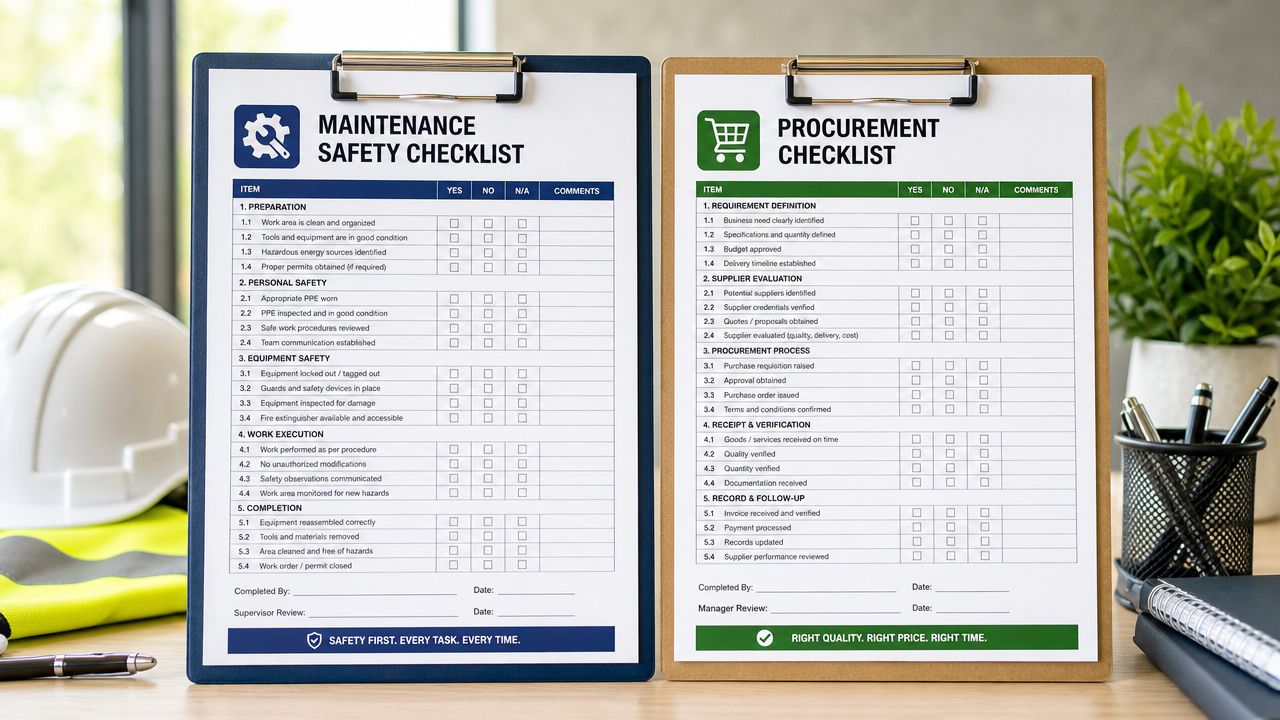
The plants that manage dosing well treat maintenance, safety, and procurement as one discipline. They verify actual chemical delivery, control contamination risk, and buy skids that can be serviced without improvisation.
Preventive maintenance checklist
A useful maintenance routine tracks the parts that drift first and the failures that hit water quality before they trigger a hard alarm.
- Daily visual check: Confirm tank level, pump status, tubing condition, leak points, pulsation dampener condition if fitted, and discharge pressure behavior.
- Dose verification: Check actual output with the calibration setup under real operating backpressure, not only at bench conditions.
- Injection point inspection: Look for scale, polymer buildup, plugging, quill damage, backflow signs, or poor mixing at the injection location.
- Valve and seal review: Inspect suction and discharge check valves for sticking, crystallization, wear, or debris that changes pump repeatability.
- Controller review: Confirm alarms, flow permissives, tank level inputs, and analyzer signals are plausible and not drifting.
- Chemical housekeeping: Keep labels legible, transfer hoses identified, and secondary containment clean enough to spot a small leak early.
Some tasks belong on a longer interval, but they should still be tied to operating risk. Diaphragm replacement, tube replacement, analyzer calibration, tank cleaning, and spare-parts review should be scheduled around chemical service, run hours, and the cost of failure. For an RO antiscalant or dechlorination loop, late maintenance usually shows up as higher cleaning frequency, lower normalized flow, or membrane warranty disputes. For EDI-related pH correction or neutralization duty, poor maintenance can create conductivity instability that is harder to diagnose than a simple pump fault.
Chemical safety checklist
Chemical handling errors damage equipment fast. They also create the kind of incident that stops production and puts procurement under pressure to buy replacements in a hurry.
- Verify chemical identity before refill: Cross-check the delivery, tank label, transfer connection, and SDS before any transfer starts.
- Match PPE to the service: Acid, caustic, oxidizer, and reducing agent duties do not all require the same glove and face protection.
- Check venting and containment: Tanks, day tanks, and transfer points need proper venting, overflow control, and secondary containment sized for a credible spill.
- Protect the area from overflow or flooding: High-level switches, leak detection, and local shutdown logic help keep a small release from reaching electrical equipment or adjacent skids.
- Avoid makeshift substitutions: Temporary tubing, borrowed gaskets, and unmatched fittings often fail first at the injection point or pump head, where consequences are highest.
- Confirm dilution and flush arrangements: Carrier water quality, pressure, and flow must be defined during design so the chemical stays in solution and the line can be flushed safely.
Dilution water is a common blind spot. If the skid depends on site water pressure that is not stable, operators end up compensating in the field, and that usually leads to scaling in the injection line, poor dispersion, or concentrated chemical reaching a sensitive pretreatment step. As noted earlier, carrier water and booster duty should be specified as a design requirement, not left to assumption.
Procurement checklist for RFQs
A better RFQ reduces commissioning changes, spare-parts surprises, and early membrane problems. It should tell the vendor what the skid must protect, not just what chemical it will pump.
- Chemical and duty description: State the chemical, concentration, storage conditions, temperature range, and the process objective.
- Protected equipment: Identify whether the loop protects RO membranes, cartridge filters, UF, EDI, mixed-bed polishers, or a neutralization system.
- Required dosing method: Define whether feed is continuous, flow-paced, analyzer-trimmed, batch, or tied to a permissive from another package.
- Operating envelope: Specify normal flow, turndown, line pressure, startup conditions, shutdown behavior, and any intermittent operation.
- Material requirements: Call out tank, pump head, tubing, valves, fittings, seal materials, and vent components based on actual chemical compatibility.
- Accuracy and verification needs: Define acceptable turndown, repeatability, calibration method, and how output will be proven in service.
- Integration details: Include interlocks with RO feed pumps, analyzer signals, low-flow shutdown, no-flow protection, and any flush or quill requirements.
- Maintainability: Require access for tube change, diaphragm replacement, valve cleaning, calibration, and safe chemical transfer without dismantling the skid.
- Safety expectations: Specify containment, leak detection, overpressure protection, level alarms, eyewash access requirements, and shutdown logic.
- Documentation: Request GA drawings, P&IDs, wiring details, I/O list, O&M manuals, recommended spares, FAT details, and a commissioning procedure.
The procurement mistake I see most often is buying a generic dosing package for a membrane plant. RO and EDI systems are less forgiving than many open-loop chemical applications. Small dosing errors, poor material choices, or weak interlocks can turn a low-cost skid into a high-cost operating problem.
If you're sourcing industrial chemical dosing systems to protect RO, EDI, filtration, or other high-value water assets, Purecowater can help you evaluate equipment fit, compatibility, and procurement requirements across the full treatment train. That's useful when you need more than a standalone pump quote and want a practical path to a system that supports uptime, membrane protection, and lower total ownership cost.