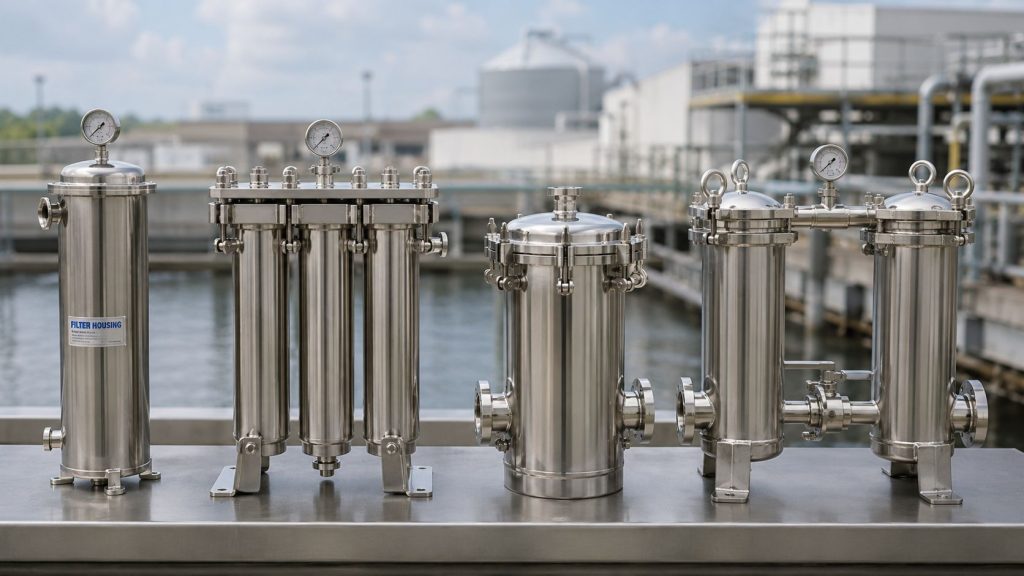
If you're replacing RO cartridges too often, chasing unstable differential pressure, or explaining an off-spec batch to operations, the cartridge filter housing deserves a harder look than it usually gets. In industrial water systems, the housing isn't just a vessel that holds cartridges. It sets the conditions for seal integrity, cartridge loading, service access, and how well upstream solids stay out of the equipment you want to protect.
That matters because most housing problems don't announce themselves as housing problems. They show up as membrane fouling, repeated cartridge changes, unexplained particle carryover, or maintenance teams swapping consumables without fixing the root cause. Procurement usually sees a vessel quote. Plant engineering sees pressure, flow, metallurgy, and connections. Reliability sees downtime. Total cost of ownership sits in the overlap.
Table of Contents
- The Critical Role of Cartridge Filter Housings in Industrial Processes
- Decoding Cartridge Filter Housing Types for Your Application
- Key Construction Materials and Wetted Components
- Sizing Calculations and Performance Optimization
- Installation and Maintenance Best Practices
- Navigating Compliance and High-Purity Requirements
- Your Industrial Cartridge Filter Housing Specification Checklist
The Critical Role of Cartridge Filter Housings in Industrial Processes
A common failure pattern in industrial water treatment starts with a system that looks properly designed on paper. The RO skid is sized correctly. The cartridge micron rating is reasonable. Instruments are in place. Then pressure drop becomes erratic, cartridge life shortens, and membrane cleaning frequency creeps up. The root cause often sits in the prefiltration vessel selection, not the membrane train.
An undersized or poorly sealed cartridge filter housing can force higher face velocity through the cartridges, shorten dirt-holding life, and allow bypass if the cartridge seating arrangement isn't secure. In a utility water system, that might mean frequent maintenance and unstable filtrate quality. In food, pharma, or electronics service, it can mean product risk.
The market size alone tells you this isn't a niche component. The global cartridge filter housing market is valued at approximately USD 3.8 billion in 2024 and is projected to reach USD 6.5 billion by 2033, with water treatment accounting for an estimated 35% of global revenue, according to DataHorizzon Research on the cartridge filter housing market. Buyers keep investing in these housings because they sit at a critical control point between dirty process reality and sensitive downstream equipment.
Where the real cost shows up
The purchase price of a housing is visible. The downstream cost of getting it wrong usually isn't.
- Membrane protection: In RO pre-treatment, poor solids control raises fouling risk and destabilizes feed conditions.
- Labor exposure: Frequent cartridge change-outs pull operators into repetitive maintenance that should've been designed down.
- Batch risk: In high-purity production, contaminant breakthrough doesn't stay local. It affects the full downstream process.
- Shutdown complexity: A vessel with poor access, poor venting, or awkward cartridge alignment slows every maintenance event.
Practical rule: If the housing choice changes cartridge life, seal integrity, or shutdown duration, it's a TCO decision, not a commodity purchase.
Why experienced buyers scrutinize the housing
A cartridge filter housing is an asset protection device. It protects RO membranes, pumps, valves, spray nozzles, heat exchangers, polishing units, and in some plants, the production batch itself. That changes how it should be specified. Pressure rating, metallurgy, cartridge count, closure style, venting, drainability, and internal sealing details all matter because they shape service life and filtration integrity under real operating conditions.
Decoding Cartridge Filter Housing Types for Your Application
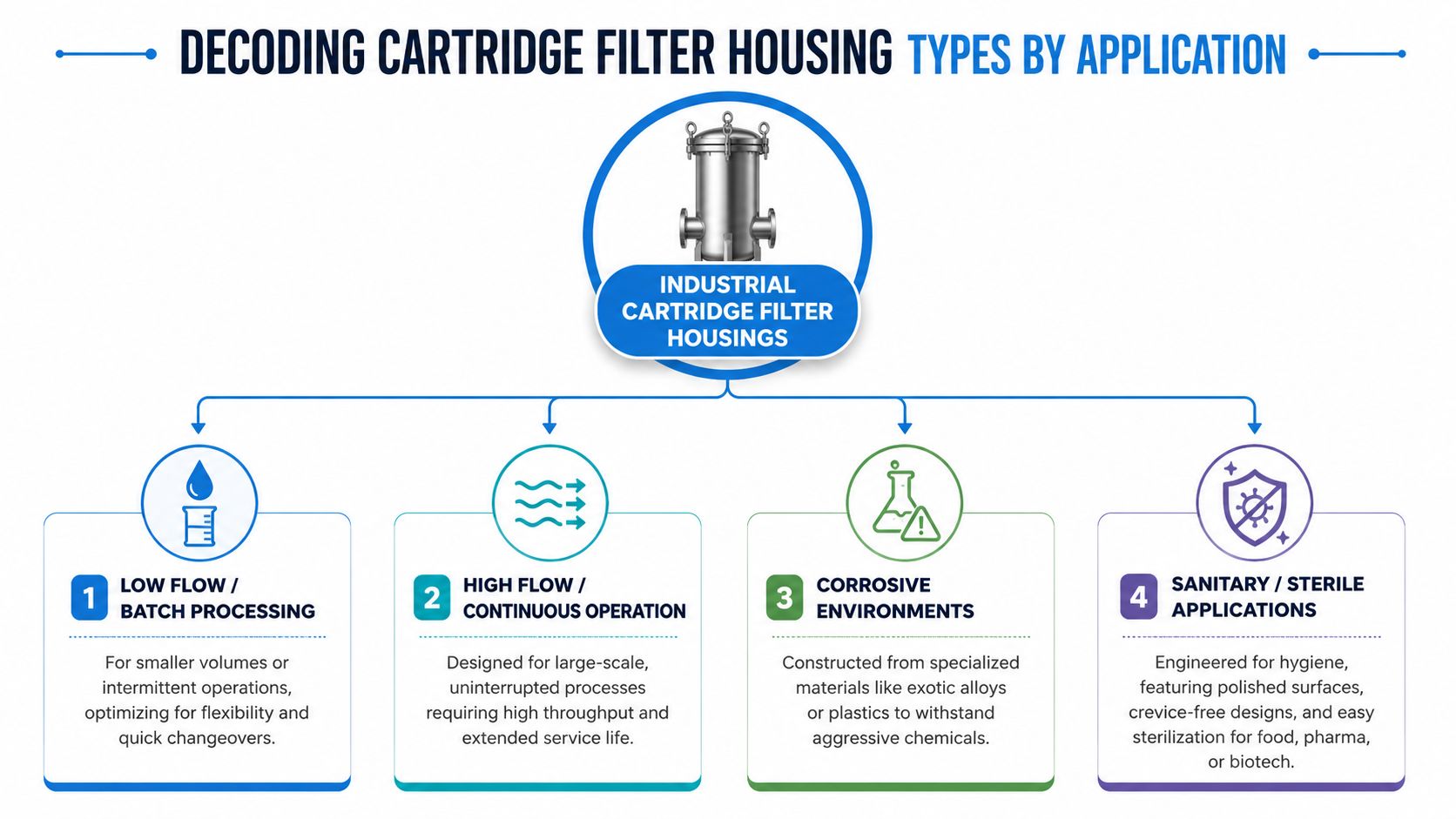
The fastest way to buy the wrong housing is to start with body size alone. Start with duty. The right cartridge filter housing depends on whether the plant runs batch or continuous service, whether shutdowns are acceptable, whether the fluid is corrosive, and whether hygiene standards define the design.
Single housings for low flow and utility duties
Single-cartridge housings fit low-flow loops, batch additions, sidestream polishing, chemical day tank recirculation, and small utility skids. They work when service interruptions are manageable and the contaminant load is modest. They also make sense where operators need quick cartridge access and low installed footprint.
This style isn't automatically cheap in the long run. If the process sees solids swings or demand spikes, a single housing can become a maintenance bottleneck fast. That's why single housings are best reserved for low-duty applications, not as a cost-saving substitute for a larger pre-treatment train.
Multi-cartridge housings for throughput and stability
In industrial RO pre-treatment and other continuous-duty systems, multi-cartridge housings are usually the practical standard. They spread flow across more media area, lower cartridge loading per element, and reduce shutdown frequency. That's where vessel design starts influencing cartridge economics directly.
For a buyer comparing options, real industrial capacity matters. AMI stainless steel multi-cartridge housings hold 5 to 22 cartridges in standard 30" and 40" lengths, support liquid filtration flow rates up to 616 gpm (140 m³/hr), and handle temperatures up to 200°F (93°C), as shown in AMI stainless steel housing specifications. That's the kind of operating range that makes multi-round housings suitable for RO feed protection and hot process streams.
A broader industrial selection often helps when matching vessel style to plant constraints. Buyers looking at basket, bag, and cartridge formats side by side can compare options in the Fil-Trek industrial housing guide.
Sanitary and duplex designs for specialized operation
Sanitary housings belong in food, beverage, pharma, biotech, and other high-purity service where finish, drainability, cleanability, and crevice control matter as much as filtration performance. These aren't standard industrial vessels with polished exteriors. They need hygienic internal geometry and compatibility with plant cleaning practice.
Duplex arrangements solve a different problem. They keep flow online during cartridge change-out by allowing one housing to operate while the other is serviced. If the process can't tolerate interruption, duplex isn't a luxury. It's operational insurance.
A practical selection framework looks like this:
- Choose single housings when flow is low, batch timing is flexible, and maintenance access is easy.
- Choose multi-cartridge housings when throughput, stable pressure drop, and fewer change-outs matter.
- Choose sanitary designs when product contact and hygiene compliance define the vessel.
- Choose duplex systems when the plant can't stop filtration to service a cartridge bank.
Buy for the operating constraint that hurts most. In many plants, that isn't the vessel cost. It's lost runtime.
Key Construction Materials and Wetted Components
Material selection decides whether the housing survives the service, cleans easily, and maintains seal integrity over time. The vessel body gets the attention, but wetted internals and elastomers usually determine whether the cartridge filter housing performs as specified.
Housing body material drives lifespan and service risk
In general industrial water service, stainless steel is often the default because it balances durability, cleanability, and broad chemical compatibility. Where corrosion risk is higher, buyers move toward more resistant alloys. Where budget dominates and fluid chemistry allows it, coated carbon steel can still be a defensible choice. Plastics also have a place in aggressive chemical service, but they need to be matched carefully to temperature, pressure, and mechanical loading.
The key mistake is treating metallurgy as an isolated line item. It has to match fluid chemistry, cleaning chemicals, expected temperature, pressure excursions, and the plant's maintenance culture. A vessel that is technically compatible but difficult to maintain often ends up costing more than the stronger option chosen upfront.
Here is a practical comparison for industrial RFQs.
| Material | Corrosion Resistance | Max Temp/Pressure | Relative Cost | Typical Applications |
|---|---|---|---|---|
| 304 Stainless Steel | Good for many general water services | Depends on vessel design and code rating | Moderate | General process water, utility filtration, non-aggressive fluids |
| 316/316L Stainless Steel | Better resistance for higher-purity and more corrosive duties | Depends on vessel design and code rating | Higher | RO pre-treatment, food and beverage, pharma, chemical service |
| Carbon Steel with coating | Depends heavily on coating quality and process chemistry | Depends on vessel design and coating limitations | Lower upfront | Non-corrosive industrial service where budget is tight |
| Polypropylene or PVC | Useful in selected chemical services | Limited by polymer design and operating conditions | Varies | Chemical dosing loops, selected corrosive applications |
| Hastelloy and other exotic alloys | Strong for aggressive chemical environments | Depends on vessel design and alloy selection | Highest | Severe corrosion service, demanding chemical processes |
Seals and internal wetted parts decide whether filtration is real
The housing can have the right body material and still fail its actual job if the cartridge doesn't seal correctly. Consequently, internal hardware, cartridge adaptors, springs, seats, and O-rings matter.
A positive sealing arrangement using double O-ring nozzle ends is critical for preventing particle and fiber migration into clean filtrate, even under high differential pressures, according to this cartridge filter housing design reference. In practical terms, that's the difference between true filtration and expensive bypass.
For high-purity systems, that sealing detail should never be treated as optional. If solids can migrate past the cartridge interface, then micron rating on the cartridge datasheet won't save the process.
Material questions buyers should settle before issuing an RFQ
- Fluid compatibility: What chemicals, oxidants, or cleaning agents will contact the wetted path?
- Temperature reality: What is the normal range, and what upset conditions can the housing see?
- Pressure margin: Are there pressure spikes, pump starts, or valve events the vessel must absorb?
- Elastomer choice: Will the gasket and O-ring material hold up, or will it swell, crack, or lose compression?
- Surface requirement: Does the service need sanitary finish, crevice control, or enhanced cleanability?
If you're paying for a fine cartridge and ignoring the seal design, you're only buying the appearance of filtration.
Sizing Calculations and Performance Optimization
Sizing is where most cartridge filter housing decisions drift off course. Buyers often start with line size or nominal flow and stop there. That usually leads to one of two outcomes. The housing is oversized without a clear operating benefit, or it's undersized and spends its life causing pressure drop, change-outs, and membrane stress.
Start with process reality, not only nameplate flow
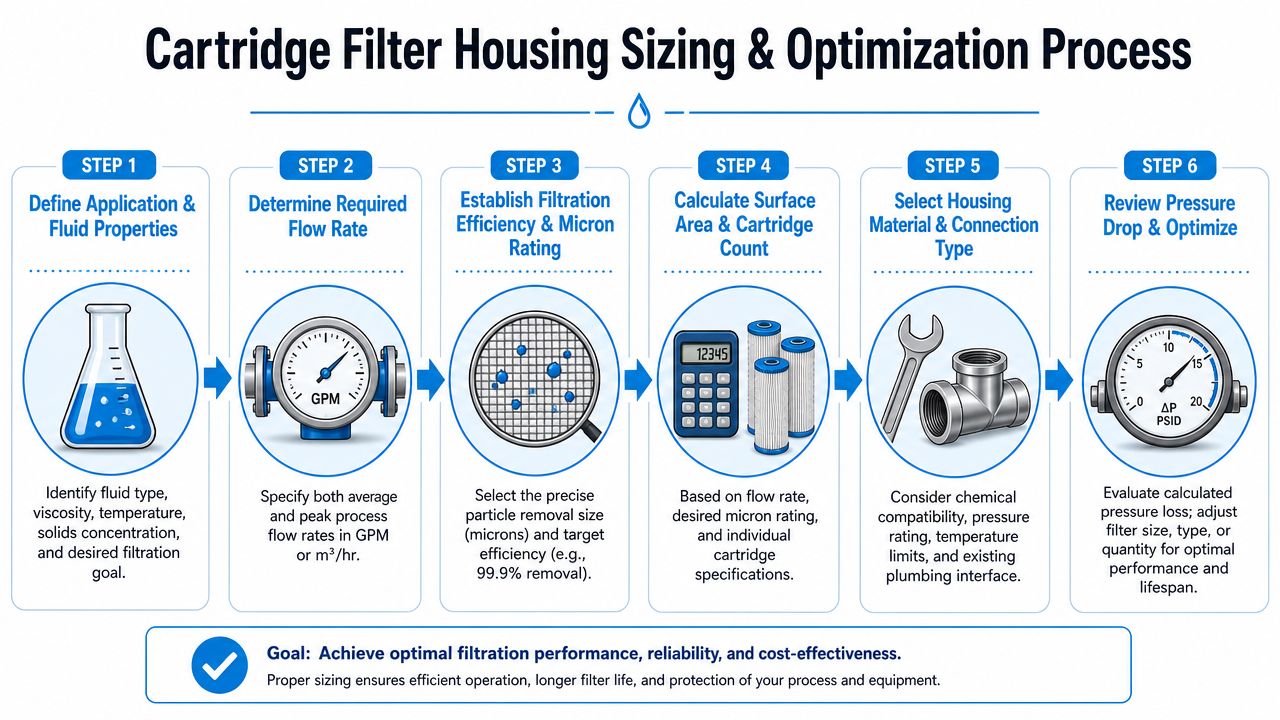
Correct sizing begins with the process fluid, not the vessel catalog. Flow rate matters, but so do viscosity, solids concentration, expected particle loading, cartridge micron selection, and acceptable differential pressure. A housing that works on clean utility water may struggle badly on variable feedwater with fines or intermittent solids slugs.
Industrial housings can span a very wide capacity range. Some cartridge filter housings are engineered to hold between 1 and 500 cartridges, supporting large contaminant holding volume and high flow in industrial service, as described by Rosedale's cartridge housing overview. That range is useful because it reminds buyers there is no meaningful “standard size” apart from what the process demands.
For plant teams evaluating broader pre-treatment and solids removal equipment around the housing, the industrial filtration machine lineup is a useful reference point for how cartridge housings fit into complete systems.
Why oversizing stays controversial
Experienced engineers often default to adding capacity margin because it lowers velocity, reduces pressure stress on the cartridges, and gives room for changing feedwater conditions. Procurement often pushes back because the larger vessel costs more upfront.
That tension is real. Engineers often struggle to balance the “oversize by 25-30%” rule with capital costs because general guides don't provide quantitative TCO data for high-solids loading scenarios, as outlined in this housing and cartridge selection discussion. The practical issue isn't whether a larger housing costs more. It does. The issue is whether the smaller housing forces enough extra labor, membrane fouling risk, and consumable usage to erase the purchase savings.
A practical sizing workflow
Use this sequence when specifying an industrial cartridge filter housing:
- Define normal and peak flow. Use actual operating flow, not only pump curve maximum.
- Confirm fluid condition. Include temperature, viscosity, solids character, and whether feed quality swings over time.
- Select cartridge type and micron target. Fine filtration with high solids loading usually needs more area than buyers first assume.
- Set an acceptable pressure-drop window. This should reflect upstream pump capability and downstream process sensitivity.
- Choose cartridge count that reduces service burden. More area usually means slower loading and fewer change-outs.
- Check maintenance access and shutdown logic. A technically correct housing can still be the wrong choice if it is awkward to service.
A simple working concept helps. Required cartridge area rises when flow rises, viscosity rises, micron rating tightens, or solids load increases. That's why one process may run well in a compact housing while another needs a much larger multi-round vessel at the same nominal flow.
For applications with highly variable feedwater, sizing for the average case often backfires. Buy the housing for the operating condition that will punish the cartridges most, not the clean-water trial run.
Installation and Maintenance Best Practices
A well-selected cartridge filter housing can still perform poorly if the installation invites stress, air binding, or bad cartridge seating. Most chronic housing problems aren't dramatic failures. They're repeatable maintenance issues that drain labor and hide the underlying cause of poor filtration.
Installation details that prevent avoidable failures
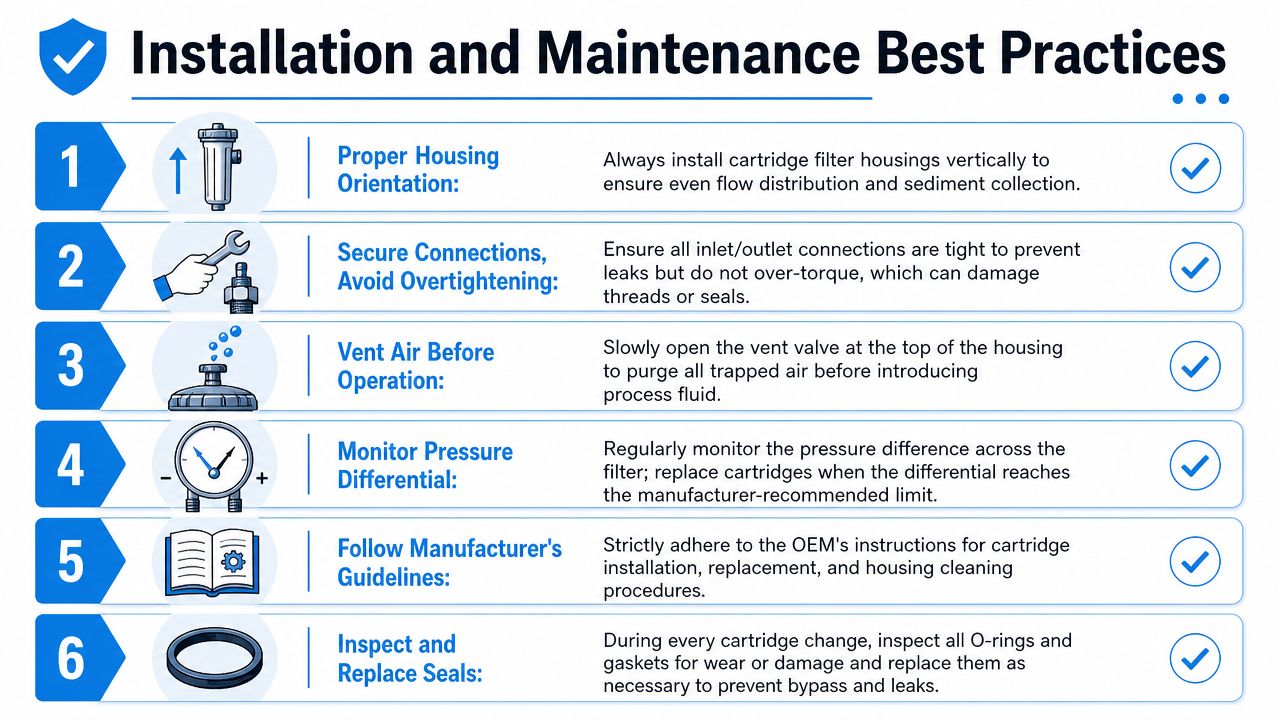
Start with physical layout. The housing needs vertical installation where the design requires it, enough overhead clearance to remove cartridges cleanly, and independently supported piping so nozzle loads don't distort the vessel connections. Operators also need working access to vent, drain, closure hardware, and gauges.
One useful operating reference comes from high-capacity housing guidance. Rosedale notes that some housings are rated up to 300 PSI in type 316 stainless steel, and that standard models may operate in the 32°F to 104°F range, with installation requiring vertical orientation plus pressure gauges and drain and vent valves for safe depressurization in its 700 Series housing information. Those details aren't minor. They determine whether maintenance is controlled or risky.
Maintenance teams dealing with broader rotating equipment reliability around filtration skids can also align service planning with pump maintenance practices, especially where suction conditions and solids loading affect both systems.
How to tell cartridge blinding from housing seal failure
One of the most expensive maintenance mistakes is replacing cartridges when the housing seal is the actual problem. A blinded cartridge and a failed seal can both show up as poor flow or poor filtrate quality, but they don't leave the same evidence.
A useful field check looks like this:
- If differential pressure rises while filtrate quality stays consistent, suspect cartridge loading first.
- If particle carryover appears without the expected loading profile, inspect cartridge seating and gasket condition before blaming the media.
- If a new cartridge set doesn't correct the problem, stop replacing consumables and inspect the sealing surfaces and internal hardware.
- If change-out history is erratic across similar runs, look for misalignment, damaged adaptors, or closure inconsistency.
A recurring blind spot in the field is exactly this failure to separate media fouling from vessel integrity problems. Maintenance guides often omit the diagnostic step needed to distinguish “filter cake” buildup from a housing's positive sealing failure, which leads to wasted cartridges and unresolved flow or quality issues, as noted in this filter housing maintenance reference.
Before discarding a full set of cartridges, verify that the housing could have sealed them correctly in the first place.
Navigating Compliance and High-Purity Requirements
In hazardous, hygienic, and high-purity environments, the cartridge filter housing specification stops being a routine mechanical selection. Compliance, documentation, and finish quality become part of the process requirement. If the vessel doesn't meet them, the plant carries safety, audit, and shutdown risk from day one.
Pressure and hazardous area compliance
In chemical plants, refineries, and similar sites, the housing may need to satisfy pressure equipment and hazardous area rules before procurement can even proceed. Cartridge filter housings must meet PED 2014/68/EU and ATEX 2014/34/EU when used in hazardous industrial environments, with design, manufacturing, and testing requirements intended to prevent failure under pressure or in explosive atmospheres, according to Parker's food and beverage housings catalogue.
That changes the buying conversation. It isn't only about throughput and metallurgy anymore. It becomes a documentation and liability issue. If the RFQ leaves compliance vague, the plant may end up comparing quotes for vessels built to very different standards.
What hygienic service changes in the specification
Food and beverage, pharmaceutical, and similar applications add another layer. The housing needs hygienic surface finish, cleanable geometry, and compatibility with plant cleaning and sterilization practice. CIP and SIP compatibility matter because the vessel has to survive how the site cleans in practice, not just how the process normally runs.
In these environments, buyers should ask hard questions about:
- Surface finish quality: Internal finish affects cleanability and residue retention.
- Crevice control: Dead legs and rough internal geometry can compromise hygienic performance.
- Material traceability: This matters during audits and quality investigations.
- Closure and drainability: Poor draining creates sanitation headaches and extended turnaround.
Compliance adds cost upfront, but non-compliance costs more once the vessel is installed. The wrong housing can block startup, fail an audit, or force replacement after the rest of the skid is already in service.
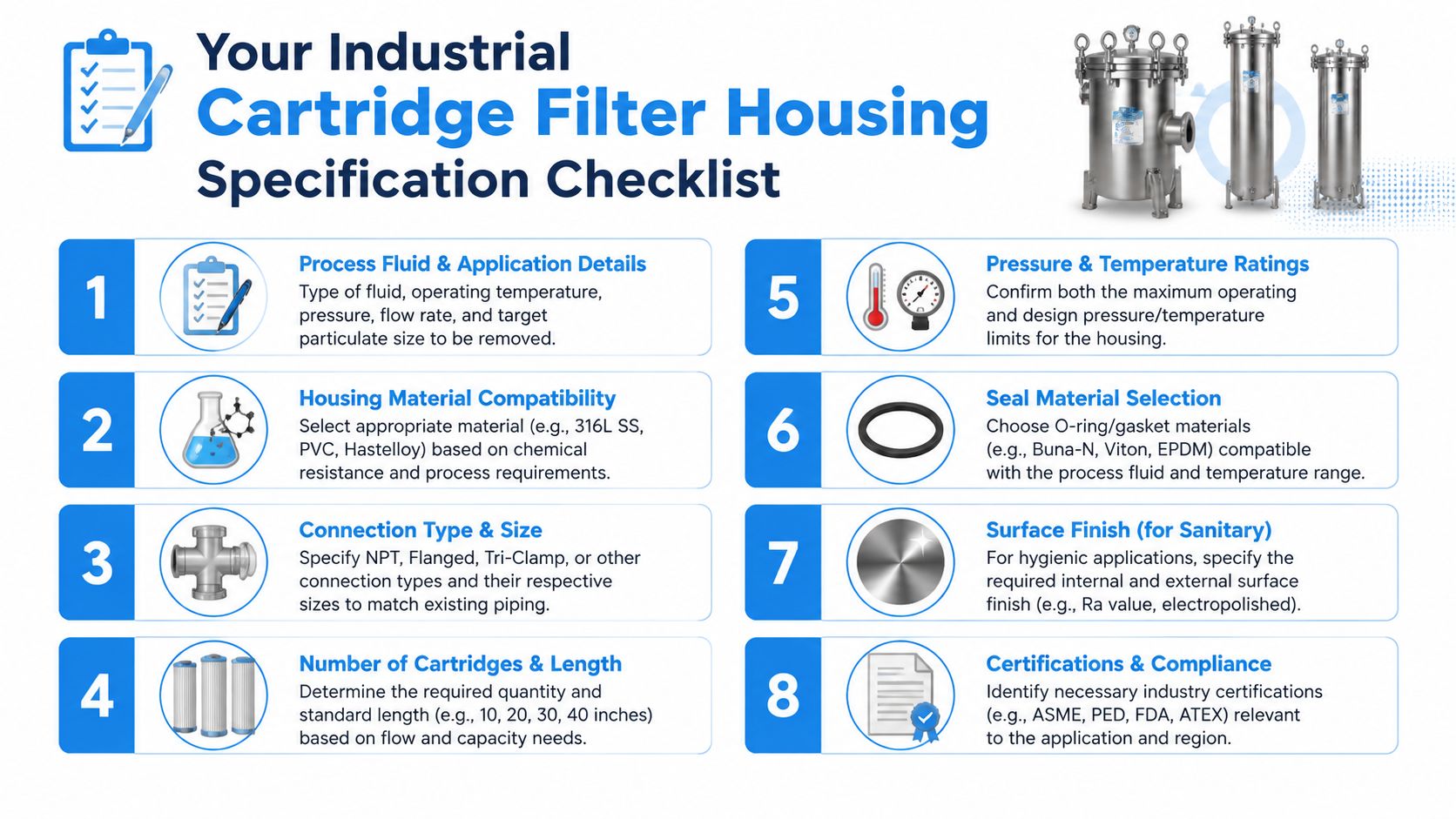
Your Industrial Cartridge Filter Housing Specification Checklist
Most RFQs for cartridge filter housings are still too thin. They ask for line size, flow, and maybe material. That isn't enough to get a technically sound quote. If the buyer doesn't define the process and maintenance constraints, the vendor fills in the gaps with assumptions. That's where expensive mismatches begin.
What an RFQ needs before you ask for pricing
A strong specification does two things. It narrows technical risk, and it makes quote comparisons meaningful. If three suppliers are quoting three different closure styles, seal arrangements, and cartridge lengths because the RFQ was vague, the prices won't tell you much.
The checklist buyers can use immediately
- Process duty: State whether the housing protects RO membranes, supports process water, polishes a batch stream, or serves a sanitary production line.
- Fluid conditions: Define the liquid, expected solids character, temperature, and operating pressure range.
- Flow envelope: Include normal flow and peak flow. If the process is cyclical, say so.
- Cartridge format: Specify the cartridge style, length, and whether the housing must accommodate future standardization.
- Material of construction: Call out vessel metallurgy and any special wetted component requirements.
- Seal material: Define gasket or O-ring compatibility with the process fluid and cleaning chemistry.
- Connections and orientation: Include nozzle type, size, and any layout restrictions in the plant.
- Access and maintenance: Note whether the site needs swing-bolt closure, davit assist, quick change-out access, or duplex service.
- Instrumentation and nozzles: Include vent, drain, and pressure gauge requirements.
- Compliance needs: State any required code, hazardous area, or hygienic expectations clearly.
Good housing procurement starts before the quote request. It starts when operations, maintenance, engineering, and procurement agree on what failure looks like and design to avoid it.
Purecowater supports industrial buyers who need cartridge filter housings, RO pre-treatment, membranes, EDI systems, and related filtration equipment specified correctly the first time. If you're comparing housing options for high-purity water, process water, or solids removal ahead of RO, contact Purecowater for application guidance, sourcing support, and quoting aligned to reliability and total cost of ownership.