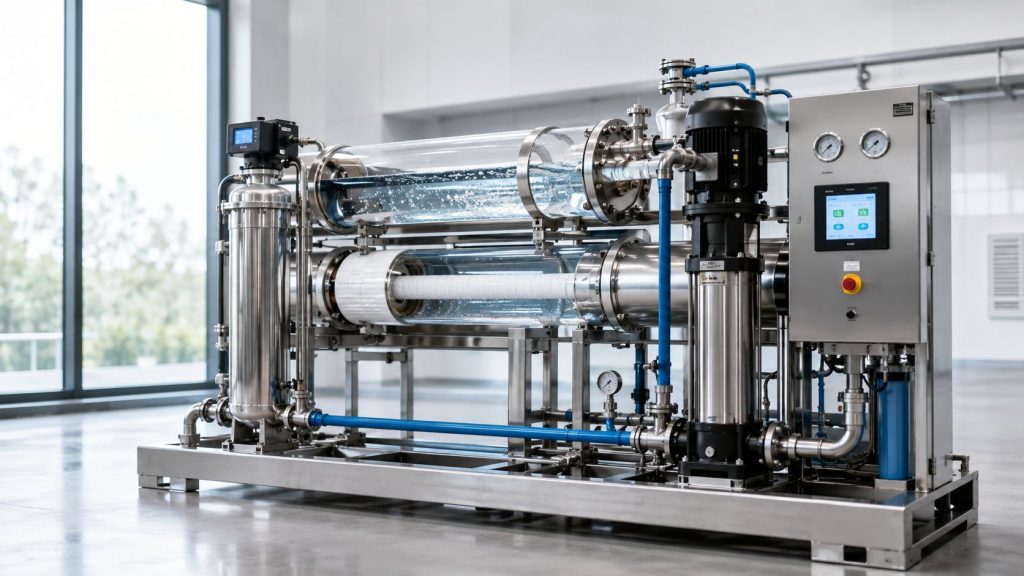
You're probably dealing with one of two situations right now. Either an existing system isn't holding product water quality consistently, or you're being asked to source an industrial reverse osmosis system for a new line, boiler feed package, process loop, or high-purity water train and need to sort through vendor claims quickly.
That's where most buying mistakes happen. Teams focus on nominal flow, membrane count, and purchase price, then get surprised later by unstable recovery, constant cartridge changeouts, frequent cleaning, or a skid that doesn't fit the site's pressure profile or pretreatment limitations. In industrial service, RO isn't a commodity box. It's a pressure-driven separation process that only performs as well as the feedwater analysis, pretreatment design, controls, and membrane selection behind it.
A well-specified industrial reverse osmosis system gives operations tighter control over conductivity, scaling risk, downstream equipment reliability, and finished water consistency. A poorly specified one becomes a maintenance project.
Table of Contents
- The Strategic Role of Industrial RO in Modern Operations
- Core Principles How Industrial RO Purifies Water
- Anatomy of an RO Skid Key Components and Brands
- Critical Pre-Treatment Protecting Your RO Investment
- Design and Sizing Considerations for Optimal Performance
- Lifecycle Management Maintenance Troubleshooting and ROI
- A Practical Guide to Sourcing and Specification
The Strategic Role of Industrial RO in Modern Operations
An industrial plant rarely notices water when it's stable. The trouble starts when feed quality drifts, scale builds in heat exchange equipment, rinse quality slips, or a downstream polishing step can't hold specification. Then water moves from background utility to production constraint.
That's why an industrial reverse osmosis system should be treated as a strategic process asset, not just a treatment accessory. In chemical, food processing, metals, and utility water applications, RO often sits at the control point between variable raw water and a process that expects repeatable input quality every shift.
Where RO changes plant performance
RO creates separation at the dissolved-solids level, which is what many conventional filters can't do. Multimedia filtration, cartridge filters, and softeners each handle part of the feedwater burden, but they don't replace a membrane barrier when the requirement is lower conductivity, lower dissolved mineral loading, and more predictable water quality.
From a buyer's perspective, that matters in four ways:
- Product quality control: Better feed to final rinse, ingredient water, utility systems, or polishing equipment.
- Asset protection: Lower dissolved solids loading on boilers, exchangers, and downstream ion-sensitive equipment.
- Operational stability: Fewer surprises when raw water quality swings.
- Procurement clarity: RO gives engineering and purchasing a definable equipment package with measurable acceptance criteria.
Practical rule: If poor water quality can stop production, degrade product, or shorten equipment life, the RO skid belongs in the same discussion as other critical process equipment.
What buyers usually get wrong
The first mistake is buying on flow alone. A quoted production rate means very little without feedwater chemistry, pressure conditions, temperature range, and recovery assumptions.
The second mistake is treating pretreatment as optional. The third is assuming a home-style RO rule of thumb applies to industrial feedwater. It doesn't.
A solid buying decision starts with process reality. What water do you have, what water do you need, how stable is the source, and what operating discipline can the plant support? Those questions decide whether the system becomes a long-life production asset or a recurring troubleshooting burden.
Core Principles How Industrial RO Purifies Water
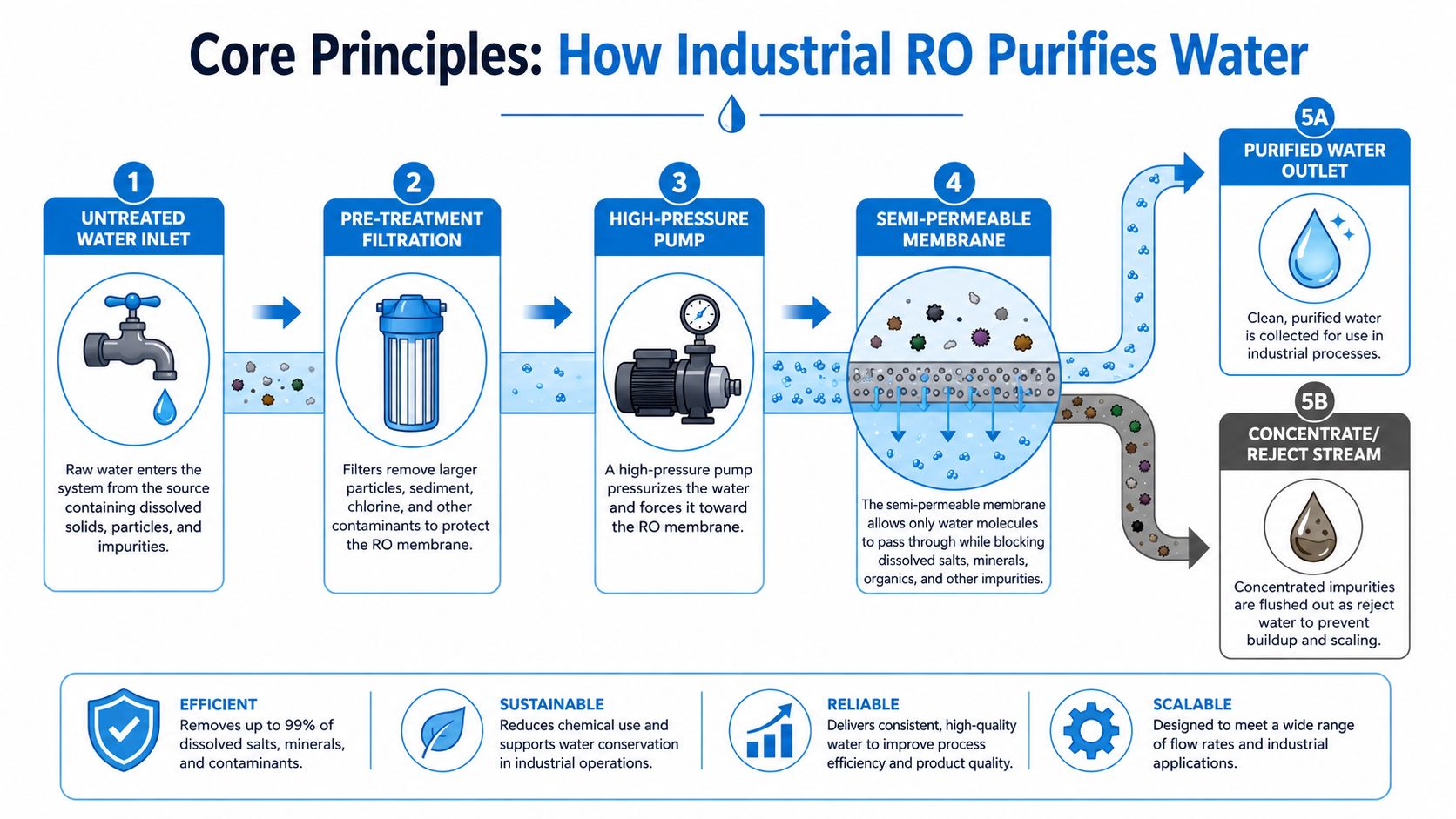
A plant takes in municipal or well water that looks stable on a bench test, then conductivity climbs, silica starts carrying through, and final rinse quality drifts. That is the problem RO is built to solve. It uses applied pressure to separate water from dissolved salts and other contaminants that conventional particulate filtration does not remove.
At the membrane surface, two forces compete. Natural osmotic pressure pulls water toward the more concentrated side. The high-pressure pump has to overcome that force before the system produces permeate at a useful rate. For engineers reviewing quotes, that is more than theory. Feed TDS, temperature, and target recovery all affect required operating pressure, specific energy use, and membrane life.
Osmotic pressure and why industrial systems need real pump power
Low-TDS brackish water and high-salinity seawater do not belong in the same buying conversation. As the U.S. Geological Survey explains in its overview of reverse osmosis and desalination, higher salinity requires much higher pressure because the system must overcome greater osmotic pressure to drive water through the membrane.
That is why pressure should never be treated as a generic catalog value. A vendor that quotes permeate flow without tying it to feedwater chemistry, design temperature, and recovery is leaving out the conditions that decide whether the skid will hit nameplate capacity in your plant.
In practice, buying errors often commence at this point. Teams compare gallons per minute and membrane count, but the underlying question is whether the pump and membrane array can hold rejection and production across seasonal water changes.
Crossflow filtration versus dead-end filtration
Industrial RO runs in crossflow. Part of the feed becomes permeate. The rest stays on the feed side, sweeps rejected salts along the membrane surface, and exits as concentrate.
That flow pattern matters because a membrane can only reject contaminants it does not allow to accumulate unchecked at the surface. Crossflow helps limit concentration polarization and slows the rate at which scaling and fouling build. It does not prevent either one.
A dead-end filter traps solids until the filter loads up and pressure drop rises. RO behaves differently. The design goal is controlled separation with enough crossflow velocity to keep the membrane surface workable between cleanings.
For buyers, that translates into practical review points: stage recovery, concentrate flow, array staging, and cleaning provisions. Those details affect fouling rate as much as the membrane brand does.
What the membrane actually rejects
RO membranes reject dissolved ions, hardness salts, many organics, and fine colloidal material. They are used when the problem is dissolved contaminant load rather than visible turbidity. If the process specification calls for lower conductivity, reduced sodium or chloride carryover, or protection for downstream EDI and ion exchange, membrane separation is usually the step that changes the result.
Rejection is selective, not absolute. Small neutral molecules can pass more readily than charged ions. Temperature shifts can change permeate flow. Recovery targets that look efficient on paper can push up concentrate-side scaling risk. Those are specification issues, not operating trivia.
For a practical example of how packaged systems are configured around these principles, the Veolia ProFlex reverse osmosis system guide shows how membrane design, controls, and operating envelope have to line up with the actual water duty.
The buying takeaway is straightforward:
- Applied pressure has to match the feedwater osmotic load.
- Membrane selection sets the rejection profile and cleaning tolerance.
- Crossflow and recovery settings decide how hard the system is on its own membranes.
- Pretreatment determines whether the RO skid runs as a production asset or spends its time in CIP and troubleshooting.
Anatomy of an RO Skid Key Components and Brands
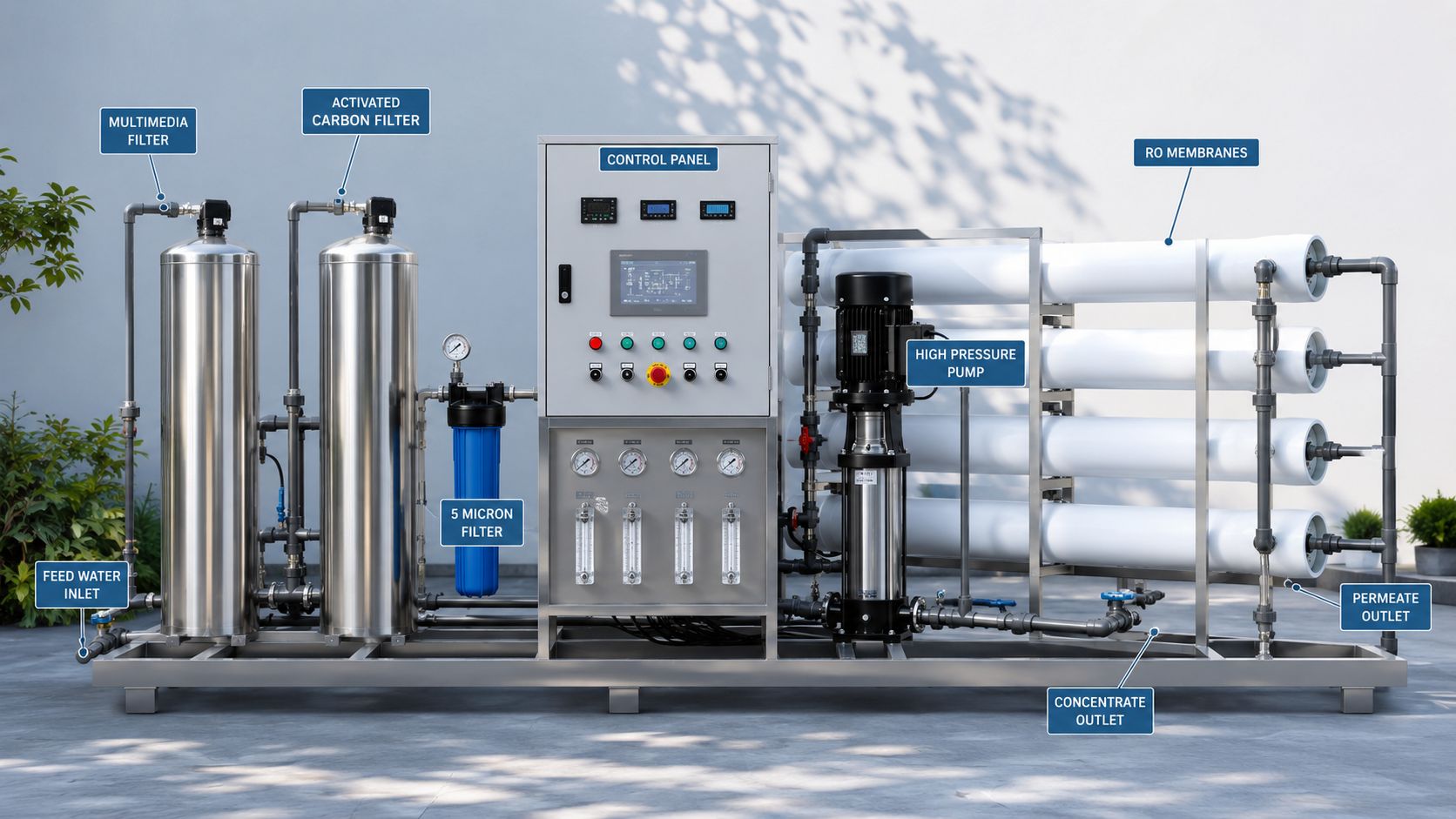
Most buyers first look at the membrane array. That's understandable, but an RO skid lives or dies by the interaction between pumps, vessels, valves, instrumentation, controls, and pretreatment interfaces. A quote with premium membranes and weak supporting hardware can still become a poor installation.
This is the hardware view most engineering teams need when comparing industrial packages.
Membranes and pressure vessels
The membrane element is still the center of the skid. In industrial brackish and seawater service, thin-film composite (TFC) membranes are the dominant technology. They use a dense polyamide top layer for salt rejection over a porous polysulfone support and are preferred over older cellulose acetate membranes for efficiency and durability, as outlined in J Mark Systems' review of RO membrane types.
In practical terms, TFC is what you'll see on most serious industrial quotations unless a niche chemistry dictates otherwise.
Pressure vessels hold these spiral-wound elements under operating pressure. Buyers should check vessel material, pressure rating, port arrangement, and service access. Membrane replacement labor becomes much harder when vessel layout is too tight or nozzle orientation conflicts with site piping.
High-pressure pump and hydraulic design
The pump does more than make pressure. It determines hydraulic stability.
A pump selected too aggressively can force operation into a narrow, touchy range. A pump selected too conservatively can leave the skid unable to maintain design output when feed conditions drift. For industrial work, I pay close attention to turndown behavior, material compatibility, seal support, and whether the vendor has matched the pump curve to actual membrane duty rather than nominal catalog flow.
A few questions usually expose whether the hydraulic design is serious:
- What operating window was used: Design pressure only, or expected plant variability too?
- How is recovery controlled: Fixed valve setting, automated control, or operator adjustment?
- What happens at low feed pressure: Reduced output, alarm, shutdown, or unstable operation?
Controls and instrumentation
Instrumentation tells you whether the skid is healthy before operators notice quality problems. At minimum, a competent industrial package should make it easy to monitor pressure profile, permeate flow, reject flow, and conductivity behavior.
The control panel matters just as much as the wet end. PLC logic should protect the membranes during startup, shutdown, low-pressure conditions, and upset events. If the system will feed a critical process, remote alarming and data logging usually deserve attention early in procurement rather than as a retrofit after commissioning.
Field note: The best control package isn't the one with the most screens. It's the one that makes abnormal operation obvious fast enough for the plant to act.
Skid frame, piping, and vendor context
Skid construction affects installation time, corrosion resistance, and serviceability. Stainless construction may be appropriate in some plants, while coated steel or other material choices may fit others depending on chemistry and environment. Pipe material should be checked for chemical compatibility, pressure class, and maintenance reality.
Membrane brand selection often comes up late in the buying process, but it shouldn't. Buyers commonly compare platforms from manufacturers and channel partners offering Veolia, LG, and other industrial membrane lines. If your team is reviewing one of the Veolia options, this guide to Veolia ProFlex reverse osmosis systems is a useful reference for understanding how those systems are positioned in industrial applications.
A good quote doesn't just name the membrane. It identifies the full bill of critical components, control philosophy, and service assumptions behind the skid.
Critical Pre-Treatment Protecting Your RO Investment
Membranes don't fail in isolation. Plants usually feed them bad conditions for months first.
That's why pretreatment deserves the same engineering attention as the RO skid itself. If the incoming water carries suspended solids, oxidants, hardness, organics, or unstable pressure, the membrane array becomes the place where every upstream problem collects at once. Then operators blame the RO.
Why pretreatment isn't optional
Industrial feedwater is often less stable than procurement documents imply. In Oil & Gas and Chemical service, feedwater can fluctuate between 30–120 PSI, creating inconsistent recovery and frequent membrane cleaning, according to the Watts reverse osmosis FAQ. The same source references a 2025 plant manager report describing 2–3 maintenance washes every 18 hours and monthly acid and hypochlorite cycles under pressure instability and ionic contaminant loading.
That's a useful warning, not a design target. If an RO package needs that level of intervention in normal service, the system design or pretreatment strategy is wrong for the duty.
Match the feed problem to the pretreatment method
A water analysis should drive pretreatment selection. Don't start with equipment preference. Start with what needs to be removed or controlled before the membranes see it.
| Contaminant Type | Primary Pre-Treatment Method | Purpose |
|---|---|---|
| Suspended solids and turbidity | Multimedia filtration and cartridge filtration | Reduce particulate fouling and protect membrane surface |
| Hardness-forming ions | Water softener or antiscalant program | Limit scale formation on the concentrate side |
| Chlorine and oxidizing residuals | Activated carbon or chemical dechlorination | Protect chlorine-sensitive membrane materials |
| Organic loading and odor/color contributors | Activated carbon | Reduce membrane fouling potential from organics |
| Biological growth risk | Biocide strategy where appropriate upstream of the membrane program | Limit biofouling pressure on the system |
| Pressure instability | Feed conditioning, buffer storage, or pump/control redesign | Stabilize recovery and membrane loading |
For teams evaluating softening and media filtration before RO, this industrial guide to Marlo water softeners and media filtration systems provides a practical reference for where those units fit in the treatment train.
Common pretreatment mistakes
The most expensive mistake is underbuilding the front end because the membrane skid looks like the “main” equipment. It isn't. The membrane is the most sensitive component in the line, so upstream protection should be sized and specified with that in mind.
Other recurring issues show up often:
- Undersized cartridge stages: They become a high-frequency maintenance item instead of a polishing barrier.
- Ignoring oxidants: TFC membranes don't tolerate chlorine exposure the way some older materials did.
- Treating antiscalant as a cure-all: It helps, but it doesn't replace proper solids control or hardness management.
- No response to pressure swings: Membranes don't like unstable hydraulic conditions.
Good pretreatment doesn't make the RO skid look more impressive on a quote. It makes the skid boring to operate, which is exactly what most plants need.
What works in practice
The most reliable installations treat pretreatment as a package, not a checkbox. That usually means the upstream train is designed around site-specific solids, hardness, oxidants, and pressure behavior, then tuned so the membranes see stable, conditioned feed.
When buyers ask where to save money, this is the part I protect first. Cheaper pretreatment usually turns into more cleaning, more troubleshooting, shorter membrane life, and less trust in the overall system.
Design and Sizing Considerations for Optimal Performance
A plant usually finds out whether an RO system was sized correctly on a cold morning, with higher feed conductivity than expected, one production line already running, and no room to miss water demand. Nameplate flow does not matter much in that moment. Operating margin does.
Start with required duty, then build the membrane array
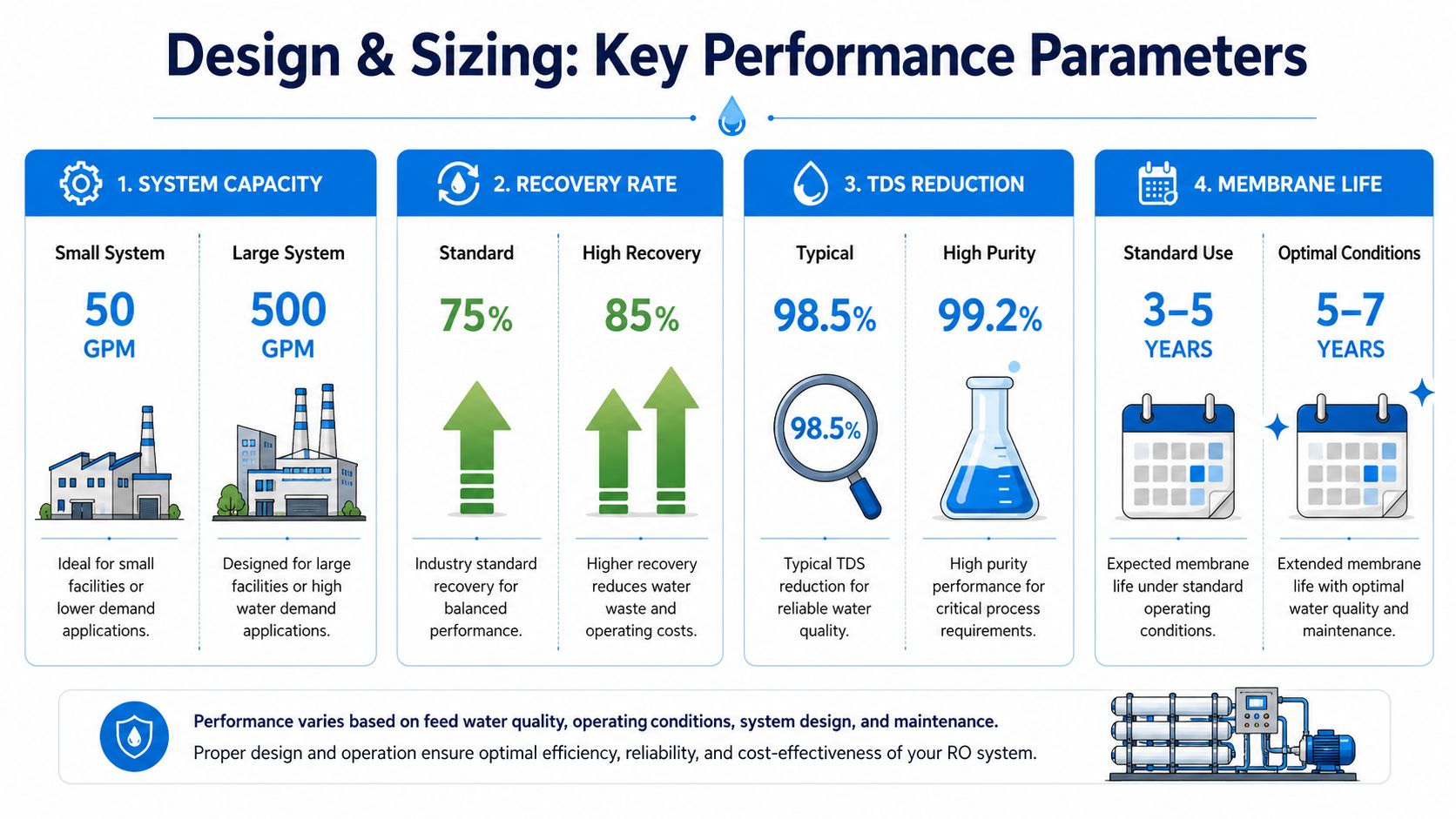
A properly sized industrial reverse osmosis system has to balance hydraulic loading, membrane area, water quality targets, cleaning frequency, and future expansion. The quickest way to buy the wrong skid is to set a production target first, then force that flow through too little membrane area or chase recovery beyond what the feed chemistry can support.
Procurement teams often ask how many membranes the skid has. Engineering should start somewhere else. Define required permeate flow, hours of operation, minimum acceptable product quality, feedwater range, turndown needs, and what underproduction costs the site in lost output or tank drawdown.
Membrane element size still matters. RO AGUA notes that 8040 elements are the standard choice for industrial systems above 5 T/H, while 4040 elements are generally used on smaller systems below 3 T/H, based on their membrane sizing guidance. That affects more than footprint. It changes vessel count, piping complexity, spare parts strategy, and how much labor is tied up during element changeout.
A skid built around smaller elements can meet the duty. It can also leave the plant with more housings, more seals, and more service time than necessary.
Design around operating range, not one lab sample
Vendor proposals often look strong because they are built around favorable feed conditions. Real plants do not run on favorable days only. Source water shifts with season, temperature, upstream process changes, and municipal supply variation. If the design basis uses average conductivity and warm-water conditions, the system may struggle during winter or during a high-TDS event.
Engineers should press for the full operating envelope. Ask what permeate flow and quality the skid can hold at low temperature, increased feed TDS, reduced feed pressure, and partial-load operation. Ask what safety margin exists before flux gets too high or concentrate scaling risk becomes unacceptable.
That review usually separates a quote built for demonstration conditions from one built for production service.
Flux and recovery decide how calm the system will be
Flux is production rate divided by active membrane area. High flux lowers capital cost because it reduces membrane count, but it raises fouling sensitivity and leaves less room for feedwater swings. Recovery has the same pattern. Higher recovery reduces reject volume and can improve water economics, but it also concentrates salts, silica, hardness, and other scale-forming species in the last stage of the array.
Those are direct trade-offs, not theory.
In practice, the better question is not "What recovery can this skid reach?" It is "What recovery can this skid hold repeatedly without unstable differential pressure, frequent CIP, or shortened membrane life?" Buyers who want a realistic budget view should also review likely RO membrane replacement cost alongside the initial skid price, because aggressive design choices often show up later in element replacement frequency.
Use these questions in the design review:
- What flux was assumed at design flow and worst-case water temperature?
- What recovery was assumed, and what part of the chemistry model limits it?
- Can the system be operated below design recovery without control issues or poor permeate quality?
- What staged array configuration was selected, and why does it fit this feedwater profile?
- How much spare capacity is built in before operators have to push pressure or recovery harder than planned?
Four checks should be on every quote review
Several variables control whether the proposed skid will deliver in service. Feedwater TDS, operating pressure, feed temperature, and recovery ratio all need to be stated clearly in the proposal, not buried in a projection spreadsheet or left inside the vendor's software printout.
If a quote gives only nominal permeate flow and target conductivity, engineering still does not have enough to approve it with confidence.
Review each offer against these points:
- Feed TDS basis: Was the system sized on average water, maximum expected water, or a blended assumption?
- Pressure basis: Does the pump duty leave room for membrane aging and filter fouling, or is the design already close to its limit?
- Temperature basis: Was cold-water output derating accounted for?
- Recovery basis: Is the proposed recovery realistic for this scaling tendency and this site's operator attention level?
- Expansion basis: Can the plant add membrane area, vessels, or a second pass later without rebuilding the skid package?
The best sizing work usually produces a skid that looks slightly conservative during bidding and completely reasonable after a year of operation.
What to ask before approving a design
A short technical review meeting can prevent a long commissioning dispute. Ask the vendor for the process design basis, membrane model assumptions, array staging, normalized performance expectations, clean-in-place trigger logic, and the controls philosophy for startup and low-demand periods.
Also ask a plain question that many buyers skip. What happens when feedwater quality moves outside the design center for three days, not three minutes? The answer says a lot about whether the supplier is selling capacity on paper or a system your plant can live with.
Lifecycle Management Maintenance Troubleshooting and ROI
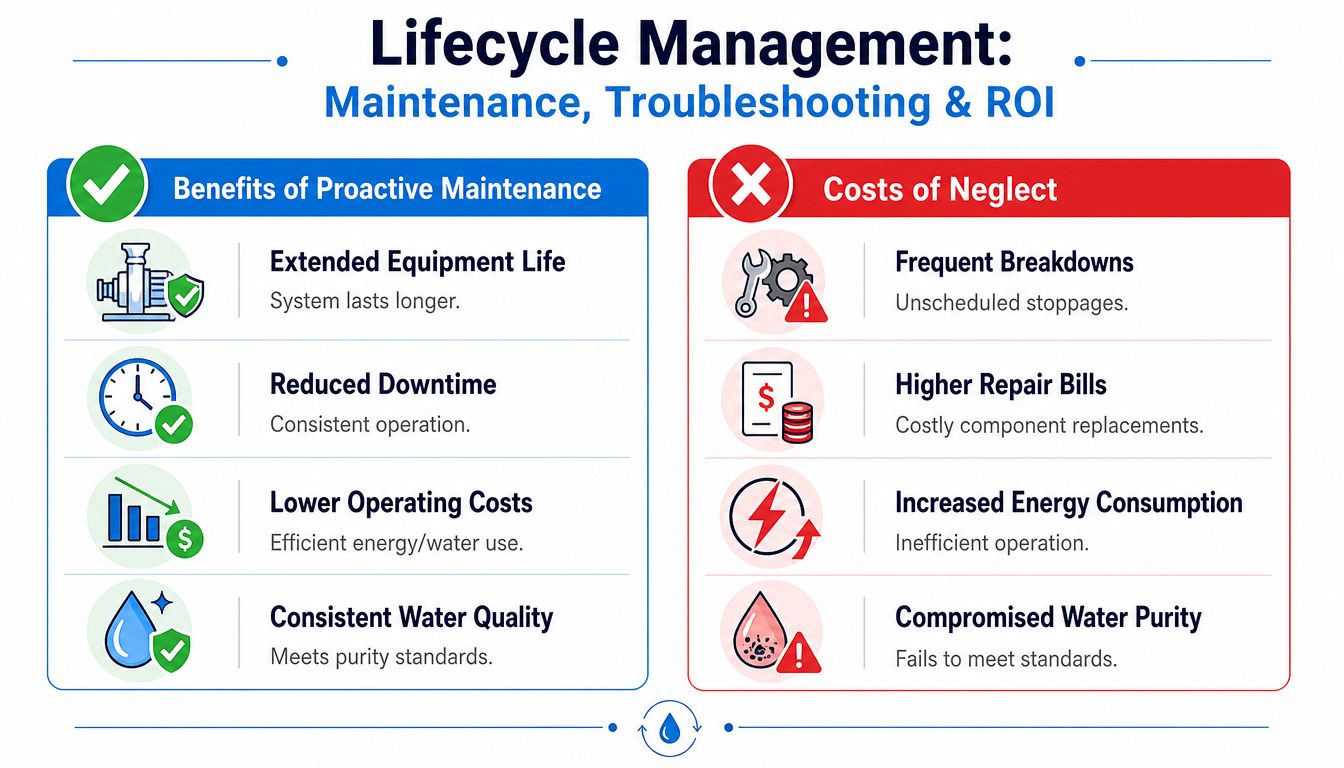
A new RO skid can run well for the first few months and still turn into a budget problem by year two. The pattern is familiar. Permeate quality starts to drift, cleanings get more frequent, operators lose confidence in the numbers, and procurement gets asked for membranes earlier than expected. Lifecycle management decides whether the system remains a controlled utility or becomes a recurring maintenance issue.
What should be monitored routinely
Useful RO monitoring is disciplined and boring. That is exactly why it works. A plant that logs the same operating values every shift can usually spot fouling, scaling, seal bypass, pretreatment failure, or instrument error before production feels it.
Track feed conductivity, permeate conductivity, concentrate flow, permeate flow, feed pressure, interstage pressure where available, differential pressure across the array, feed temperature, and recovery. Normalize flow and salt passage to a consistent reference condition so cold water or seasonal TDS changes do not get mistaken for membrane damage. Salt rejection should be calculated consistently using feed and permeate conductivity on the same time basis.
Those values support day-to-day decisions:
- Permeate conductivity trend: A gradual rise can point to membrane aging, oxidant exposure, O-ring problems, or an upset in operating chemistry.
- Differential pressure trend: A steady increase usually means particulate fouling, biological growth, or scale deposition in the lead elements.
- Normalized permeate flow: Falling normalized flow is one of the clearest early warnings that cleaning or pretreatment correction is needed.
- Instrument verification: Conductivity probes, pressure transmitters, and flowmeters need routine checks. A bad sensor can trigger unnecessary cleaning or hide a real failure.
One caution from operating experience. Absolute numbers matter less than stable trends taken under comparable conditions.
Troubleshooting common symptoms
Troubleshooting should follow the symptom pattern, not assumptions. Membranes are expensive, and premature replacement often covers up the underlying issue for only a short time.
| Symptom | Likely Cause | First Checks |
|---|---|---|
| Lower permeate flow | Fouling, scaling, reduced feed pressure, temperature shift | Feed pressure trend, pretreatment condition, cartridge loading |
| Higher permeate conductivity | Membrane damage, seal bypass, chemistry upset | Conductivity sensor validation, membrane integrity review |
| Higher differential pressure | Particulate fouling or biofouling | Pretreatment performance, filter condition, CIP need |
| Frequent cleanings | Pretreatment mismatch or unstable operating conditions | Feed analysis, pressure stability, recovery setting |
The pattern across multiple variables matters. Lower flow with stable conductivity often points toward fouling or colder feedwater. Lower flow with rising conductivity suggests a more serious membrane or sealing problem. Higher differential pressure concentrated in the first stage usually points upstream. If every symptom appears at once, start by checking instruments and recent operating changes before pulling vessels apart.
Diagnose the skid with flow, pressure, conductivity, temperature, and recovery together. One number rarely tells the full story.
CIP, spares, and replacement planning
Clean-in-place is a recovery tool, not a maintenance strategy by itself. A good CIP restores normalized flow or rejection by a meaningful amount and gives the operator a new baseline. If the same symptom returns quickly, the plant still has an upstream solids problem, scaling chemistry problem, biological issue, or a control sequence that is stressing the membranes.
Spare parts planning should focus on failure points that stop production. Keep cartridge filters, critical probe spares, valve actuators if lead times are long, pump mechanical seals where appropriate, and the consumables needed for the approved cleaning procedures. Membrane inventory needs more judgment. Some sites keep full replacement sets on hand because downtime costs dwarf inventory cost. Others plan around supplier lead time and keep only a few matching elements for emergency swaps.
Budgeting should also separate routine consumables from capital replacement. Membranes have a finite service life, but the replacement interval depends heavily on pretreatment quality, oxidant control, cleaning discipline, and how often the system cycles. For teams estimating long-term spend, this RO membrane replacement cost guide is a practical starting point.
How ROI should actually be judged
ROI on an industrial RO system is rarely decided by purchase price alone. The better comparison is cost per year of acceptable water delivered to the process, with the operating burden included.
Review the system on five practical measures:
- Water quality stability: Fewer downstream process interruptions and less rework.
- Operator attention required: Less time spent chasing alarms, recalibrating instruments, and repeating cleanings.
- Chemical and filter consumption: Lower spend when pretreatment and recovery are set correctly.
- Availability: Fewer outages and less lost production during troubleshooting.
- Component life: Longer service from membranes, pumps, valves, and instruments.
I have seen low-bid skids cost more within a year because the pretreatment was marginal, the controls did not protect the membranes during shutdowns, and the cleaning frequency became normal instead of exceptional. A system with a higher initial price can be the cheaper asset if it holds performance, gives operators clear diagnostics, and reaches membrane replacement on a reasonable schedule. That is the ROI standard worth using.
A Practical Guide to Sourcing and Specification
By the time you request quotes, most technical risk is already baked into the information you give vendors. If the RFQ is vague, the proposals will be vague too. Then procurement ends up comparing prices on systems that were never designed to the same basis.
What to gather before asking for quotes
A usable industrial RO RFQ should include the actual operating context, not just desired product flow.
Start with these inputs:
- Required permeate demand: Normal, peak, and minimum operating cases.
- Feedwater analysis: Include dissolved solids, hardness indicators, oxidants, suspended solids, and any known variability.
- Water quality target: Define what downstream equipment or process needs.
- Site utility conditions: Available feed pressure, power, drain, footprint, and control integration requirements.
- Operational expectations: Staffing, maintenance capability, spare parts philosophy, and whether continuous operation is required.
Industrial-grade RO systems with proper maintenance can achieve 95% to 99% or higher salt rejection and remove inorganic molecules plus organic compounds with molecular weight greater than 100, according to DuPont's reverse osmosis technology overview. That's a meaningful benchmark, but only if the vendor clearly states the basis for expected performance and the pretreatment required to sustain it.
Questions that separate strong vendors from weak ones
A quote should answer more than “How much water will it make?”
Ask suppliers:
- What design assumptions were used: Especially around feed variability and pretreatment.
- Which critical components are specified by brand and model: Membranes, pumps, vessels, instruments, controls.
- How the system is protected during upset conditions: Low pressure, shutdown, poor feed quality, conductivity excursion.
- What after-sales support looks like: Startup help, consumables support, replacement parts, and technical response expectations.
Choosing the right supply partner
Large OEMs can be a fit when you need standardized packages and broad installed-base familiarity. Distributors and OEM-integrators can be a fit when you need flexibility in brands, pretreatment combinations, or replacement compatibility with existing equipment.
One option in that category is Purecowater, which supplies industrial RO, pretreatment, and high-purity water equipment across multiple manufacturers for process and utility water applications.
The strongest buying decisions usually come from teams that specify the duty clearly, insist on a traceable design basis, and evaluate support capability alongside equipment price.
If your team is evaluating an industrial reverse osmosis system and wants help with membrane selection, pretreatment fit, replacement compatibility, or quotation support, Purecowater can help source and configure industrial water treatment equipment for process and utility applications.