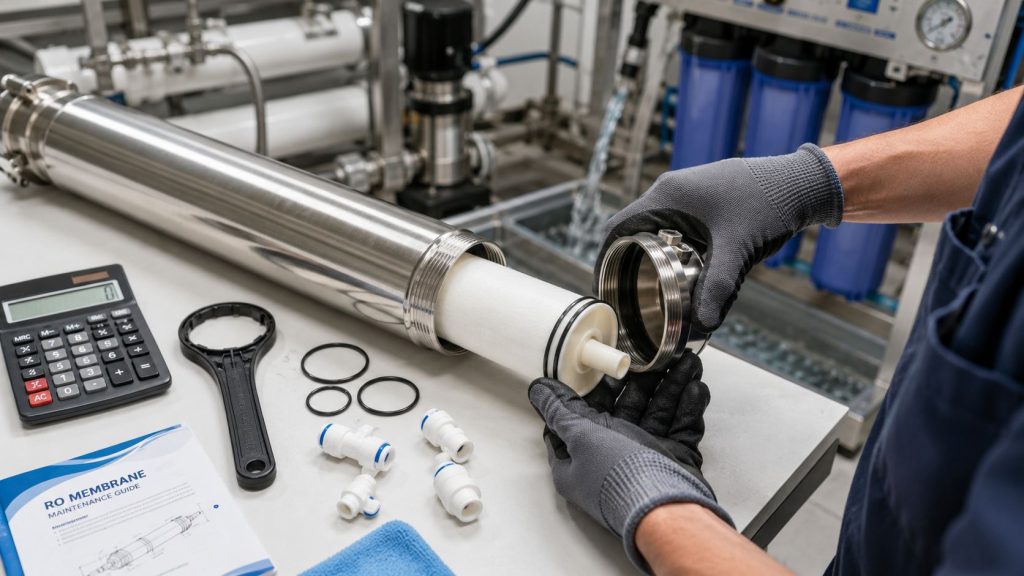
Your RO skid is still running, but the signs are there. Differential pressure is creeping up. Permeate quality isn't where it was last quarter. Cleaning restores performance for less time than it used to. Procurement wants a number for replacement, and the fastest answer is the membrane element price.
That answer is usually incomplete.
For an industrial plant, RO membrane replacement cost is a total cost of ownership decision tied to uptime, labor planning, pretreatment quality, sourcing risk, and how much operational disruption your facility can absorb during the changeout. If you buy only on unit price, you can still end up with the most expensive outcome.
Table of Contents
- Understanding the Total Cost of RO Membrane Replacement
- Breaking Down the Direct Costs of RO Membrane Replacement
- Hidden Costs That Impact Your Budget
- Industrial RO Membrane Replacement Cost Examples
- Choosing Your Sourcing Strategy OEM vs Compatible Parts
- How to Extend Membrane Life and Lower Replacement Costs
- Partnering for Smarter RO System Management
Understanding the Total Cost of RO Membrane Replacement
A membrane replacement discussion usually starts at 2 a.m., not in the budget meeting. Conductivity is drifting, normalized permeate flow is down, differential pressure is up, and operations is asking how fast the plant can get back to stable production. In that moment, the membrane price matters. It just is not the full cost.
The useful question for a plant manager or procurement lead is straightforward: What will this replacement event cost from shutdown through stable operation?
The purchase order covers only one part of the decision. The plant also absorbs labor, outage time, startup losses, cleaning and flushing water, possible vessel or seal repairs, and the performance risk tied to the membrane selected. A lower element price can still produce a higher total cost if the replacement window runs long, the new elements foul early, or post-startup performance misses design targets.
Practical rule: If the budget only includes membrane elements, it does not reflect replacement cost. It reflects invoice cost.
A workable TCO framework starts with five checks:
- Parts cost for membranes and any related consumables or hardware needed during the changeout.
- Installation and commissioning cost for internal maintenance labor or outside field service.
- Production impact during shutdown, restart, flushing, and stabilization.
- Procurement risk tied to OEM versus compatible elements, lead times, warranty terms, and expected service life.
- Root-cause exposure in pretreatment and operating practice, so the plant does not buy a fresh set of membranes into the same fouling or scaling conditions.
That last point is where plants often lose money. If membrane failure is driven by poor SDI control, oxidant breakthrough, inadequate CIP execution, or unstable recovery rates, replacement solves the symptom for a short time and leaves the cost driver in place.
Membrane replacement also needs to be viewed in the context of the full RO operating budget. Energy usually remains the largest lifecycle cost in industrial RO service, while membranes, labor, and chemicals make up the rest of the operating picture in different proportions depending on feedwater quality, recovery target, and cleaning frequency. That is why a TCO review matters more than a unit-price comparison. The membrane choice affects cleaning intervals, operating pressure, reject quality, and replacement frequency, all of which show up later in OPEX.
Plants that treat membrane replacement as a lifecycle decision usually make better calls on sourcing, outage planning, and pretreatment upgrades. Plants that treat it as a parts purchase often pay twice. First for the changeout, then for the avoidable downtime and shortened membrane life that follows.
Breaking Down the Direct Costs of RO Membrane Replacement
A plant can approve a membrane purchase order in one afternoon and still miss the full direct replacement cost by a wide margin. The invoice usually starts with elements, but the full direct spend also includes vessel consumables, installation labor, startup support, and any related mechanical work required to return the train to stable operation.
Membrane elements
The membrane element is still the largest line item in many changeouts. Price moves with membrane type, salt rejection target, fouling resistance, pressure rating, and brand. A standard brackish water element for utility service does not cost the same as a seawater element or a specialty element selected for difficult feed conditions.
Commercial and industrial RO membranes typically cost between $200 and $1,000 or more per unit, with a typical replacement cycle of 1 to 2 years under normal operating conditions Chunke Water Treatment.
That range matters because the element count drives the total quickly. On a multi-stage industrial skid, a small difference in unit price can add up fast. A low purchase price can also shift cost elsewhere if the element has higher pressure drop, less stable rejection, or shorter run length between cleanings.
Procurement should break the element decision into practical categories:
- BWRO elements for process and utility water systems with moderate salinity
- SWRO elements for high-pressure duty and higher rejection requirements
- Fouling-resistant elements for feeds with higher organic, colloidal, or biological loading
- OEM-branded replacements where warranty, validation, or documented plant history carries more weight than lowest first cost
I would not treat all 8-inch elements as interchangeable just because the dimensions line up. Active area, feed spacer design, pressure drop, cleanability, and brine seal fit all affect startup behavior and long-term operating cost.
Pressure vessels and hardware
A membrane replacement scope should include the vessel internals every time. Plants often budget for elements and overlook the lower-cost hardware that decides whether startup goes smoothly or turns into a leak check and rework exercise.
Common direct material items include:
- O-rings and seals
- Interconnectors and adapters
- Food-grade lubricant, where the membrane supplier or vessel manufacturer specifies it
- End cap or closure service parts
- Replacement hardware identified during vessel inspection
Reusing flattened elastomers or worn interconnectors is a false economy. The parts are inexpensive compared with the labor tied to reopening a vessel after a failed restart. If the high-pressure side has broader reliability concerns, it also makes sense to align the membrane job with related industrial pump maintenance planning.
Buyers usually remember the membrane part number. Maintenance teams remember the missing seal kit that delayed restart.
Installation and commissioning
Direct cost does not stop at delivery. The train has to be isolated, opened, unloaded, inspected, cleaned as needed, reloaded, flushed, and returned to service within acceptable normalized performance.
Labor cost depends on crew experience and site conditions. Some plants handle changeouts with in-house maintenance and operations staff. That can work well if the team knows vessel opening procedures, loading direction, brine seal orientation, preservative flushout, and startup ramping. If that experience is not on site, field service support can be cheaper than correcting an installation error after the system is back under pressure.
Commissioning should be budgeted as part of the direct replacement event, not treated as incidental labor. The first stable hours after startup matter. This is when the team confirms pressure profile, permeate conductivity, differential pressure, and mechanical integrity. A lower membrane quote loses its value quickly if the plant later pays for emergency support, repeat flushing, or vessel rework because the initial installation scope was priced too narrowly.
Hidden Costs That Impact Your Budget
Most plants don't blow the budget on the membrane invoice. They blow it on everything around the invoice.

Labor is more than wrench time
A membrane changeout looks straightforward on paper. Isolate the skid, open the vessels, remove old elements, clean, reload, reassemble, flush, and restart. In practice, labor expands when technicians discover fouled vessels, seized closures, damaged adapters, or instrumentation that needs validation before restart.
Using in-house maintenance can work well when the team has repeated RO experience. It can also create hidden cost if the crew has to stop and troubleshoot fit, seal orientation, flushing sequence, or startup pressure behavior. That's one reason many plants also look at related equipment condition before a membrane event. If your high-pressure side has reliability concerns, it's worth aligning replacement planning with broader industrial pump maintenance considerations.
Downtime usually costs more than parts
This is the expense plants underestimate most often.
If the RO train feeds a boiler makeup system, process rinse line, ingredient water loop, or high-purity utility header, every hour offline pushes stress into another part of the facility. Operators start rationing water, switching tanks, delaying production steps, or accepting lower operating margin until the system stabilizes again.
That doesn't always show up as a maintenance cost. It shows up as lost production flexibility, quality risk, overtime, or expedited freight for emergency parts.
The cheapest membrane replacement is the one that finishes inside the planned outage window and comes back online cleanly on first startup.
Ancillary losses that buyers miss
A realistic replacement budget should also include the surrounding losses that don't sit neatly on a PO.
- Flush water and commissioning loss because new elements need proper rinsing and stabilization before the train returns to normal service
- Freight and handling for industrial elements, vessel parts, and rush-ordered consumables
- Disposal and site handling of spent membranes and contaminated packaging
- Quality hold risk if product water needs verification before the process can fully restart
A plant that focuses only on material price can end up choosing the wrong outage timing, the wrong labor plan, and the wrong supplier response model. That's why hidden costs deserve the same review as the membrane quote itself.
Industrial RO Membrane Replacement Cost Examples
A budget model doesn't need fake precision to be useful. It needs the right structure.
Below is a practical way to estimate RO membrane replacement cost for two common industrial situations. The scenarios are illustrative, not prescriptive. The point is to show what belongs in the worksheet so procurement, maintenance, and operations are all looking at the same event.
Sample RO Membrane Replacement Cost Calculation 2026 Estimates
| Cost Component | Scenario 1: 50 GPM System (Food & Bev) | Scenario 2: 200 GPM System (Chemical Plant) |
|---|---|---|
| Membrane elements | Use the applicable industrial membrane quantity multiplied by the published industrial range of $200 to $1,000 or more per unit | Use the applicable industrial membrane quantity multiplied by the published industrial range of $200 to $1,000 or more per unit |
| Installation and commissioning | Include professional service if used, based on $50 to $200 for installation and commissioning fees | Include professional service if used, based on $50 to $200 for installation and commissioning fees |
| Vessel service parts | O-rings, interconnectors, adapters, lubricant, and any closure hardware found worn during inspection | O-rings, interconnectors, adapters, lubricant, and any closure hardware found worn during inspection |
| Labor planning | In-house maintenance time or contractor scope for isolation, removal, loading, flush, and startup | Larger scope due to more vessels, more elements, and longer verification time |
| Downtime allowance | Production coordination, temporary water management, and restart verification | Higher operational exposure because more plant systems may depend on the RO train |
| Freight and disposal | Standard or expedited freight plus spent membrane handling | Higher logistics complexity if multiple elements or remote-site service are involved |
| Contingency fund | Reserve for vessel hardware issues, startup leaks, or unexpected consumables | Reserve for the same issues, with greater exposure on larger skids |
The membrane line is the easiest one to calculate because the verified industrial price range exists. The other rows should be developed from your own plant conditions, because that's where wide variation happens. A food and beverage site may spend more effort on sanitation, quality release, and protected restart. A chemical plant may care more about utility continuity, buffer storage, and how the outage affects upstream or downstream units.
How to use the table for your own plant
Start by confirming the exact membrane count, element type, and vessel configuration on the skid. Then match the replacement event to the outage reality at your site.
For example, the same membrane changeout can carry very different total cost depending on these conditions:
- Process criticality if RO water feeds a production bottleneck
- Redundancy if a parallel train or storage tank can carry the load
- Labor readiness if your technicians do this routinely
- Hardware condition if vessels haven't been opened for multiple service cycles
A useful estimate doesn't pretend every site is the same. It captures your specific exposure before the plant commits to a sourcing and outage plan.
Choosing Your Sourcing Strategy OEM vs Compatible Parts
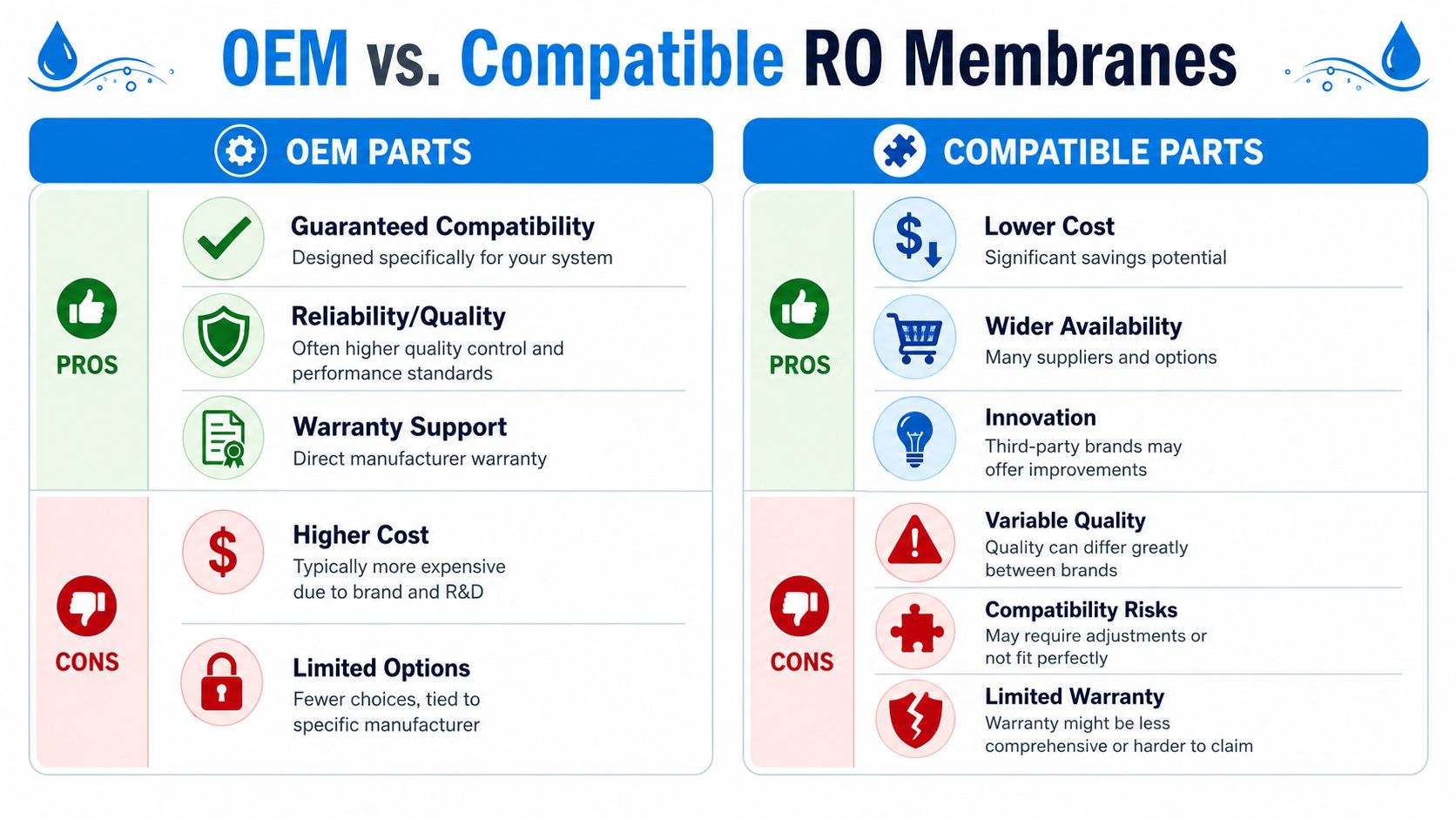
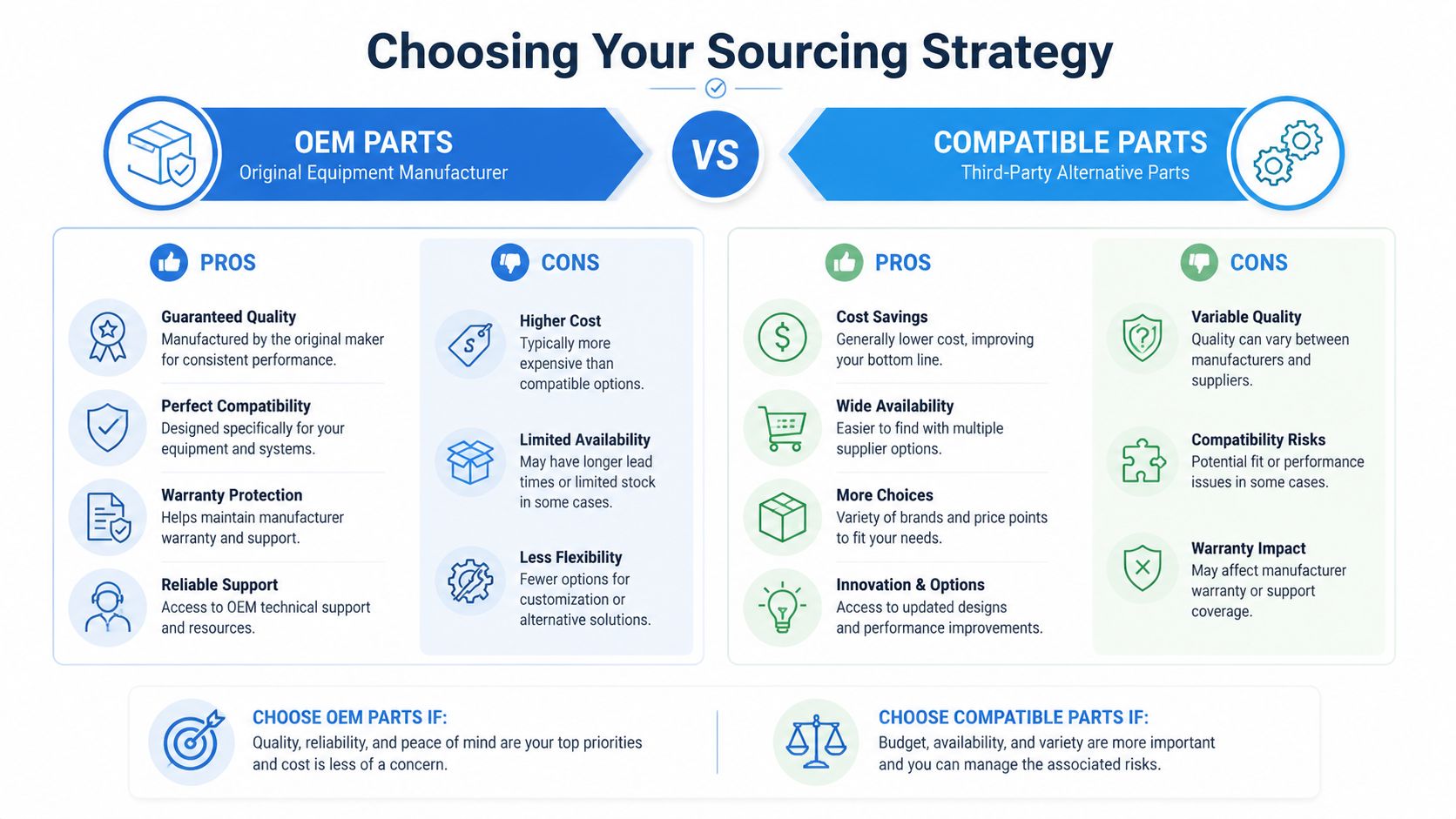
Procurement usually reaches this decision after the first quotes land. One option is the original branded element. The other is a compatible replacement that fits the system and often lowers upfront price. Both can be valid. Neither should be selected on sticker price alone.
Where OEM parts make sense
OEM membranes are usually the safer choice when the system has tight validation requirements, warranty sensitivity, or a well-documented performance baseline. If you're replacing Veolia, LG, or another established industrial element in a process where water quality variance creates quality risk, OEM supply often buys confidence as much as hardware.
That's especially true when your team needs a known operating profile and doesn't want to re-interpret pressure drop, rejection behavior, or cleaning response after startup. Buyers reviewing Veolia industrial membrane options and compatibility details usually care about that continuity.
When compatible parts can work
Compatible membranes can be a smart buy if the supplier understands your application, the part is a true equivalent for the duty, and the plant is willing to evaluate risk beyond fit-up. In less sensitive utility applications, a qualified compatible element may reduce initial spend without compromising the process.
The problem isn't the category. The problem is buying “compatible” as if all compatible options perform the same. Quality control, material consistency, and pretreatment match still matter.
A useful reference point comes from Filter United's analysis of long-term RO ownership costs, which notes that proprietary filter systems can cost $80 to $150 annually versus $30 to $50 for universal ones, potentially leading to a 2 to 3x higher total cost of ownership over 5 years. The same source also states that 2025 data showed 68% of premature membrane failures correlated with inadequate pre-treatment in proprietary systems. That's a useful reminder that purchase strategy and pretreatment discipline are linked. A lower part price won't rescue a bad upstream protection strategy.
A procurement rule that avoids false savings
Use a side-by-side decision screen before you issue the PO:
- Check compatibility depth rather than matching only dimensions and nominal rating
- Review warranty impact on the RO skid and any integrated package commitments
- Audit pretreatment performance because poor chlorine or solids control can erase any savings fast
- Model lifecycle purchase cost across replacement frequency, not just this outage
Buy the membrane that best fits your feedwater, pretreatment reality, and production risk. The lowest quote often wins the meeting and loses the year.
How to Extend Membrane Life and Lower Replacement Costs
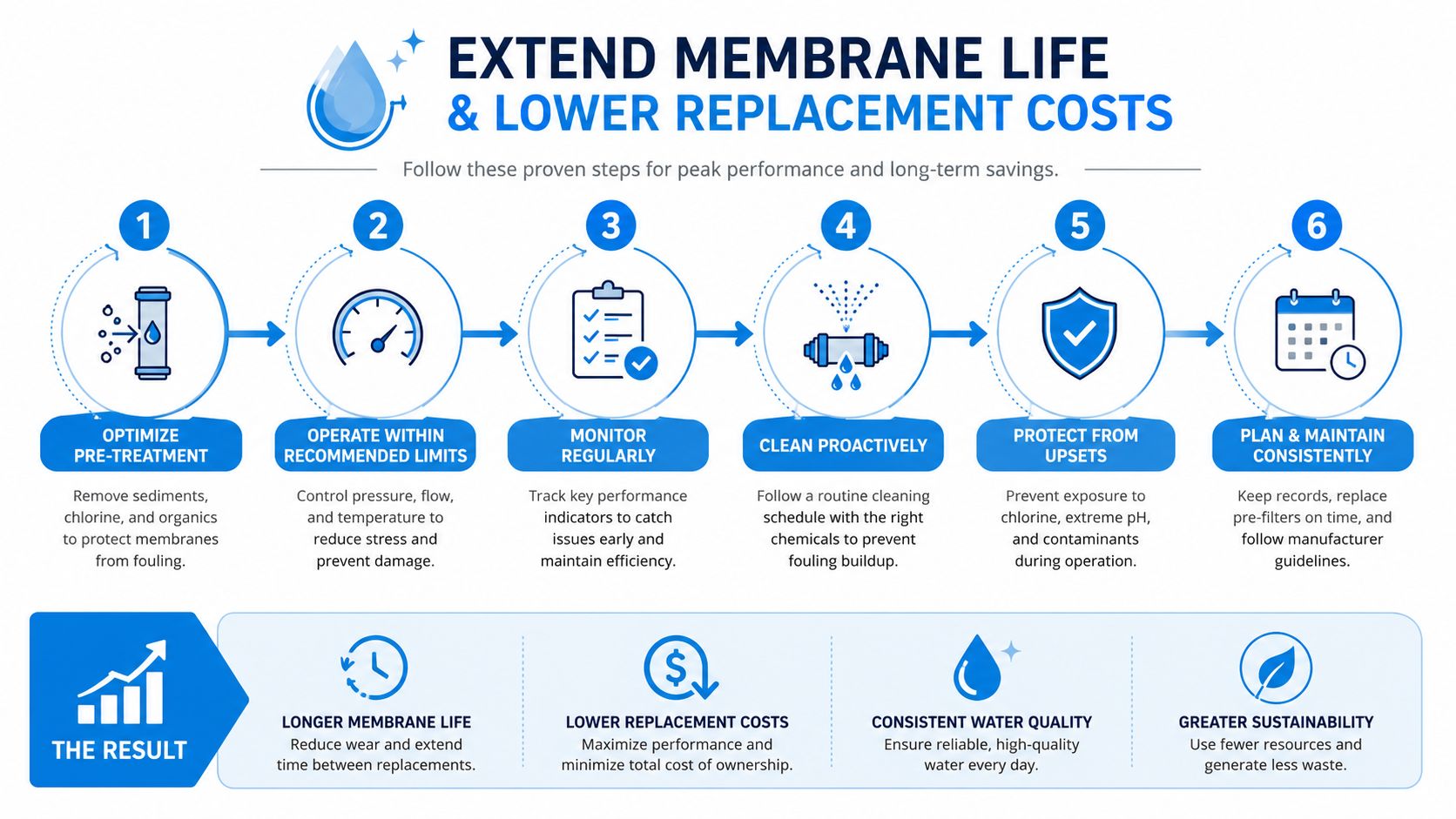
A plant usually does not lose money on membranes the day it places the order. It loses money in the months before that order, when fouling is allowed to build, cleanings come too late, differential pressure keeps rising, and the eventual changeout turns into an unplanned outage.
Pretreatment is the first cost lever
Membrane life is set upstream first. If pretreatment does not match the feedwater profile, the RO train absorbs the penalty through faster fouling, more frequent CIP events, lower normalized flow, and earlier replacement.
For industrial systems, that usually means checking whether multimedia filtration, cartridge filtration, softening, dechlorination, antiscalant dosing, and upstream oxidation control still fit current conditions, not the water analysis from startup. Feedwater often changes with season, source blending, or production shifts. The skid may still run, but the membrane sees that drift immediately.
Review RO membrane and system protection requirements against your actual pretreatment train, recent SDI results, chlorine exposure risk, and scaling history. That comparison often shows where replacement cost is really coming from.
Operating discipline protects the asset after startup
Plants that get long membrane life tend to run to normalized data, not operator feel. They watch normalized permeate flow, salt passage, and differential pressure by stage, then act before loss becomes permanent.
The operating habits that cut replacement frequency are straightforward:
- Set cleaning triggers from trend data instead of waiting for a major production hit
- Confirm CIP chemistry and temperature match the foulant, because the wrong clean wastes labor and shortens recovery
- Control shutdowns and restarts so membranes are not exposed to oxidation, biological growth, or hydraulic shock
- Replace pretreatment consumables on schedule rather than stretching cartridges, carbon, or chemical feed for one more run cycle
- Verify instrumentation accuracy because bad pressure or conductivity readings lead to bad replacement decisions
I have seen plants blame the membrane when the actual issue was a drifting conductivity probe or a carbon bed that stopped protecting against oxidants weeks earlier. That is a cheaper problem to fix than a full vessel reload.
Focus on avoidable cost, not just membrane age
A membrane can reach end of life for the right reason, normal wear under controlled conditions, or for expensive reasons like scaling, oxidation, mechanical damage, or neglected cleaning. Procurement should care about that difference because it changes the actual replacement cost.
An early failure does not just add element spend. It adds rush freight, contractor time, overtime for operations, startup losses, extra CIP chemicals, and sometimes off-spec water during recovery. If production is tight, downtime usually costs more than the membrane set.
That is the practical TCO view. The lowest annual replacement budget often comes from spending more attention on pretreatment verification, trend review, and cleaning discipline.
Build a lifecycle review around four checks
Use a simple operating review before each planned outage or replacement decision:
- Has feedwater quality shifted from the design basis or recent baseline?
- Is pretreatment still removing the contaminants the membranes are seeing?
- Do normalized RO trends point to reversible fouling, irreversible loss, or instrument error?
- Is replacement the lowest-cost option, or will a well-timed cleaning and pretreatment correction recover performance?
Plants that use this review make better decisions on both timing and sourcing. They replace elements when the economics support it, not just when performance becomes painful enough to force the issue.
Partnering for Smarter RO System Management
The best membrane replacement programs aren't reactive. They're planned around system data, outage discipline, and procurement choices that hold up after startup.
For a plant manager or buyer, that means treating RO membrane replacement cost as a management issue, not just a parts issue. The right answer balances membrane selection, compatibility, labor planning, vessel condition, pretreatment performance, and the production risk carried by the outage itself.
A capable partner should help with all of that. Not just quote element part numbers. The strongest support model combines component sourcing, application guidance, compatibility review, and practical help on how to lower lifecycle cost without creating new reliability problems.
If you're evaluating industrial RO membranes, pretreatment equipment, or replacement options for an existing skid, Purecowater can help you compare OEM and compatible parts, review system fit, and build a smarter total cost of ownership plan for your facility.