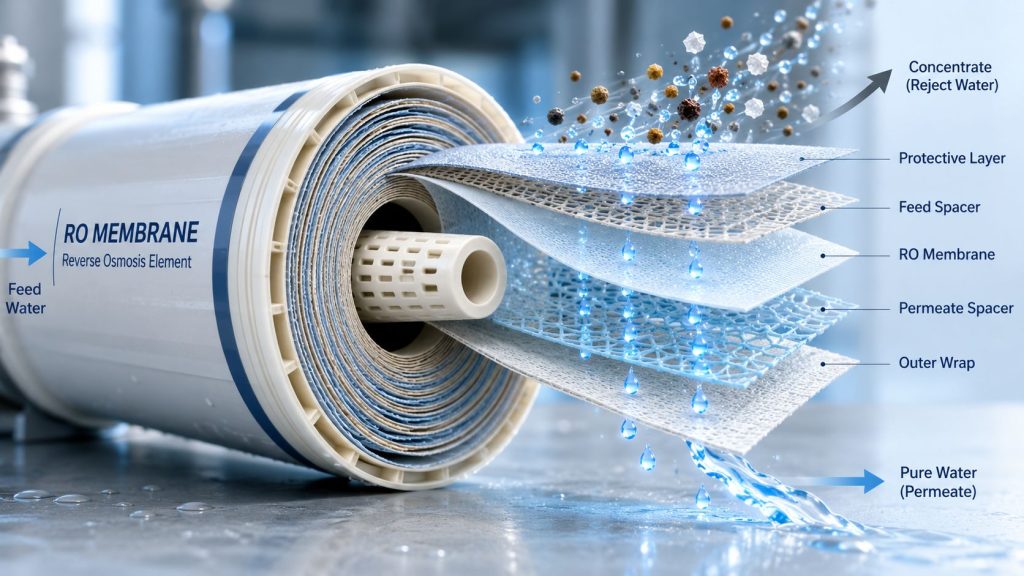
You're usually not shopping for a reverse osmosis system membrane because everything is going well. More often, you're trying to solve a specific plant problem. Permeate quality is drifting. Differential pressure is climbing. Cartridge filters are loading too fast. Operators are cleaning too often, yet the skid still won't hold stable output.
In industrial service, the membrane isn't a standalone consumable. It's the core separation asset inside a system that only performs as well as the feedwater preparation, hydraulic design, and operating discipline around it. Buyers who focus only on element price usually pay for that mistake later through lost recovery, unstable conductivity, shortened run lengths, and avoidable changeouts.
Table of Contents
- The Role of RO Membranes in Industrial Water Treatment
- How Industrial RO Membrane Technology Works
- Selecting the Right RO Membrane for Your Application
- The Critical Importance of System Pre-Treatment
- RO System Operation and Troubleshooting
- Membrane Cleaning CIP Protocols and Best Practices
- Sourcing Membranes and Partnering for Success
The Role of RO Membranes in Industrial Water Treatment
Industrial water treatment lives or dies on consistency. Boilers, rinsing lines, process loops, ingredient water systems, and reuse plants all depend on stable water quality. When that quality moves around, downstream equipment sees the impact first. Heat transfer suffers, product specs tighten, and maintenance teams get pulled into troubleshooting work that often started upstream.
That's why the reverse osmosis system membrane matters so much. It's the barrier that determines whether a plant gets reliable permeate or a steady stream of operating headaches. In practice, the membrane decides more than water purity. It shapes cleaning frequency, pump loading, reject handling, and the true cost of ownership for the whole skid.
The broader market reflects that importance. The global RO membrane market was valued at USD 4.77 billion in 2025 and is projected to reach USD 11.52 billion by 2034, with a 10.3% CAGR, while the wastewater segment accounted for 60.0% of the market in 2025, according to Polaris Market Research on the reverse osmosis membrane market. That growth isn't abstract. It tracks directly with how central RO has become in industrial desalination, wastewater recycling, and high-purity utility water production.
Where the membrane really earns its keep
A membrane buyer in industry isn't buying a sheet of material. They're buying operating stability.
- Asset protection: A well-matched membrane reduces dissolved salts and contaminants before they reach sensitive downstream equipment.
- Process reliability: Stable permeate helps plants hold utility water quality without constant operator correction.
- Reuse performance: In wastewater applications, the membrane often sits at the point where reuse economics either work or collapse.
- Cost control: Better membrane selection lowers the odds of repeated cleaning, premature replacement, and production interruptions.
Practical rule: In industrial service, membrane selection is a plant reliability decision first and a consumables decision second.
A lot of buyers still treat membranes like interchangeable commodities. They aren't. A low-cost element can look acceptable on a quote sheet and still underperform badly once variable feedwater, fouling load, and real plant upsets show up. The membrane has to match the application, but it also has to survive the way the plant runs.
How Industrial RO Membrane Technology Works
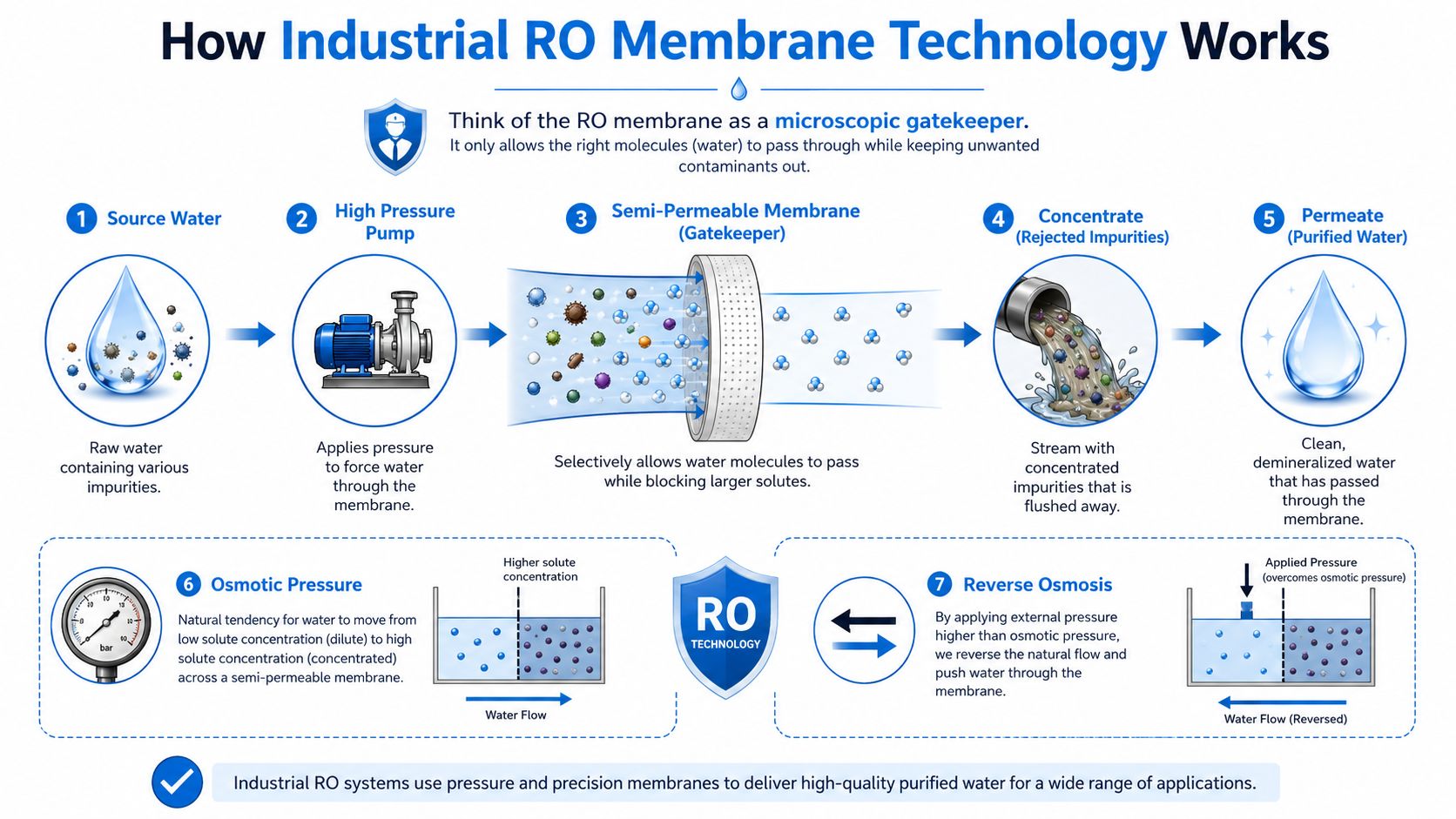
At its simplest, an RO membrane acts like a microscopic gatekeeper. Water molecules pass. Dissolved salts and many other impurities don't. That sounds straightforward, but the operational reality comes from how pressure, membrane material, and feedwater chemistry interact inside the pressure vessel.
The separation mechanism in plain terms
Natural osmosis pushes water toward the side with higher solute concentration. Reverse osmosis does the opposite. The system applies external pressure to overcome that natural osmotic tendency and force purified water through the membrane.
The membrane surface doesn't work like a simple strainer. In high-performance industrial service, the standard material is aromatic polyamide thin-film composite, commonly called TFC. That material has an effective pore bore size of about 0.0005 microns, which is small enough that separation is dominated by molecular diffusion rather than ordinary mechanical filtration, as described in Axeon Supply's guide to choosing the right RO membrane.
That material choice matters because it enables industrial RO systems to remove dissolved solids at very high levels. The same source notes that TFC membranes can reject TDS up to 40,000 mg/l and achieve salt rejection rates reaching 99.75% for seawater desalination.
What enters and what leaves
Every RO skid has the same basic streams:
| Stream | What it contains | Why it matters |
|---|---|---|
| Feed | Raw water entering the membranes | Drives fouling risk, pressure demand, and membrane selection |
| Permeate | Purified water that passes through | Determines product quality and utility water suitability |
| Concentrate | Rejected salts and contaminants | Affects recovery strategy and reject management |
A properly designed industrial system typically rejects 95% to 99% of dissolved salts, and common systems operate with 50% to 85% recovery, according to Dayton Water Systems' reverse osmosis fundamentals PDF. The same reference gives a practical example. If feed water is 300 ppm TDS, product water may land at 15 to 30 ppm depending on rejection performance.
The membrane doesn't create purity by itself. The pump supplies the force, and the hydraulic design determines whether the membrane sees conditions it can actually handle.
Pressure and flux are tied to feedwater type
Higher salinity requires higher operating pressure. That's one of the first mistakes buyers make when they compare industrial membrane options as if all feedwaters behave the same. Axeon Water's discussion of membrane performance metrics notes that seawater membranes operate around 55.15 bar with 32,000 ppm NaCl feed salinity, while brackish water membranes use about 15.5 bar with 2,000 ppm feed salinity.
So the membrane decision always has to answer two questions at once. What quality do you need out, and what burden are you asking the membrane to carry on the way there?
Selecting the Right RO Membrane for Your Application
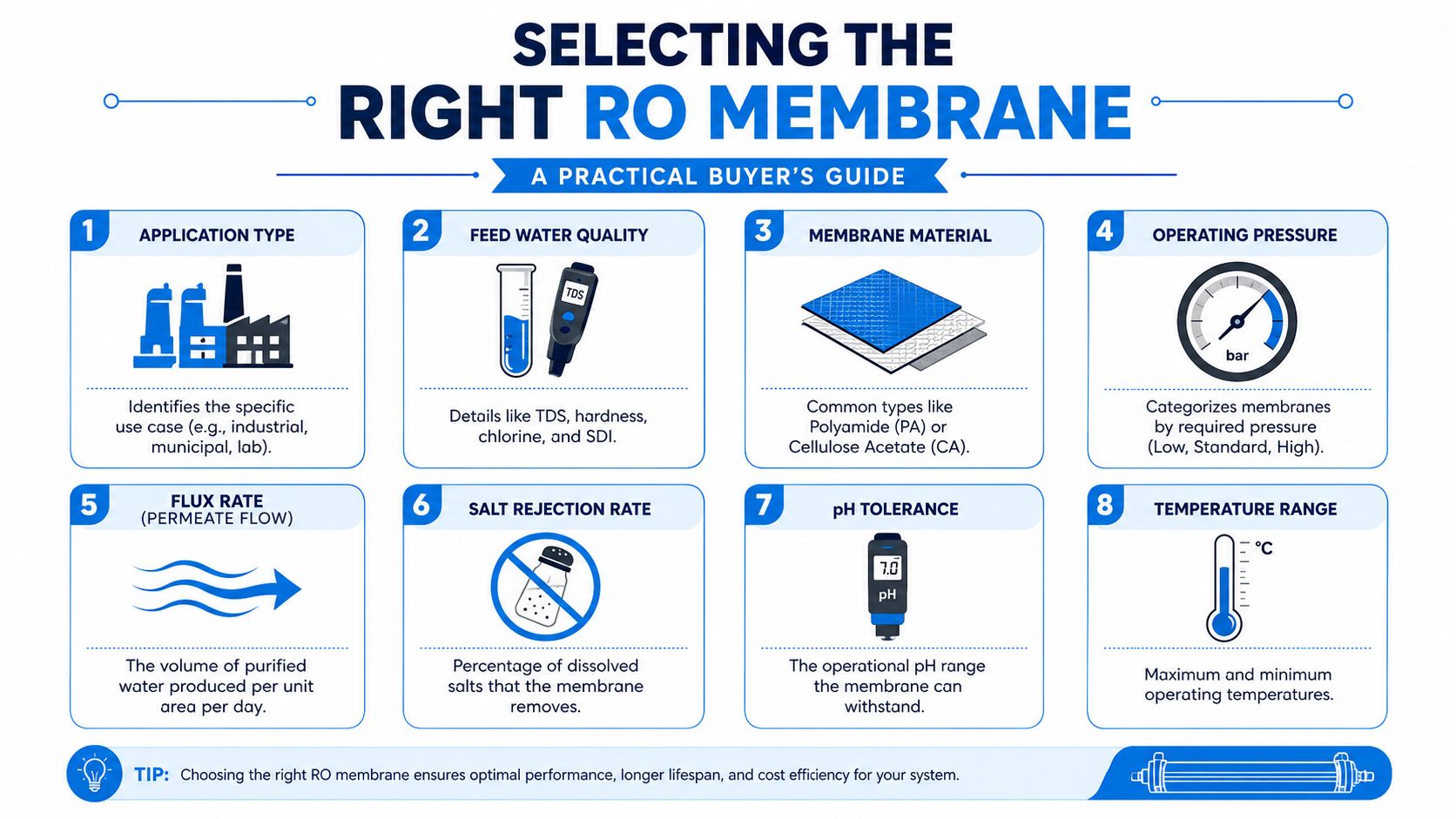
Buyers often start with element size, brand familiarity, or a replacement part number from the last project. That's backward. The right industrial reverse osmosis system membrane starts with water analysis, system duty, and the operating window you expect the skid to survive.
Start with the water, not the element part number
Brackish water service and seawater service are not interchangeable. Neither are nanofiltration duties where partial rejection may be desirable. If the feedwater has moderate salinity, a brackish element may deliver the required permeate quality at lower pressure. If salinity is far higher, seawater construction and pressure tolerance become mandatory.
The operational distinction is clear. Seawater membranes are built for much harsher osmotic conditions, while brackish membranes are optimized for lower-pressure service. Buyers who ignore that difference usually end up with either an underperforming skid or a system that uses more pressure than the application requires.
When comparing specific product families from industrial brands such as LG or Veolia, ask vendors to show the actual basis of selection. If they can't explain feed chemistry, target recovery, expected permeate conductivity, and fouling risk in the same conversation, they're selling a catalog item, not engineering support.
For buyers reviewing FilmTec-compatible options, this overview of BW30-400 industrial equivalent membrane specifications and benefits is the kind of product-level reference that helps connect element selection to application fit.
What separates a good membrane buy from a bad one
Membrane selection should balance immediate performance against long-term stability. A membrane that tests well on day one but loses rejection stability over time usually costs more than a premium option that holds performance.
One metric matters a lot here. Premium industrial membranes retain 98% to 99% of their initial salt rejection capacity after 5 years of operation, while lower-quality alternatives can drop to 85% to 90% over the same period, according to Rotec's discussion of industrial RO membrane performance metrics.
That's not a lab curiosity. It affects all of the following:
- Permeate consistency: Higher rejection stability means less drift in finished water quality over the life of the element.
- Operating cost: Stable rejection can reduce the pressure to over-correct with additional treatment downstream.
- Replacement planning: Buyers can make cleaner lifecycle decisions when performance declines gradually instead of collapsing unpredictably.
A useful buying framework looks like this:
| Selection factor | What to ask | Bad buying habit |
|---|---|---|
| Feedwater class | Is this brackish, seawater, reuse, or specialty process water? | Reordering the previous element without rechecking water |
| Pressure envelope | Can the system hold the pressure this membrane requires? | Assuming the pump can cover any membrane upgrade |
| Rejection stability | How well does performance hold over years, not weeks? | Comparing only initial spec sheet rejection |
| Fouling tolerance | What upstream protection does this element expect? | Treating pre-treatment as separate from membrane choice |
Buy the membrane for the water you have on your worst operating day, not the sample you took on your best one.
The Critical Importance of System Pre-Treatment
Most premature membrane failures don't start at the membrane. They start upstream. Feedwater variability, solids breakthrough, oxidant exposure, and unstable pretreatment conditions load the system until operators see the symptom at the RO skid and blame the element.
Why industrial systems fail early
Consumer guidance often says membranes last 1 to 5 years. That's not wrong in a residential context, but it hides the industrial reality. The more useful lesson is that industrial feedwater volatility can shorten membrane life to less than 6 months when SDI exceeds 3 and pre-treatment isn't robust enough. The same source notes that 5-micron cartridge filters after pre-treatment are essential to prevent this failure mode, as summarized by EPA WaterSense information on point-of-use reverse osmosis systems.
In plants, I see the same pattern repeatedly. Someone installs a good membrane and assumes routine annual filter service is enough. Then a multimedia filter underperforms, a carbon bed sheds fines, a softener leaks hardness, or raw water turbidity swings harder than expected. The membrane gets the blame, but the actual cause was that the skid never received stable feed.
Field reality: If pre-treatment lets particles, oxidants, or scale formers reach the element, the membrane becomes your most expensive sacrificial filter.
What a protective pre-treatment train looks like
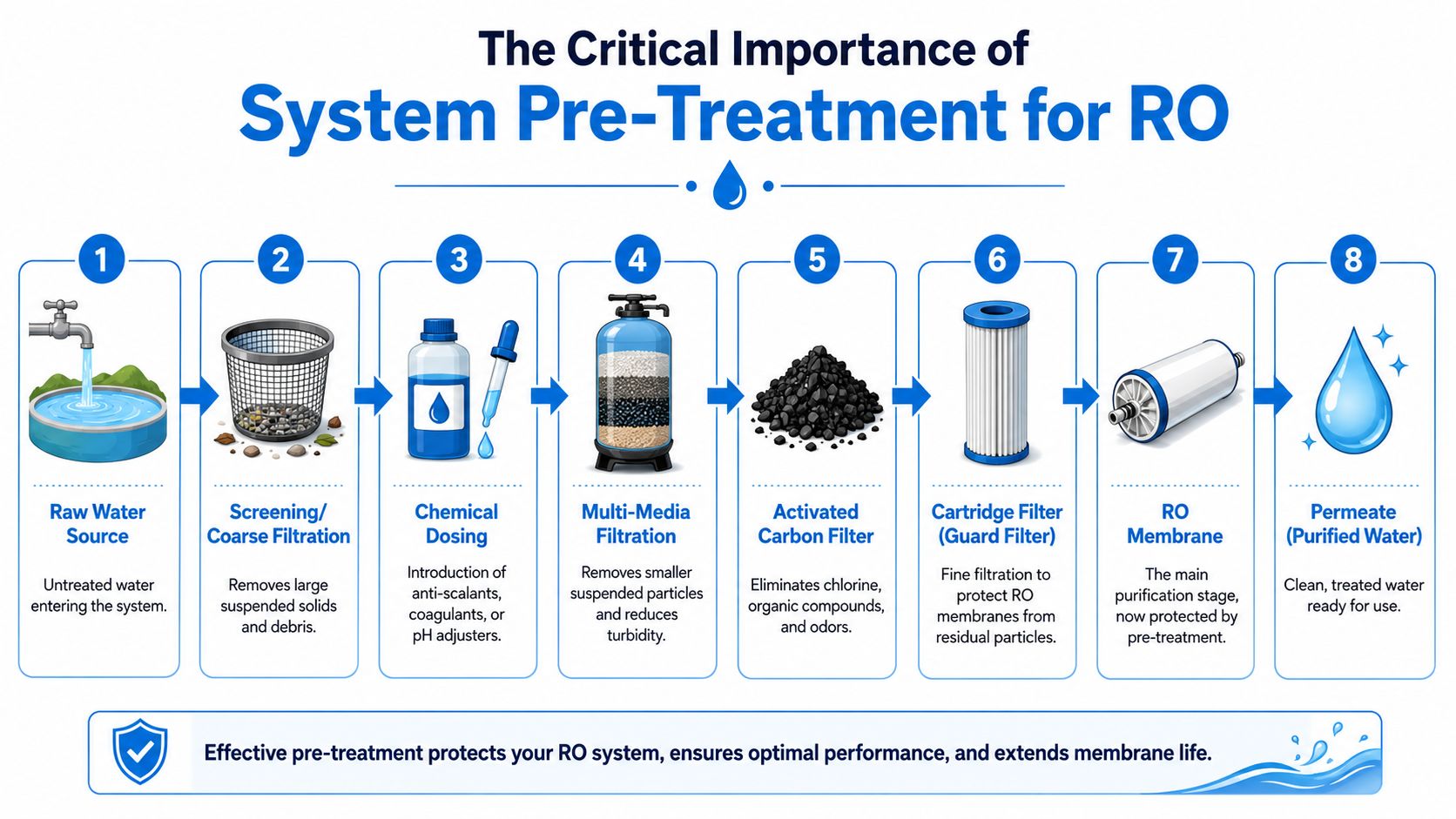
A strong pre-treatment train is designed around the feedwater problem, not around a generic skid template. In industrial systems, that usually means combining several barriers so one upset doesn't immediately foul the membrane.
Common components include:
- Screening or coarse filtration: Removes larger suspended matter before it loads finer equipment.
- Chemical dosing: Supports scale control, coagulation, or pH adjustment where needed.
- Multimedia filtration: Reduces turbidity and protects downstream polishing stages.
- Activated carbon: Used where chlorine or organics threaten polyamide membranes.
- Guard filtration: A final cartridge stage catches carryover before water enters the pressure vessels.
For teams evaluating upstream protection hardware, this guide to industrial water softeners and media filtration systems is a useful reference point because it ties equipment choice to membrane protection rather than treating softening and media filtration as separate purchases.
A practical pre-treatment review should answer these questions:
- Is suspended solids removal stable, not just adequate on a clean startup?
- Can the system absorb feedwater swings without immediate SDI spikes?
- Is there a final guard filtration stage before the RO?
- Are chlorine, hardness, and colloidal fouling risks addressed before the membrane sees them?
Plants that answer yes to all four usually get longer membrane life, more predictable cleaning intervals, and fewer emergency changeouts. Plants that don't often end up replacing membranes for conditions no membrane should have been asked to tolerate.
RO System Operation and Troubleshooting
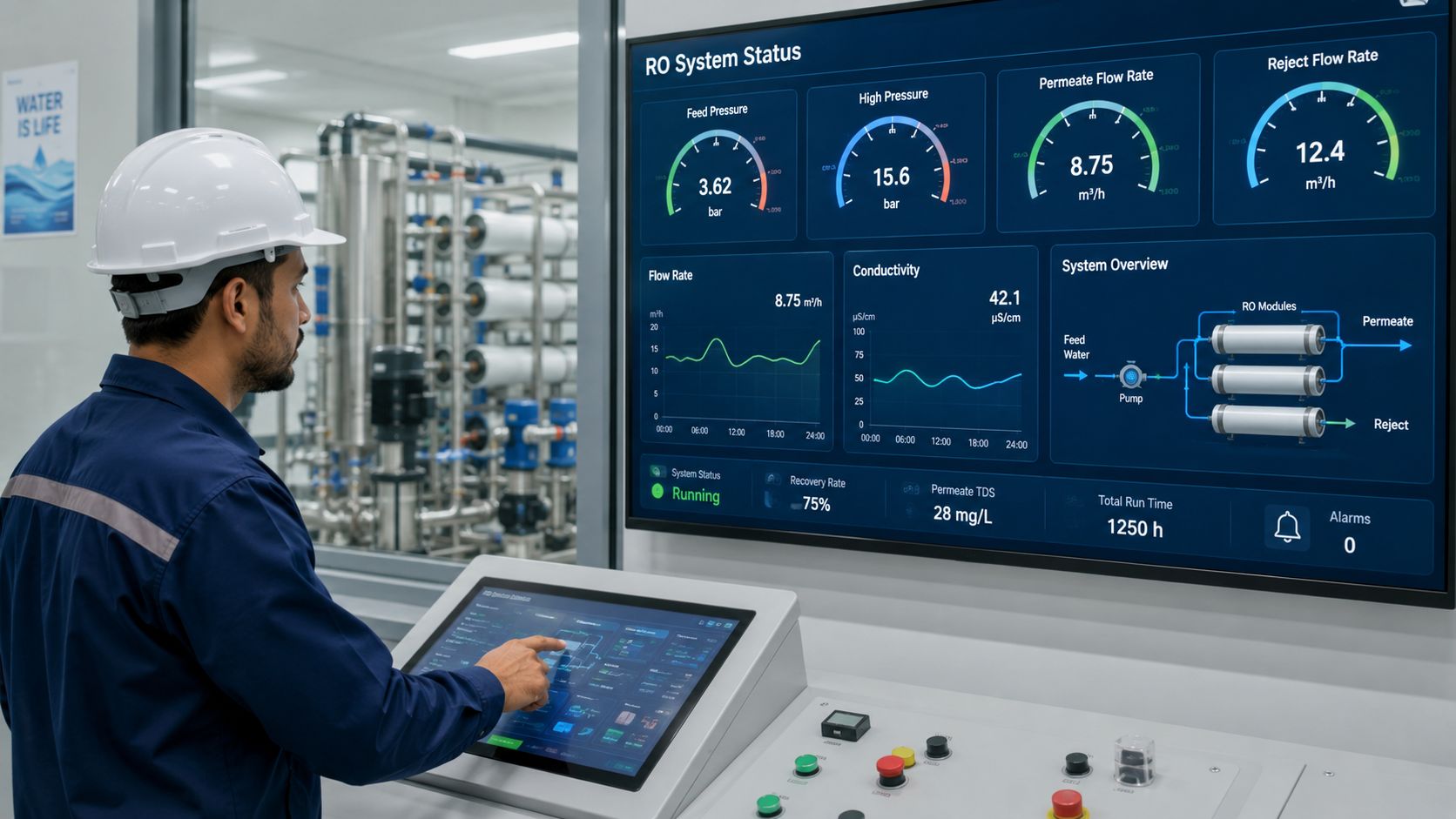
A good design can still perform badly if operators don't track the right signals. In industrial RO, stable operation comes from trending a small set of numbers consistently, not from reacting only after water quality goes out of spec.
What operators should watch every shift
For industrial wastewater RO plants, a standard operating flux is typically selected between 17 to 20 lmh, with system recoveries maintained in the 75% to 85% range, according to this wastewater RO operational performance paper. Those values don't apply universally to every industrial feed, but they're a good reminder that flux and recovery must stay inside a controlled design envelope.
The most useful operating indicators are usually:
- Permeate conductivity: Rising conductivity often signals higher salt passage, membrane damage, or a sealing issue.
- Differential pressure across stages: An increase often points to fouling, solids loading, or scaling.
- Normalized permeate flow: Falling output at similar conditions usually means the membrane surface is becoming less effective.
- Concentrate and feed trends: These show whether the skid is drifting toward overly aggressive recovery.
Operators don't need a complicated dashboard. They need disciplined trend review. A single bad reading can be noise. A directional move across several shifts usually means the membrane or pre-treatment is changing.
A practical troubleshooting sequence
When a system starts underperforming, don't jump straight to membrane replacement. Work the problem in order.
If permeate flow drops:
- Check whether pre-filters or guard filters are loaded.
- Review differential pressure across the RO stages.
- Look for signs of scaling or fouling in recent trend data.
- Confirm the feed pump is still delivering stable pressure.
If salt passage increases:
- Inspect for damaged elements, brine seal issues, or O-ring problems.
- Confirm the membranes installed match the intended duty.
- Check whether recent chemical exposure could have damaged the active layer.
If cleanings are becoming more frequent:
- Audit upstream pre-treatment first.
- Review whether recovery has been pushed too hard.
- Check for unrecognized raw water variability entering the skid.
| Symptom | Likely cause | First place to look |
|---|---|---|
| Lower permeate flow | Fouling, scaling, loaded pre-filters | Differential pressure and pre-treatment |
| Higher permeate conductivity | Membrane damage, seal failure, mismatch | Element condition and vessel sealing |
| Rising cleaning frequency | Unstable feedwater, recovery too aggressive | Pre-treatment performance and operating setpoints |
A membrane rarely “fails without warning.” Plants usually miss the warning because no one is trending normalized performance against feed conditions.
Membrane Cleaning CIP Protocols and Best Practices
CIP restores performance when fouling or scale has reduced membrane effectiveness, but it isn't a cure for poor design or weak pre-treatment. If the same foulant keeps returning, repeated cleanings only treat the symptom. The useful mindset is simple. Clean to recover performance, then fix the reason the membrane loaded in the first place.
When a CIP makes sense
A cleaning should be triggered by performance decline, not by habit alone. Operators usually have enough information from pressure, flow, and permeate quality trends to tell whether the membrane surface is carrying foulant or mineral scale.
The cleaning chemistry should match the foulant:
- High-pH cleaners are typically used when organics or biological fouling are the likely problem.
- Low-pH cleaners are used when mineral scale is the more probable cause.
- Mixed foulants often require sequential cleaning, because one chemistry won't remove everything well.
If teams clean with the wrong chemistry, the system may come back only partially, and operators may wrongly conclude the membrane is worn out. In many plants, that leads to premature replacement of otherwise recoverable elements.
How to run a sensible cleaning sequence
A practical CIP sequence usually follows a disciplined order.
- Flush first. Remove loose solids and residual concentrate before introducing cleaning chemistry.
- Prepare the right solution. Match pH and cleaner type to the known or suspected foulant.
- Recirculate at controlled conditions. The goal is contact and foulant release, not harsh hydraulic abuse.
- Allow soak time when needed. Some deposits need dwell time to break loose.
- Rinse thoroughly. Any residual chemistry left in the system can create new problems on restart.
- Restart and trend recovery. Watch normalized flow, differential pressure, and permeate conductivity rather than relying on a quick visual judgment.
A few practices consistently work better than aggressive shortcuts:
- Clean early enough: A lightly fouled membrane is easier to recover than one that has been left to harden under prolonged operation.
- Document every CIP: Record the symptom, chemistry used, and performance before and after. Patterns show up fast.
- Protect the membrane surface: Stronger chemistry and hotter solutions aren't automatically better. Compatibility matters.
The best CIP program is boring. It uses repeatable chemistry, clean records, and quick root-cause follow-up after every event.
When a membrane doesn't respond well to cleaning, the next question shouldn't be “which replacement do we buy?” It should be “what loaded this element, and has that upstream condition been corrected?”
Sourcing Membranes and Partnering for Success
A membrane purchase goes well when engineering, operations, and procurement stay aligned. The buyer needs more than a brand and a part number. They need a membrane matched to feedwater, pressure envelope, recovery target, and pre-treatment reality.
That's why a procurement checklist is more useful than a simple quote comparison. Before placing an order, confirm these points:
- Application fit: Is the membrane selected for the actual feedwater class and duty?
- Hydraulic compatibility: Can the existing skid support the pressure and flow the element expects?
- Pre-treatment readiness: Is the upstream train good enough to protect the new elements from immediate fouling?
- Lifecycle value: Will rejection stability and cleanability support the plant's maintenance strategy?
- Supply support: Can the vendor help with replacement equivalency, startup review, and troubleshooting if performance drifts?
Buyers sourcing Veolia product lines can use a product-focused reference such as this guide to Veolia reverse osmosis membranes for industrial filtration to compare membrane families against duty requirements before final selection.
The primary goal isn't just to buy a reverse osmosis system membrane. It's to secure a membrane package that holds performance in the field, works with the pretreatment you have, and fits the maintenance discipline your plant can sustain. Plants that treat membranes as engineered assets usually run longer between interventions. Plants that treat them as generic commodities usually spend more time reacting.
If you're evaluating industrial RO membranes, pre-treatment equipment, or a full high-purity water package, Purecowater can help you source the right components for the application. Their team supports industrial filtration, RO, and EDI projects with application guidance, OEM sourcing, and coordinated supply across established manufacturers.