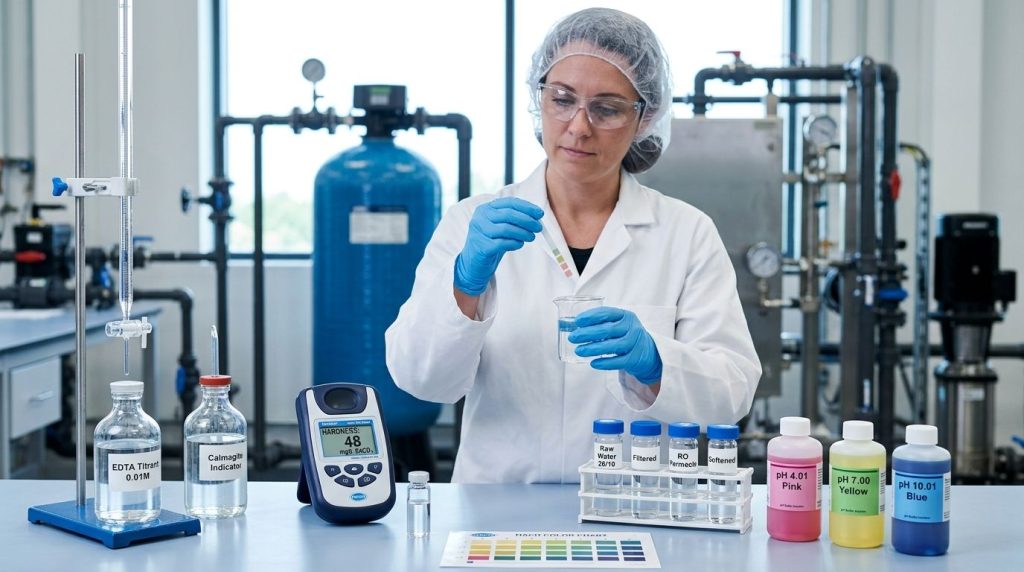
You usually notice the problem after the downstream equipment starts complaining. RO differential pressure creeps up. CIP frequency gets tighter. Product water consistency drifts. Someone blames the membrane, someone else blames the chemistry, and only then does the team ask the basic question: what is the actual hardness of the feedwater right now?
That sequence is expensive because a hard water test isn't just a lab checkbox. In industrial service, it's the first decision point for choosing softening, cartridge filtration, chemical dosing, membrane selection, and the limits of what an EDI system can tolerate. A rough hardness guess may be acceptable in a house. It isn't acceptable when you're protecting industrial RO skids, EDI modules, heat exchangers, and boilers.
Table of Contents
- Why Accurate Hardness Testing Is Critical for Industrial Operations
- Choosing the Right On-Site Hardness Test Method
- When to Use Advanced Laboratory Analysis
- Translating Test Results into Equipment Decisions
- Ensuring Accurate and Reliable Test Results
- Protecting Your Assets with Proactive Water Management
Why Accurate Hardness Testing Is Critical for Industrial Operations
A plant can run for weeks with a hidden hardness problem before the damage becomes obvious. Scale doesn't need a dramatic failure to hurt you. It only needs enough calcium and magnesium in the wrong place, over enough runtime, to lower heat transfer, foul pretreatment, and force RO elements to operate under conditions they weren't designed to tolerate.
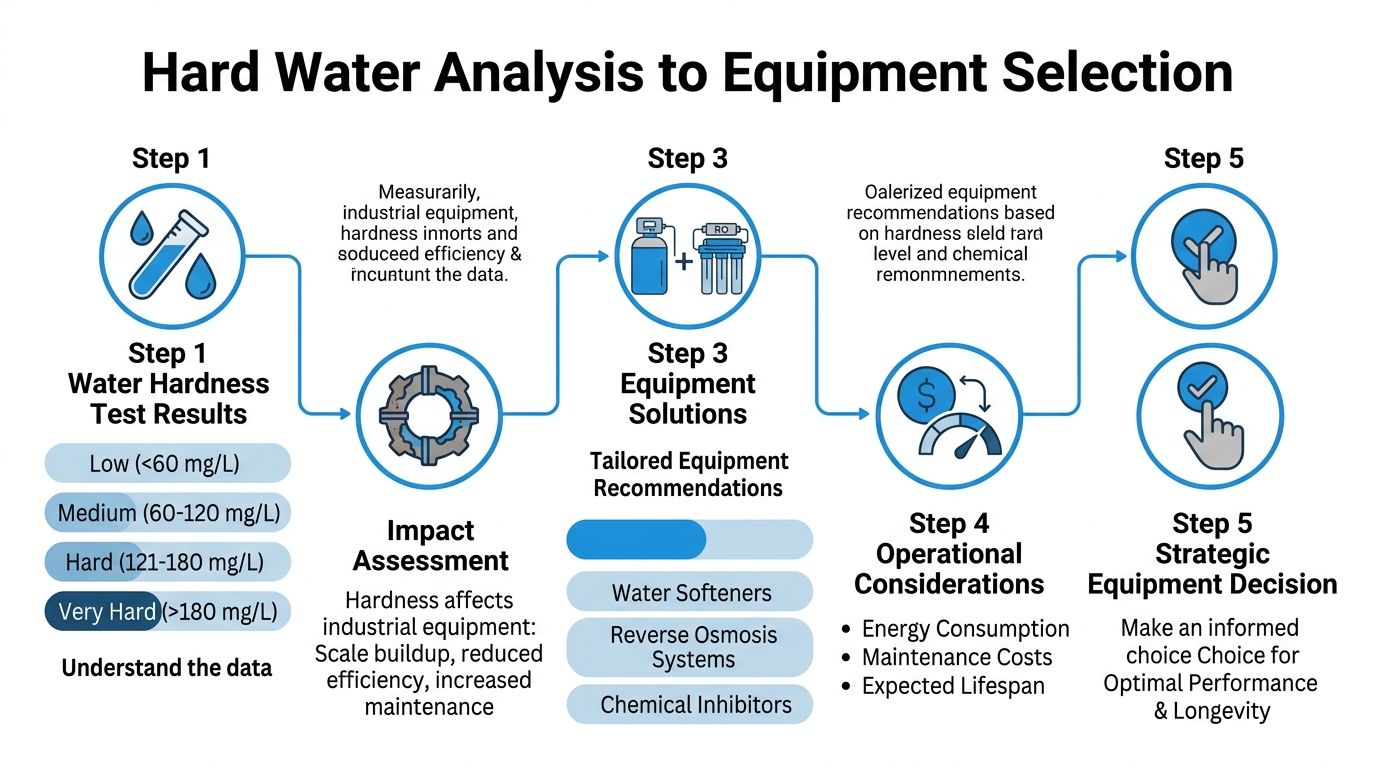
The classification matters because it gives engineers a shared threshold for action. According to U.S. Geological Survey hardness guidance, water at 121 to 180 mg/L is classified as hard, and water above 180 mg/L is very hard. That isn't an academic label. The same reference notes that hard water can reduce reverse osmosis membrane recovery rates by up to 15 to 20% in industrial settings.
If you're running cooling systems, boiler makeup, or RO pretreatment, a hardness result changes what equipment belongs upstream. It also changes what maintenance rhythm you're signing up for. Teams working on industrial cooling tower treatment programs already know that feedwater chemistry drives scaling risk long before visible deposits show up on equipment surfaces.
Hardness is an asset protection metric
A good hard water test tells you whether the problem is minor enough for routine control or serious enough to justify a dedicated pretreatment barrier. That difference affects:
- RO uptime: Hardness scale reduces recovery, increases cleaning pressure on operators, and shortens the gap between maintenance events.
- EDI reliability: EDI modules prefer stable, well-controlled inlet chemistry. Hardness slipping through pretreatment often creates downstream headaches that look electrical but start as water chemistry.
- Pretreatment design: The right answer may be softening, multimedia filtration plus dosing, or a more robust train that addresses multiple foulants.
Practical rule: If the hardness result isn't quantitative, you can't use it to size pretreatment responsibly.
Why this matters commercially
Industrial water equipment is purchased in response to risk. Buyers don't order a softener, RO skid, or membrane set because "hard water is bad" in the abstract. They buy because a test result defines the risk in engineering terms. Once hardness crosses the line from nuisance to scaling threat, the conversation moves from maintenance preference to capital protection.
That's why the test comes first. Not the membrane quote. Not the cleaning plan. Not the blame meeting after performance drops.
Choosing the Right On-Site Hardness Test Method
Field testing has one job: give operations a number they can trust enough to act on. In industrial practice, the method you choose should match the decision you're making. A quick screening method is useful for routine trending. It isn't enough when you're setting softener regeneration logic, checking pretreatment effectiveness, or deciding whether RO feed is safe.
The benchmark method remains EDTA titration. According to ETI's water hardness testing guidance, the titration-based EDTA method is the industry-standard protocol, operators should verify hardness daily using a digital titrator, maintain pH between 7.6 and 8.0, and avoid common errors such as skipping a 30-second pre-tap flush or using expired reagents.
What each field method does well
EDTA titration kits are the method to use when hardness data will drive an equipment or control decision. They take more operator attention, but they give a defensible result. In plants with softeners upstream of RO, this is the method that tells you whether the unit is protecting the membrane train.
Colorimetric test strips are useful for quick checks. They are fast, simple, and easy to hand to operations staff across shifts. Their weakness is obvious to anyone who has used them in a wet, fast-moving plant environment: the reading depends on color interpretation, timing, and strip condition. Use them for routine surveillance, not for final design calls.
Handheld digital meters can be convenient in the field, especially when teams want fast repeat readings. The limitation is that a digital readout can create false confidence. If the meter isn't appropriate for the analyte range or isn't maintained correctly, the display looks precise even when the number isn't.
A number on a screen isn't automatically better than a titration endpoint. In industrial water work, method discipline matters more than convenience.
Comparison of on-site hard water test methods
| Test Method | Accuracy & Precision | Cost Per Test | Best Industrial Use Case |
|---|---|---|---|
| EDTA titration kit | Highest practical field precision when procedure, pH control, and reagents are managed correctly | Moderate | Softener verification, RO pretreatment checks, commissioning, troubleshooting scale risk |
| Colorimetric test strips | Fast but lower precision, dependent on color match and handling | Low | Shift checks, preliminary screening, trend spotting |
| Handheld digital hardness meter | Convenient and repeatable when properly maintained, but method limitations still apply | Higher instrument cost | Routine plant monitoring where staff need quick readings and can support calibration and maintenance |
Why the soap test fails in industrial work
The soap or bubble test belongs in casual household screening, not in industrial specification. It can suggest that hardness is present, but it doesn't quantify hardness in the way a plant engineer needs. It won't tell you whether the feed is near a manageable threshold or deep into a zone that requires aggressive pretreatment.
That gap matters because equipment decisions are numerical. Softeners are selected based on water chemistry and duty. RO pretreatment is chosen based on scaling risk, membrane sensitivity, and operating objectives. A "not many bubbles" observation doesn't support any of that.
Three practical failures show up again and again:
- No quantitative output: You don't get a reliable ppm result for equipment selection.
- No repeatability across operators: One technician's interpretation won't match another's.
- No value for troubleshooting: When RO performance changes, you need hard data you can compare over time.
If the test result will affect regeneration settings, antiscalant strategy, membrane warranty discussions, or pretreatment purchasing, skip the improvised methods and use a field method that produces a defensible number.
When to Use Advanced Laboratory Analysis
Field tests are enough for daily control when the only question is total hardness and the system is stable. They stop being enough when you need to know what is in the water beyond a combined hardness result.
What field testing leaves out
A standard hard water test often reports total hardness as calcium plus magnesium, but that can hide other foulants that matter more to membrane life than the headline hardness number. As noted by Grand Water & Sewer guidance on water hardness, a hard water test may miss iron, manganese, or silica, and iron above 0.3 ppm can aggressively foul RO membranes.
That is where laboratory analysis earns its cost. If you are specifying an RO system for variable industrial feedwater, a total hardness result alone may lead you toward the wrong pretreatment train. Iron fouling doesn't behave like simple calcium hardness. Silica doesn't behave like magnesium. A softener may address one risk and leave another untouched.
When a lab report changes the equipment decision
Escalate to advanced lab analysis when any of these conditions are present:
- Unexplained membrane fouling: If the RO train keeps fouling despite acceptable field hardness readings, the missing contaminant may not be calcium or magnesium.
- Variable source water: Municipal blends, wells, and mixed process sources can shift chemistry enough that spot field testing becomes incomplete.
- EDI downstream: EDI systems are less forgiving of pretreatment errors. A broad ion profile is worth having before final design.
- Pretreatment under review: If you're choosing between softening, iron removal, multimedia filtration, cartridge protection, or a combined train, species-level data improves the decision.
- High-value membrane procurement: Before selecting elements such as industrial Veolia RO membranes for process filtration, it makes sense to confirm whether the fouling threat is simple hardness or a broader contaminant mix.
Total hardness answers one question well. Lab analysis answers the question buyers actually care about, which is what pretreatment the membrane system needs to survive.
In practice, use field testing to operate the plant. Use laboratory analysis to settle design disputes, diagnose recurring failures, and avoid buying the wrong pretreatment package.
Translating Test Results into Equipment Decisions
A hardness number has no value until it changes a purchase decision. Plants don't buy testing for the sake of testing. They buy it because feedwater chemistry determines whether a cartridge train is enough, whether an industrial softener is mandatory, and whether the RO membrane should be a standard element or a low-fouling, high-rejection model.
What a hardness number means for pretreatment
Start with the operating question, not the chemistry in isolation. Are you feeding a utility RO? A high-purity RO followed by EDI? A cooling water side loop? The same hardness result has different implications depending on the asset at risk.
Where hardness is low and stable, plants often rely on a simpler pretreatment approach. That may mean suspended solids removal, cartridge polishing, and chemical support where appropriate. The key condition is stability. If the source fluctuates or downstream equipment is sensitive, a marginally acceptable number can still justify stronger pretreatment.
Once the water enters the hard and very hard categories used in industry, softening moves from optional to serious consideration. For procurement teams evaluating industrial Culligan water softener specifications and benefits, the point isn't brand preference alone. The point is that hardness data tells you whether ion exchange belongs ahead of RO at all.
Where membrane selection changes
Not all RO elements should be treated as interchangeable. According to Axeon membrane selection guidance, industrial-grade low-fouling RO membranes are rated for 99.75% nominal salt rejection and operate at 225 psi, while residential membranes typically achieve 97 to 98% rejection at 50 to 70 psi.
That difference matters when the feed is fouling-prone. If hardness testing shows a challenging water profile, the right response isn't to hope a lighter-duty element will cope. It usually means combining pretreatment with a membrane built for industrial pressure and fouling risk.
Use the hardness result as a trigger for these buying decisions:
- Simple pretreatment train: Appropriate when hardness is controlled, source variability is limited, and the downstream duty is less sensitive.
- Industrial softener ahead of RO: Appropriate when hardness levels point to persistent scale risk that will otherwise reach the membrane.
- Low-fouling industrial RO membranes: Appropriate when the plant cannot tolerate frequent cleanings or unstable recovery.
- RO plus EDI configuration with tighter pretreatment discipline: Appropriate where high-purity product water is the end goal and feedwater excursions aren't acceptable.
Operational cost consequences of the wrong choice
The most expensive option is usually the underbuilt one. Plants that skip effective pretreatment often pay later through shorter membrane runs, unstable product quality, more operator intervention, and avoidable cleanings. Plants that overtreat stable water can overspend on capital and unnecessary complexity.
That's why a hard water test should lead to a buying decision, not just a water quality report. A quantitative result lets engineering decide whether the issue is manageable with softening and standard pretreatment or whether the project requires a broader industrial train with fouling-resistant membranes and tighter controls.
Buy pretreatment based on the failure mode you're preventing. Hardness scale, iron fouling, suspended solids loading, and high-purity water targets do not call for the same equipment package.
Ensuring Accurate and Reliable Test Results
Bad sampling ruins good testing. Plants often blame the method when the problem itself started at the sample point, in the bottle, or in the delay between collection and analysis.
Build a defensible sampling routine
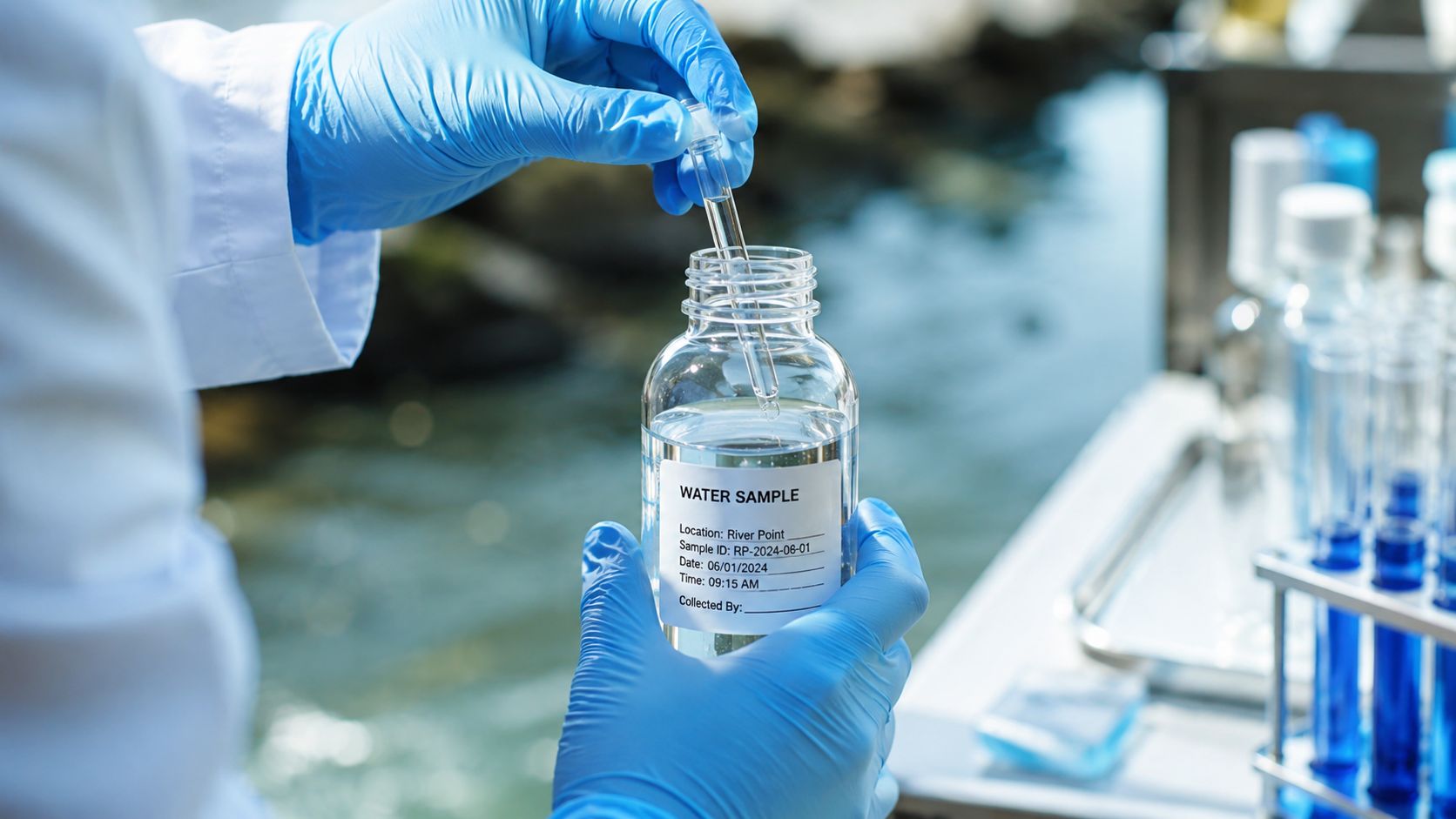
A reliable hard water test starts with consistency. If one operator samples upstream of pretreatment, another samples after a partially mixed tank, and a third pulls from a stagnant point, the trend line becomes useless.
Use a routine that operators can repeat without interpretation drift:
- Choose a representative point: Sample where the water encountered by the protected equipment can be measured.
- Flush before collecting: Remove stagnant water so the sample reflects current conditions.
- Use clean containers: Contaminated bottles create false readings and false troubleshooting paths.
- Test quickly: Delays between collection and testing reduce confidence in the result.
- Document the location and time: A number without context has limited diagnostic value.
Use normalized performance to trigger action
Testing shouldn't sit in a notebook as isolated numbers. It should connect to operating baselines, especially on RO systems. According to Puretec guidance on reverse osmosis basics, industrial RO normalization protocols require investigation and cleaning when normalized performance deviates by ±15% from baseline data.
That threshold matters because it prevents two common mistakes. The first is waiting too long and allowing fouling to become more difficult to reverse. The second is cleaning too early or too often without evidence that normalized performance justifies it.
A sound monitoring routine usually includes:
- A baseline set after stable startup
- Regular hardness checks at the same sampling points
- Trend review against RO performance
- A clear action trigger tied to normalized data
- A record of what changed before and after intervention
Good testing programs don't just produce numbers. They produce repeatable decisions.
If the plant can't trust the sample, it can't trust the conclusion. And if it can't trust the conclusion, it will either delay action or buy the wrong fix.
Protecting Your Assets with Proactive Water Management
The practical value of a hard water test isn't in confirming that minerals exist. Everyone in industrial water already knows they do. The value is in connecting a specific result to the right operating response, before scale or fouling forces the issue.
That's one reason hardness testing keeps gaining attention across industrial treatment markets. The Data Bridge water hardness test strip market report states that the global market was valued at USD 68.90 billion in 2025 and is projected to reach USD 95.76 billion by 2033. The larger point is clear even without the market projection. Operators want faster, more usable water quality information because pretreatment decisions, membrane protection, and maintenance planning depend on it.
The right method depends on the job. EDTA titration remains the field standard when the number needs to support an engineering decision. Test strips have a place for quick trending. Laboratory analysis becomes necessary when total hardness no longer explains the system behavior. The most expensive mistake is treating all three as interchangeable.
Plants that manage water proactively protect more than membranes. They protect uptime, maintenance labor, chemical programs, and the credibility of the treatment strategy itself. When the data is solid, equipment selection gets easier. When the data is vague, everything downstream becomes a debate.
Purecowater helps industrial teams turn water analysis into the right pretreatment and high-purity system decisions. If you're evaluating softening, cartridge and multimedia pretreatment, RO skids, Veolia or LG membrane options, or E-Cell EDI modules, Purecowater can help you interpret your water chemistry and match it to an equipment package that protects uptime and reduces avoidable fouling.