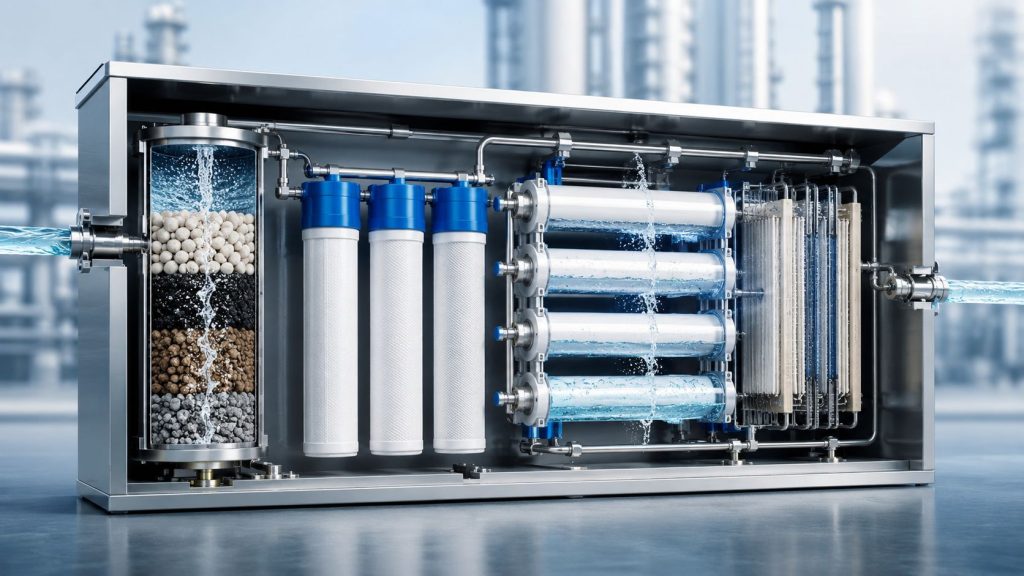
A plant usually starts this conversation after the same pattern repeats for a few weeks. Differential pressure climbs sooner than expected. CIP frequency increases. Finished water quality drifts enough that operators compensate by adjusting setpoints, throttling flow, or changing cleaning schedules just to keep production on spec.
At that point, water is no longer just a utility. It is a process input that affects throughput, asset life, product consistency, and maintenance hours. I have seen facilities focus on the purchase price of a skid, then spend far more on membrane replacements, chemical cleaning, labor, and lost production because the system did not match the actual feedwater or operating duty.
That is the mistake this guide is built to prevent.
Industrial water filtration systems should be selected on total cost of ownership first, then on capital cost. A lower-priced system can become the expensive option if it fouls early, runs with poor recovery, needs constant operator attention, or leaves downstream equipment exposed to scale and solids. A better specification usually costs less over the service life because it protects uptime and reduces avoidable maintenance.
The starting point is always the incoming water. A basic hard water test for feedwater screening helps identify whether hardness is likely to drive scaling, pretreatment changes, or a different membrane strategy before those costs show up in operation.
Market growth reflects how many industrial operators now treat water quality as an asset-protection decision, not just a utilities purchase, as noted earlier in the article. The practical question is not which technology sounds advanced on paper. It is which system will hold performance, stay maintainable, and deliver acceptable operating cost over years of real plant conditions.
Table of Contents
- The True Cost of Inconsistent Water Quality
- A Guide to Core Filtration Technologies
- The Critical Role of System Pre-Treatment
- Sizing and Specifying Your Filtration System
- Common Failure Modes and Mitigation Strategies
- Calculating ROI and Total Cost of Ownership
- Partnering for Optimal Filtration Performance
The True Cost of Inconsistent Water Quality
A line can run for weeks with water quality drifting just enough to avoid alarms, while costs keep stacking up in the background. Operators open bypasses more often. Filters blind off earlier than expected. CIP frequency increases. The plant still produces, but it does so with more labor, more chemical use, and less margin for error.
That pattern matters because water problems rarely stay inside the treatment room. Hardness drives scale on heat transfer surfaces and inside downstream equipment. Suspended solids raise differential pressure and shorten filter life. Variation in utility water shows up in washdown, rinsing, batching, and final product consistency. What looks like a small raw water issue at the inlet can turn into avoidable maintenance and process instability across the site.
I usually tell buyers to price the full chain of impact, not just the failed component. A fouled membrane is one line item. Lost recovery, extra cleanings, off-spec production risk, operator callouts, and unplanned downtime are the larger costs. That is where many filtration projects get evaluated too narrowly. The lowest purchase price can become the highest ownership cost if the system cannot hold stable performance under real plant conditions.
A practical starting point is confirming what the incoming water is doing over time, especially at sites where hardness or solids swing by season, source, or shift. Reviewing a hard water test resource is a useful first step before comparing housings, membranes, or packaged skids.
Practical rule: If a water issue reaches production before it reaches the treatment system, the filtration design is already behind the plant's needs.
Good filtration improves more than water quality. It improves repeatability. For most plants, that means fewer surprise interventions, more predictable maintenance planning, and a clearer path to controlling total cost of ownership over the life of the system.
A Guide to Core Filtration Technologies
A plant can buy the right skid and still get the wrong result if the technology match is off. I see this most often when buyers compare micron ratings, pump sizes, or membrane brands before they define the actual separation job. The practical sequence is to identify the contaminants, the required outlet quality, and the operating limits of the process. Then choose the treatment train that will hold that performance with acceptable maintenance cost over time.
For most industrial water filtration systems, three core technologies carry the load: depth filtration, reverse osmosis, and electrodeionization. Each solves a different problem. Each also brings different failure risks, operator demands, and ownership costs.
Depth filtration for suspended solids
Depth filtration handles suspended solids, turbidity, and particulate loading before those contaminants reach tighter downstream equipment. In practice, that usually means multimedia filters, AFM media beds, bag filters, or cartridge filters selected around actual solids loading and service intervals, not just line size.
The main trade-off is operating cost versus solids capacity. Media filters are usually the economical choice for bulk solids and high flow rates. They tolerate heavier loading and spread maintenance cost over a larger throughput. Cartridge filters give finer final polishing, but they turn into a recurring consumables expense if they are asked to do bulk removal work. That is why many industrial systems use both. Media first, cartridges second.
AFM® Grade 1 media is one option used in industrial beds where tighter particulate capture is needed ahead of RO or EDI. Supplier data for AFM Grade 1 industrial media describes nominal filtration to sub-5μm particles and stronger downstream membrane protection than standard sand in comparable service.
If the next stage is RO, membrane selection still matters. A detailed Veolia reverse osmosis membrane guide for industrial filtration is useful when you are comparing element compatibility, flux targets, and cleaning limits.
Reverse osmosis for dissolved contaminants
Reverse osmosis removes dissolved salts and a wide range of dissolved contaminants that depth filtration does not address. It is usually the point in the treatment train where water quality starts to affect both process capability and recovery economics in a serious way.
RO is often evaluated too narrowly on purchase price or headline rejection performance. In operation, the better question is how reliably the system can hold flux, recovery, and permeate quality under real feedwater variation. A cheaper RO package with weak controls, poor instrumentation, or aggressive design assumptions often costs more to run. The penalties show up as more frequent cleaning, lower membrane life, unstable output, and higher reject volume.
Current RO systems also support much better salt rejection and water recovery than older conventional treatment approaches, which is one reason they are widely used in process water, utility water, and reuse service. That performance only holds when the membrane is protected and the recovery target matches the scaling risk. I would rather specify a slightly more conservative recovery rate that runs for years than chase a theoretical maximum that drives constant intervention.
EDI for high-purity process water
EDI is a polishing step for plants that need high-purity water on a continuous basis after RO. It is common in applications where residual ionic contamination still creates production risk, including high-pressure boilers, electronics, and some food, beverage, and pharmaceutical utilities.
The business case for EDI usually depends on stability. When RO feed and permeate quality are consistent, EDI can reduce chemical handling and avoid the service pattern that comes with regenerated ion exchange beds. When the upstream RO is unstable, EDI becomes expensive fast. Stack performance drops, resistivity falls off, and troubleshooting turns into a recurring operating burden.
That is the design point many buyers miss. EDI is not a rescue step for weak upstream treatment. It is a polishing technology that rewards stable, low-conductivity feed.
| Technology | Primary Removal Target | Typical Application | Relative Cost (CapEx) | Relative Cost (OpEx) |
|---|---|---|---|---|
| Depth filtration | Suspended solids, turbidity, particulate matter | Pre-treatment ahead of RO, EDI, and process equipment | Low to moderate | Low to moderate |
| Reverse osmosis | Dissolved salts and ionic contaminants | Process water, utility water, wastewater recovery, reuse | Moderate to high | Moderate |
| Electrodeionization | Trace ions after RO | High-purity water for critical industrial processes | High | Low to moderate when feed is stable |
The right selection is rarely a single technology decision. It is a treatment-train decision based on contaminant profile, operating discipline, and total cost of ownership across the life of the system.
The Critical Role of System Pre-Treatment
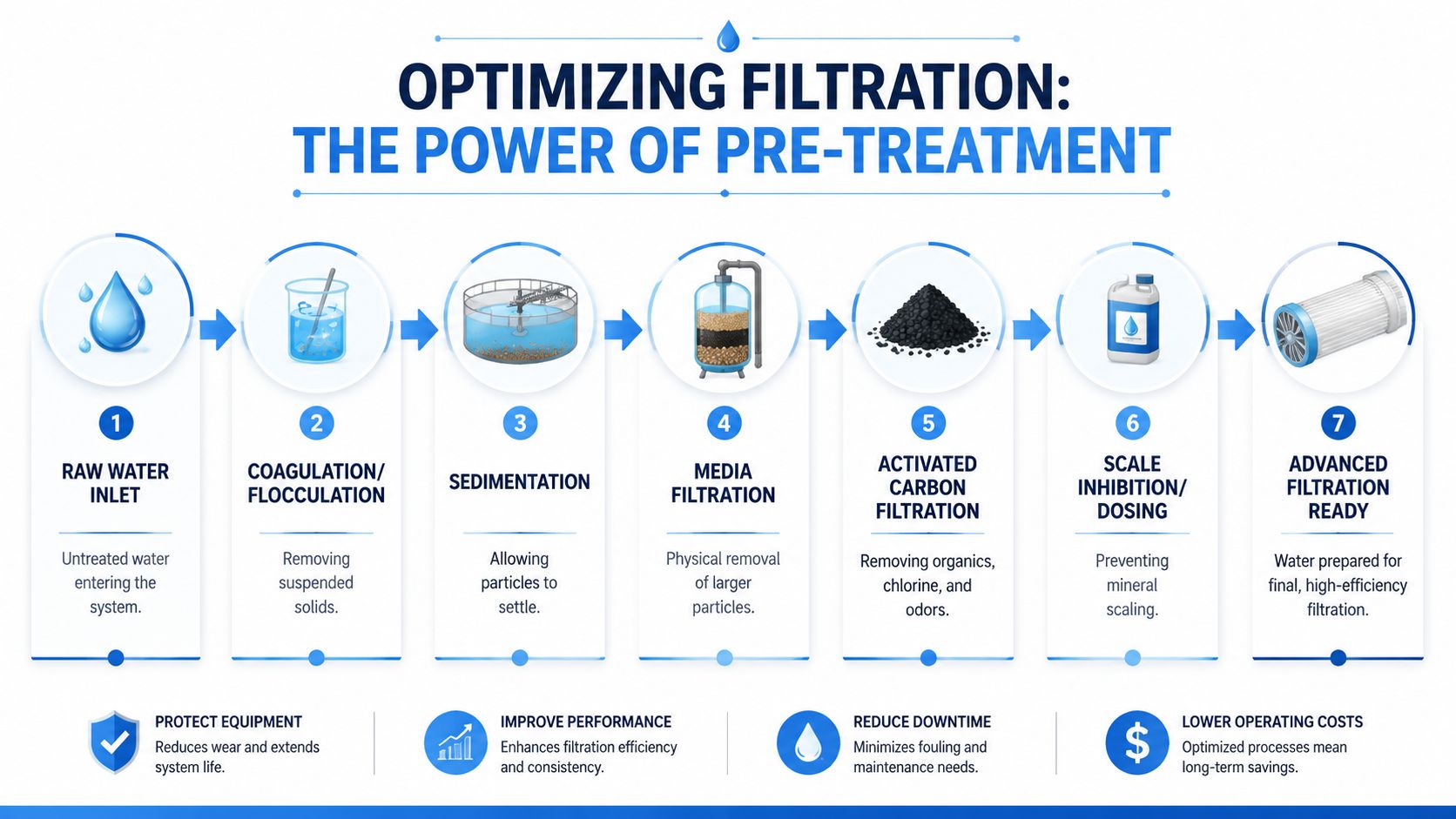
Pre-treatment gets undervalued because it doesn't usually produce the final water specification by itself. It protects the equipment that does. In industrial water filtration systems, that protection often determines whether the plant sees predictable output or recurring failure.
What poor pre-treatment does downstream
The main downstream victim is usually the RO membrane. Once particulate loading, hardness, oxidants, or biological growth get past the front end, the expensive part of the plant becomes the sacrificial part. Operators see flux decline, rising differential pressure, unstable recovery, and more frequent cleaning.
The numbers on suspended solids control are clear. In industrial RO systems, pre-treatment must achieve an SDI below 5.0 to prevent accelerated membrane fouling. Maintaining SDI below 3.0 can extend membrane life by 40–60% and stabilize recovery rates, according to the industrial RO technical specification covering SDI requirements.
That's why pre-treatment isn't an optional accessory line on a quote. It's membrane insurance. If you need the final polishing stage before RO, an industrial cartridge filter housing option for pre-treatment trains is often part of that barrier strategy.
Field note: Plants rarely regret adding robust pre-treatment. They often regret trying to save money by trimming it back.
What a practical pre-treatment train includes
A useful pre-treatment train is built around failure prevention, not around copying a generic P&ID. The sequence depends on feedwater, but the logic is consistent:
- Bulk solids removal first: Multimedia filters, AFM media, or clarifying steps reduce the particulate burden before fine filtration.
- Final solids interception: Cartridge filters catch remaining fines before they hit membrane elements.
- Hardness control where needed: Softening or scale inhibition protects recovery targets in hard-water applications.
- Chemical compatibility management: Activated carbon or dosing programs manage oxidants, organics, pH, and biological activity.
A weak front end creates expensive back-end problems. A strong front end makes the rest of the system easier to run, easier to clean, and easier to trust.
Sizing and Specifying Your Filtration System
A system can pass startup, hit the quoted flow for a few days, and still be the wrong purchase. The warning signs usually show up after production is relying on it. Cartridge changeout comes too often, pressure loss builds faster than expected, operators start bypassing steps, and water quality drifts during peak demand. That is a sizing problem, but it is also a business problem because the actual cost shows up in labor, downtime, chemical use, and premature component replacement.

Start with the feedwater, not the equipment
Good system sizing starts with variability. A lab report from one sampling date is useful, but it is not a design basis if the source swings by season, shift, well blend, or process discharge. The right question is not only, "What is in the water?" It is also, "How bad does it get, how often, and what happens to production when it does?"
That changes equipment selection fast. A plant with stable municipal feed can often run a tighter design window than a facility pulling from surface water or mixed sources. If the raw water moves around, the filtration train needs operating margin in flow, solids loading, backwash capacity, and control logic. Paying for that margin up front often lowers total cost of ownership because it reduces upset events and operator intervention later.
For depth filtration hardware, basic vessel geometry still matters. Standard industrial filter vessels need enough media bed depth to deliver contact time and solids capture, and they need enough freeboard to allow proper bed expansion during backwash. A 24-inch diameter vessel with a 1-meter sand bed typically requires several hundred kilograms of media, as outlined in industrial filter media quantity and vessel sizing guidance.
Mechanical rating deserves the same level of attention. Vessel sizing should account for startup transients, pump cycling, fouling-related pressure rise, and imperfect field operation, not just clean-water duty. Clean-bed differential pressure should be documented at commissioning so the site has a real baseline for troubleshooting later, according to depth filtration hardware alignment guidance.
The specification checklist buyers should bring to a vendor
A useful RFQ gives the vendor the boundaries that control performance and operating cost. Flow rate matters, but it is only one line on the page.
Use this checklist:
Feedwater profile
Define the source, expected variability, suspended solids loading, hardness, organics, oxidants, temperature range, and any known seasonal shifts.Required product water quality
Specify the water quality the process requires, not a generic “as pure as possible” target. Over-specifying drives up capital and operating cost without improving production.Flow and operating pattern
Provide normal flow, peak flow, turndown, batch versus continuous operation, and whether demand changes by shift or CIP cycle.Recovery target and reject handling
Set a realistic recovery target based on feed quality, scaling risk, cleaning strategy, and local discharge constraints. Higher recovery can reduce water waste, but it can also increase fouling pressure and chemical demand if the front end is not sized for it.Maintenance constraints
State what the site can support. Staffing level, spare parts practice, cleaning windows, instrumentation discipline, and operator skill all affect which design will hold performance in the field.
I tell clients to treat this checklist as a cost-control tool, not paperwork. If the operating envelope is vague, the quote usually looks competitive at purchase and expensive in service.
Clear inputs let vendors size pumps, vessels, cartridge stages, membrane arrays, controls, and cleaning provisions around the plant's real duty. That is how you get a system that performs on the production floor and not just on a datasheet.
Common Failure Modes and Mitigation Strategies
Most industrial water filtration failures are predictable. The equipment usually gives warning signs early. The bigger issue is that plants often interpret those signs too late or treat the symptom instead of the cause.
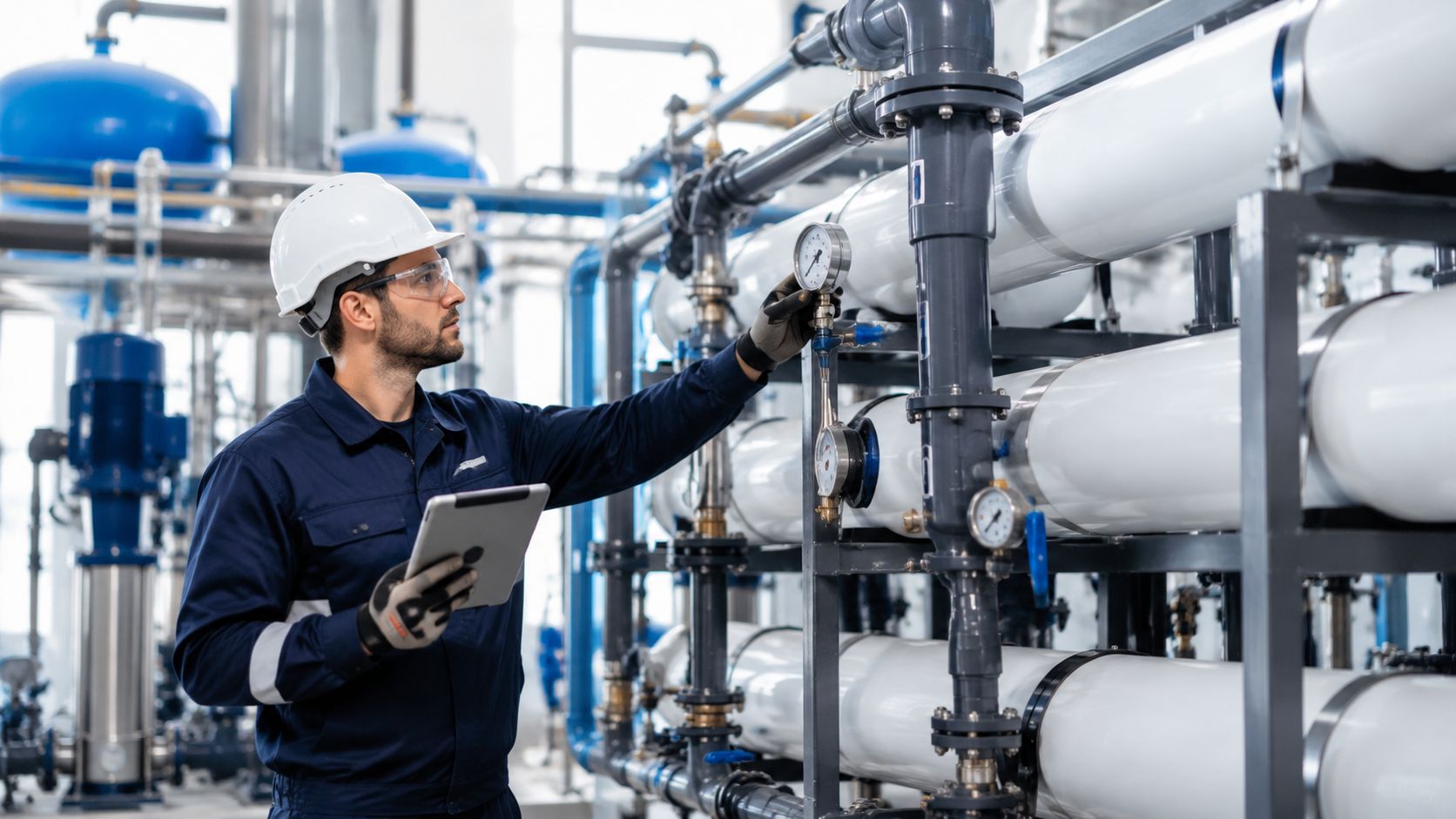
Membrane fouling and scaling
Problem: RO performance drifts, differential pressure rises, and cleaning frequency increases.
Typical cause: Suspended solids breakthrough, hardness carryover, biological loading, or poor chemical control upstream. Plants often blame the membrane first, but the membrane is commonly the component showing the evidence, not creating the problem.
Practical mitigation: Treat membrane trends as process data, not as maintenance surprises. Review feed consistency, cartridge loading rate, softener performance, dosing control, and cleaning triggers together. If pretreatment barriers aren't stable, a new membrane set won't stay clean for long.
Pressure drop and mechanical reliability
Filter trains also fail mechanically, even when the chemistry is acceptable. High differential pressure across media beds or cartridge stages can come from loading, poor backwash performance, bad vessel sizing, or a filtration layout that asks one stage to do too much.
Depth cartridges have their own selection criteria. For industrial depth filter cartridges, the key performance parameters are initial pressure drop, dust loading attributes, and particle capture efficiency, with multi-layer configurations using an upstream bulk-loading layer and a fine final layer, according to research on industrial depth filter cartridge performance parameters. In practice, that means buyers shouldn't choose cartridges by micron rating alone.
A short problem-solution view helps maintenance teams act faster:
| Failure mode | What usually causes it | What works |
|---|---|---|
| Rapid cartridge loading | Poor bulk solids removal upstream | Add or improve media filtration, review solids profile |
| Rising filter differential pressure | Media saturation, poor backwash, undersized vessel | Recheck bed design, backwash adequacy, vessel rating |
| Unstable RO output | Variable feed quality, scaling, fouling | Stabilize pretreatment and review operating setpoints |
| Repeated pump or seal issues | Solids carryover, cavitation risk, off-design operation | Correct hydraulics and protect rotating equipment from solids exposure |
Maintenance teams get better results when they trend pressure, flow, and cleaning intervals together. One data point rarely tells the full story.
Plants that run reliably usually do one thing differently. They define normal operating signatures early, then investigate drift before production quality drops.
Calculating ROI and Total Cost of Ownership
The purchase price on the quote is the easiest number to compare and often the least useful one. Industrial water filtration systems should be evaluated on what they cost to own over time, not just what they cost to install.
What belongs in a real TCO model
A realistic total cost of ownership model includes more than capital equipment. Buyers should account for:
- Consumables: Cartridge elements, membranes, media replacement, chemicals, and cleaning supplies.
- Energy demand: Pumping pressure, recovery target, and pressure drop all change operating cost.
- Water and discharge cost: Every unit of reject water affects utility economics and sustainability targets.
- Maintenance labor: Cleaning frequency, changeout complexity, and service intervals matter.
- Downtime exposure: Unplanned shutdowns are often more expensive than the consumables themselves.
Low-price systems often sacrifice their primary advantage. If a cheaper design needs more cleaning, shorter change intervals, and more operator attention, the savings disappear quickly.
Where buyers misread membrane economics
One of the clearest examples is the comparison between ceramic membranes and polymeric membranes in high-solids applications. Ceramic options usually come with a higher upfront cost, which can stop a project at the procurement stage. That's understandable, but it's incomplete analysis.
A key TCO consideration is the trade-off between higher-cost, durable components like ceramic membranes and standard polymeric ones, because the initial investment can be offset by savings in energy and chemical cleaning costs in high-solids applications, according to guidance on industrial membrane trade-offs and TCO.
That doesn't mean ceramic is always the right answer. It means buyers should evaluate where the solids load, fouling pattern, and cleaning regime make durability economically relevant.
Cheap equipment is only cheap if the plant can run it without paying for the difference somewhere else.
A sound ROI discussion asks practical questions. Will the chosen design reduce cleaning events? Will it lower chemical exposure? Will it hold performance longer under the site's actual solids profile? If the answer is yes, higher CapEx may still be the lower-cost decision over the operating life of the system.
Partnering for Optimal Filtration Performance
A plant can buy good individual components and still end up with a poor water treatment system.
That usually happens when procurement is split across multiple vendors. One supplier sizes cartridge housings, another recommends membranes, and a third provides chemical dosing equipment. Each piece may be acceptable on its own, but gaps show up at the interfaces: incompatible cleaning chemistry, mismatched flow assumptions, control conflicts, or consumables with uneven lead times. Those issues do not stay on paper. They show up as startup delays, unstable performance, and higher operating cost than the original budget suggested.
What good technical support looks like
A capable partner starts with the process requirement and works backward through the treatment train. That means checking feedwater variability, solids loading, membrane protection, operating pressure, cleaning method, operator workload, and the plant's tolerance for downtime. The goal is not to sell a single skid or cartridge line. The goal is to specify a system the site can keep running without constant correction.
For engineering firms and integrators, that support matters during sourcing as much as during design. Industrial projects often require depth media, cartridge filtration, RO packages, EDI components, housings, and replacement consumables from different manufacturers. Purecowater serves in that role as an industrial water treatment distributor and OEM for filtration, reverse osmosis, and electrodeionization equipment across process and utility water applications.
The difference shows up over time. A well-matched supplier helps prevent the kind of design compromises that lower membrane life, increase cleaning frequency, or create dependence on hard-to-source replacement parts.
How to buy with less risk
A reliable supplier relationship is usually methodical. Buyers should expect detailed questions before they get a final recommendation, because those questions are what protect long-term performance and total cost of ownership.
A practical shortlist includes:
- Application fit: Can the vendor match media, cartridges, RO membranes, and polishing stages to the actual feedwater condition and required product-water quality?
- Integration support: Will the proposed equipment fit the site's hydraulics, controls, cleaning practices, and maintenance staffing?
- Supply continuity: Can the plant get replacement membranes, housings, cartridges, and treatment chemicals on a predictable schedule?
- Operational honesty: Does the vendor explain where the design is sensitive, what operating limits matter, and what will happen if feed conditions drift?
The strongest projects start with a plain discussion about failure risk, maintenance burden, and ownership cost over the life of the system. That is where reliable performance begins: in equipment selection, vendor coordination, and clear operating assumptions.
If you're comparing industrial water filtration systems for process water, utility water, RO pre-treatment, or high-purity applications, talk to Purecowater about the feedwater, recovery target, and maintenance constraints before finalizing equipment. A clear application review often prevents expensive changes after commissioning.